HokieMark has a great article that makes you wonder about if FSU forgot if it's a football school or not. Certainly helps explain how FSU lost it's way in SOO many areas the last 5 years.
BOTTOM LINE: The ACC is investing in the wrong sport.
I can halfway understand Louisville, who has to compete with Kentucky and whose donor base leans heavily towards hoops. Plus, it's not like the Cardinals don't spend a lot on football, too.
Duke just doesn't seem to care about football - they are determined to funnel their money into basketball. In my opinion, that can work - but only if Duke agrees to be a non-football member of the ACC, like Notre Dame (see Rx: At Least $3.8M more per team).
I'm not sure how FSU got roped into this, but until the revenue flow increases, the Noles may need to back off the MBB spending just a bit. Florida State is just ahead of Alabama in hoops-related expenses, but the difference is the Tide can afford it, the Seminoles not so much.
Syracuse needs to decide: are you another Duke, or another Louisville?
Virginia and North Carolina are focused on the wrong sport, but at least they get a good return on their investment; I give them a pass - do what you want.
Pitt is simply wasting money on basketball. The Panthers should cut costs and plow that money into hiring and retaining great football assistant coaches.
Florida State University is ranked among the top 50 universities worldwide for producing patented technologies, according to a new report from the National Academy of Inventors and the Intellectual Property Owners Association. ⚡️💡#FSUDaypic.twitter.com/syXqxVk4IL
— Florida State University (@floridastate) March 31, 2021
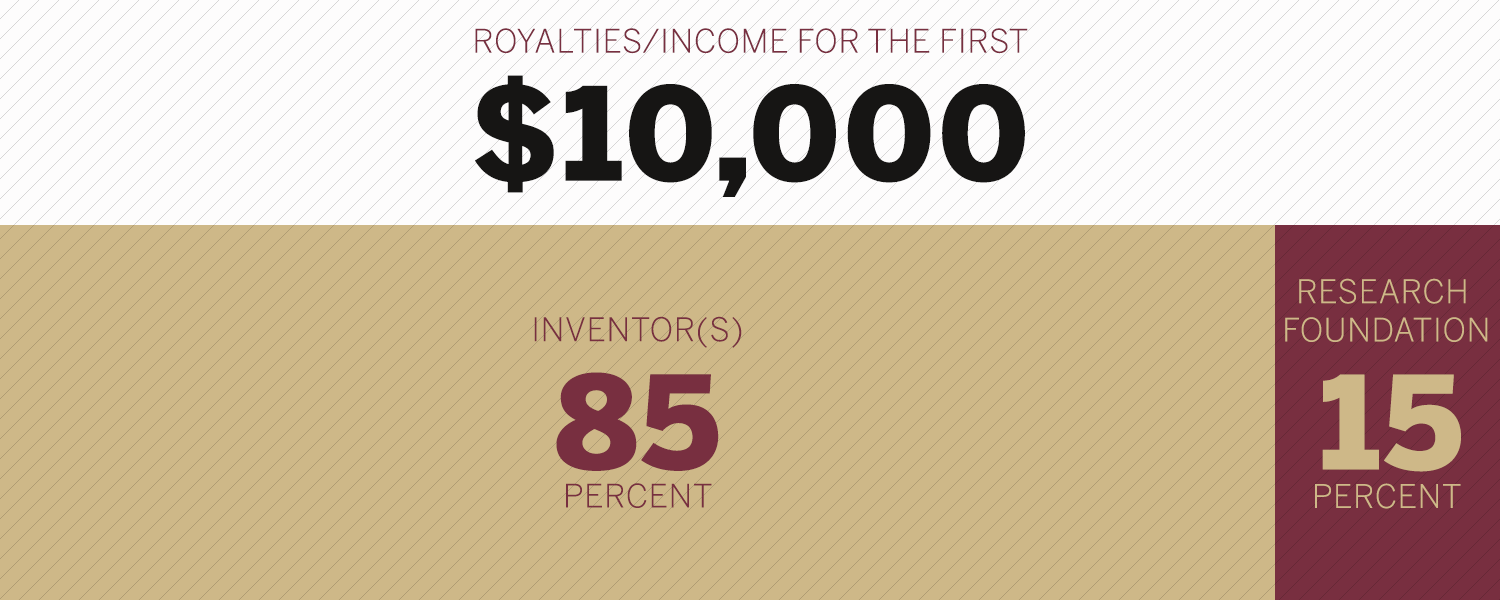
When a U.S. patent is issued on an invention assigned to the University, the inventor(s) will receive a $500 payment. Royalties or other income resulting from inventions in which the University takes title will be distributed as follows: 85 percent to inventor(s) for the first $10,000; 15 percent to University.
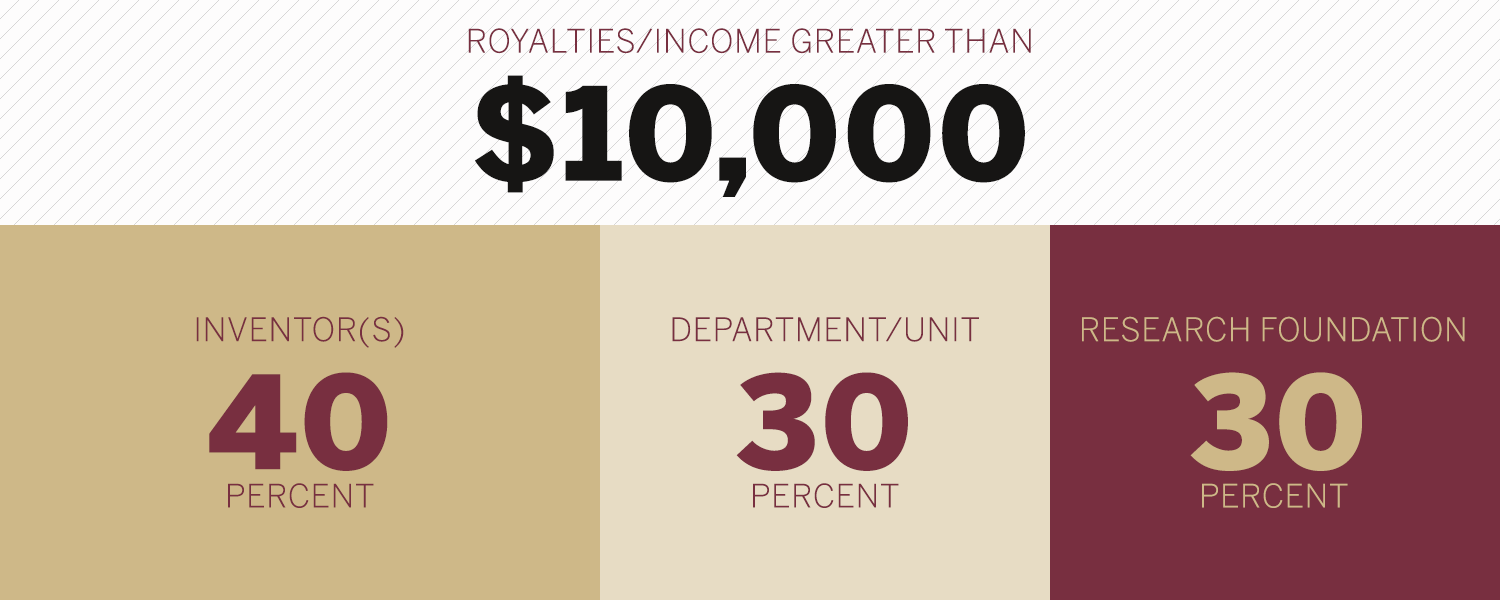
Once the $10,000 plateau has been reached, net income (gross royalties minus direct costs of patenting, licensing, legal, and other related expenses) will be divided as follows: For net income in excess of $10,000: 40 percent to inventor(s), 30 percent to dept. or unit or both, which inventor is member; 30 percent to University.
Copyrights
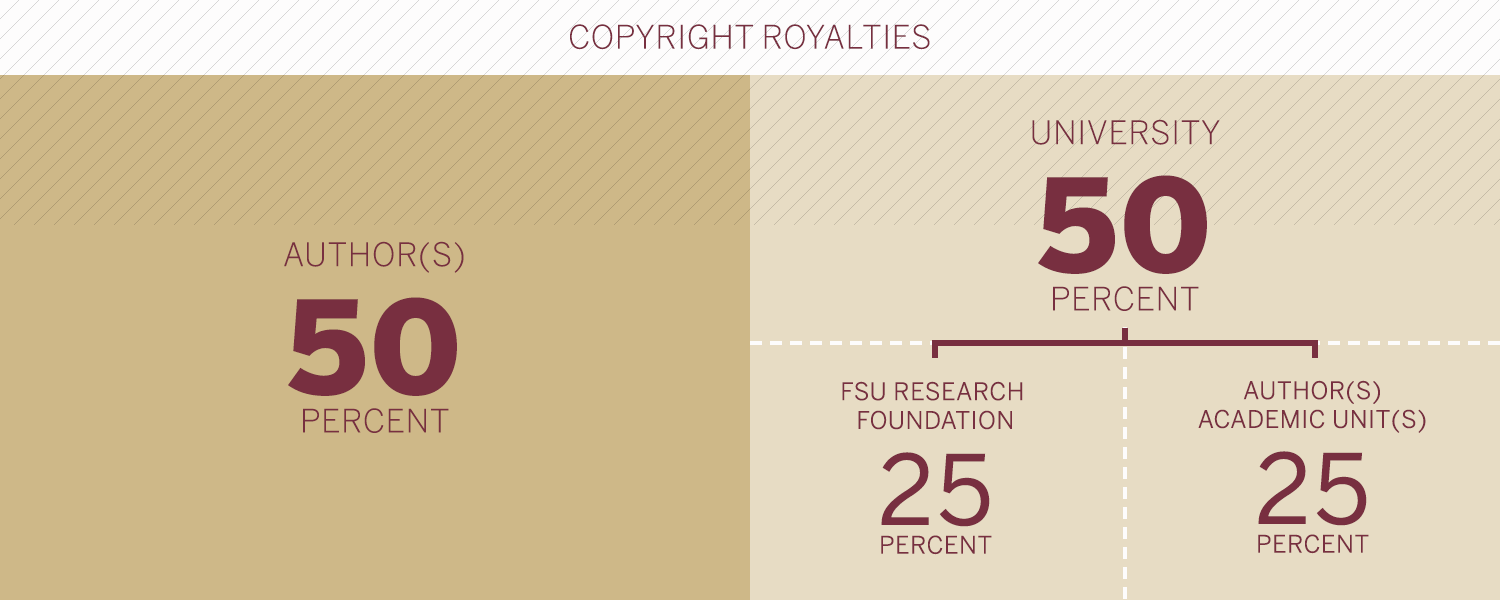
Royalties or other income resulting from copyrighted work in which the University takes title will be distributed as follows:
Will lease it back to organization for $700K annually
For the second time in little over a year, Florida State University’s Real Estate Foundation is stepping in to purchase valuable property from the Seminole Boosters, Inc.
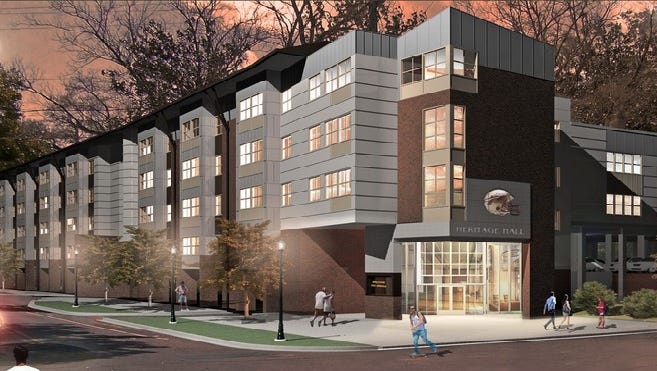
During its meeting Thursday, FSU’s Board of Trustees approved the purchase of Champions Hall by FSU’s Real Estate Foundations from the Seminole Boosters, Inc. for up to $12 million. The purchase includes the 60-unit complex and a 1-acre lot nearby used primarily for parking.
The $12 million is being provided to the foundation by the FSU Research Foundation, said Kyle Clark, FSU’s vice president for finance and administration.
Clark described the property as “strategically important property for the university.”
Champions Hall was built in 2014. It sits on 1.2 acres at 232 Hayden Road and consists of 60 units or about 145 beds. It was constructed for the Boosters to house members of the Seminoles football team.
Seminole Boosters President and CEO Michael Alford shared the presentation during this month's FSU Board of Trustees meeting, calling it, "The preliminary phase one of a long process."
Alford's request wasn't for the board to officially approve the renovation, but simply for him to allow sharing the vision with boosters in an effort to begin selling the vision to them and helping them discover where they would want to sit in this redesigned stadium setup.
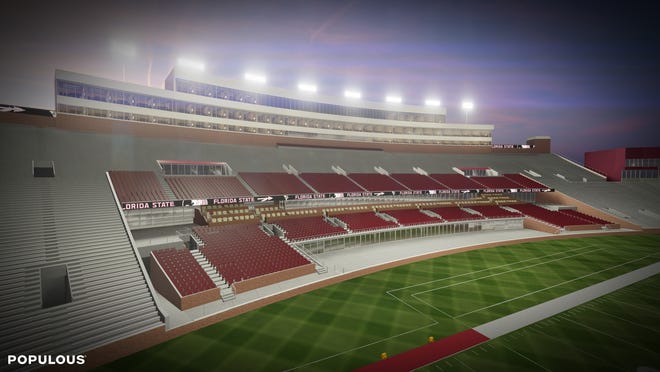
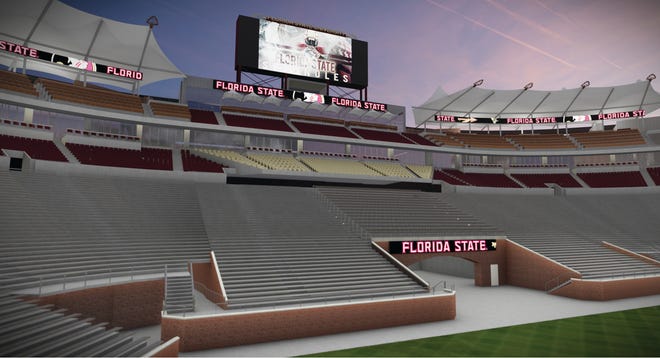
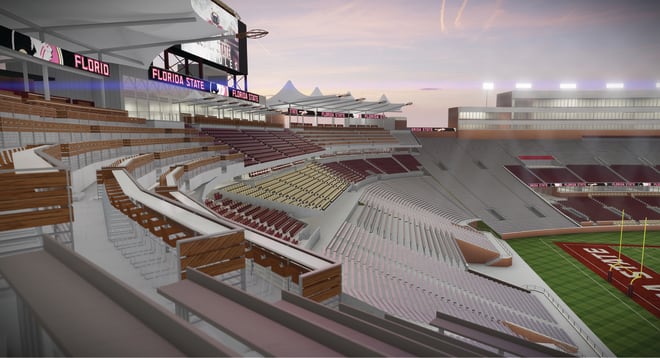
The main areas that will have seating options affected by this renovation would be the south end zone and the west (home) sideline.
The west sideline would see some seats close to the field on the 50-yard line taken out and replaced with a field-level club. The seats in this area, which are currently all bleachers, will be replaced by chair-back seats in a club area, premium loge boxes (private four to six-seat open-air boxes) and premium sideline suites.
Fans in the premium club area will be able to come down to the field-level club and stand on a railing right behind the FSU bench area during games, providing a different in-game experience.
"A different vantage point. You're standing behind the sidelines, you're part of it, you're hearing things go on..." Alford said.
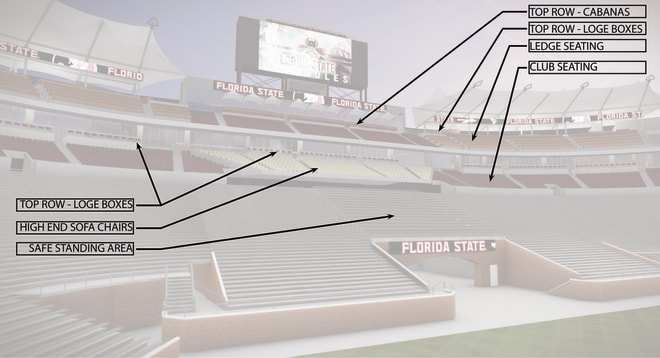
As for the south end zone, FSU would be creating seven different seating options. These would include cabanas, ledge seating, standing free porch seating (fans would have a place to stand and a table to lean on and put things on but no seat), both premium and regular loge boxes and club seating with sofa-like cushions and phone chargers in each seat.
Based on the survey data, CSL recommended a certain number of each type of seat for both the west sideline and the south end zone.
This renovation would also allow FSU to improve much of the gradual infrastructure of the stadium. Some of the many issues with the current infrastructure brought up by the survey results included restroom conditions, lack of handrails and concessions, WiFi and seat comfort.
The expectation is that these renovations would reduce the capacity of Doak Campbell Stadium from nearly 80,000 to around 70,000. But Alford sees it as a net positive as it creates a more premium experience for a number of fans.
It's not something that is locked in yet, but Alford says the estimated timeline would be that these renovations would be done just in time for the 2024 football season. The state of the stadium means it could be finished entirely between November of 2023 and August of 2024.
Along with the usual address from FSU Director of Athletics David Coburn - and a special information item from FSU women’s golf coach Amy Bond - Seminole Boosters, Inc., CEO Michael Alford is expected to request approval to begin raising money for upcoming renovations to athletic facilities, according to the meeting agenda posted online.
Chief among those facility upgrades is expected to be a renovation to Doak Campbell Stadium.
Seminole Boosters - the fundraising arm for FSU athletics - ran a survey last year before Alford was hired to replace Andy Miller that asked members about potential renovations and changes they would like to see come to Doak Campbell Stadium.
he ACC also distributed a little more than half the revenue of what the SEC sent its member schools for the 2018-19 season, and that gap figures to grow unless the ACC can somehow convince Notre Dame to join as a full-time member.
The SEC and Big Ten remain the dominant financial forces in college football. From TV deals, merchandising, league championship games and bowl revenue, the two conferences sent member schools about $45 million and $54 million, respectively, in 2018-19 (the last year for which data is publicly available). The ACC, meanwhile, distributed at least $27 million to each school that year.
The Big 12 distributed an average of $37 million to its 10 schools, which represented a small decrease from the previous year. The futures of its TV deals, including the Longhorn Network, represent a clear inflection point on the horizon that has led some athletic directors to again ponder the possibility of another round of conference realignment, which nearly toppled the Big 12 a decade ago.
The Pac-12 saw a small increase in total revenue for 2018-19 and distributed about $3 million more per team than the ACC, despite failing to place a team in the College Football Playoff for four straight seasons and commissioner Larry Scott stepping down in June. While the league has had its own concerns over revenue and its struggling TV network, one Pac-12 administrator suggested there was obvious room for growth, while the ACC had flatlined. A number of ACC coaches and athletic directors who spoke to ESPN for this story agreed with that assessment.
"If we don't get our TV contract in the ballpark of [the SEC and Big Ten], there will be no level playing field in the Power 5," said one ACC coach, who spoke on condition of anonymity. "There will not be a Power 5 anymore, in my opinion."
The SEC just negotiated a new 10-year deal with ESPN that will further increase its revenue starting in 2024. Although terms were not disclosed, multiple outlets reported the deal is worth about $3 billion. The Big Ten's current deal, meanwhile, goes through the 2022-23 season, and it will likely get a new, more lucrative television contract long before the ACC's current contract is up (2036).