Showing posts with label President. Show all posts

Wednesday, April 9, 2025

FSU president makes case for TMH as an academic medical center


'Top tier' health care: FSU president makes case for TMH as an academic medical center

As discussions continue about the future of health care in Tallahassee, it’s important to understand what an academic medical center (AMC) is and what it would mean for patients, physicians, and the broader medical field.

An academic medical center is a hospital that is closely partnered with a medical school at a major research university. It combines patient care, medical education, and groundbreaking research. It is a place where physicians, scientists, and educators work together to heal patients, discover new treatments, and train the next generation of health care professionals. Academic medical centers have driven some of the greatest advancements in modern medicine.

Here’s what an academic medical center would mean for Tallahassee.

Your existing health care:  Doctors who want to continue to focus 100% on direct patient care would do so, with no changes. There would not be any expectation for doctors currently here to do research. The hospital would remain committed to serving the local community and provide care to individuals who are uninsured.

Outlook for health care in Tallahassee with an AMC:  Patients would have access to expanded top-tier medical care without having to leave Tallahassee. Tallahassee would have more doctors and health care professionals who perform specialized care and more doctors and health care professionals who provide excellent generalized care.

In addition, an academic medical center would have doctors who conduct research to bring new, cutting-edge treatments to Tallahassee. The goal is to hire additional doctors who see patients and do research. This combined approach helps save patients’ lives. A study published in the Journal of the American Medical Association found that patients treated at hospitals with AMCs have up to 20% higher odds of survival compared to those treated at non-AMC hospitals.

Cutting-edge treatments: Academic medical centers are known for developing new treatments and conducting clinical trials that give patients access to the latest innovations in medicine. I have personally witnessed how medical discoveries at academic medical centers have cured some cancers, transformed lives of those with genetic diseases, and greatly improved patient outcomes. Innovations in health care includes technologies such as advanced imaging, genetic therapies, artificial intelligence, and advanced diagnostics. 

Economic growth: Investment in health care, medical education, and research will attract top talent, create new jobs in Tallahassee, and strengthen our local economy. AMCs provide more than 6 million jobs nationwide and contribute hundreds of billions of dollars to the U.S. economy each year.

A community partnership:  TMH and FSU are both committed to having the hospital remain a community asset. While FSU is a state university, we are in Tallahassee and have always been firmly committed to the well-being of Tallahassee. To be clear, FSU is interested in creating an academic medical center with TMH to improve and advance health care in our community. There’s no state takeover and employees would not become state workers.

Florida State University is already deeply committed to advancing health care in our community. We are very proud that our faculty in the College of Medicine are doing leading research and our students have been receiving clinical education from health care professionals in this community for decades. We have residents and fellowship students in the community and many of our graduates are practicing here in Tallahassee.

Our goal is to expand these commitments and make them even better. With a $134 million investment appropriated to FSU from the State of Florida, we are constructing a health research building in Tallahassee on TMH’s campus. We are also borrowing $419 million to build a 180-bed hospital in Panama City Beach called FSU Health.

Academic medical centers save and improve lives, train future medical professionals, ensure that communities benefit from the highest standard of care, and expand resources and expertise for our community.

As this conversation moves forward, we welcome an open dialogue with local officials, health care leaders, hospital staff, and members of the community.

The opportunity is here. Together, we can make it happen.

Richard McCullough is president of Florida State University, one of the top public universities in the nation.


City pushes pause on TMH bylaws request as it seeks asset audit, answers to 58 questions


Tuesday, October 17, 2023

FSU slips to no. 23 in U.S. News rankings

 FSU slips to no. 23 in U.S. News rankings

Florida State University’s march to the nation’s Top 15 public universities took a few steps back in the latest U.S. News & World Report’s “2023-2024 Best Colleges" rankings. 

After changes to the media company's methodology, FSU fell four spots to No. 23, tied with the University of Minnesota Twin Cities and the College of William & Mary. 

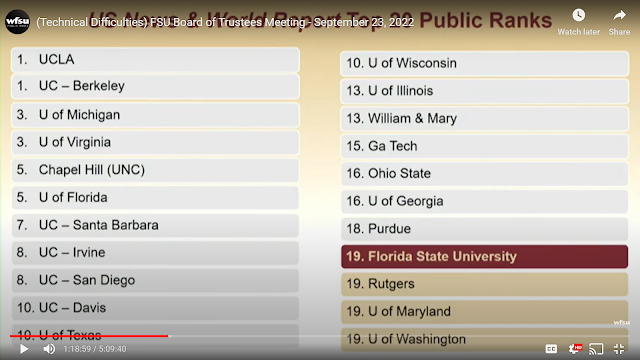
FSU had been ranked in the Top 20 for four consecutive years — where it was No. 19 last year, tied with the University of Maryland, the University of Washington and Rutgers.

The slip comes despite FSU improving in each of the categories measured in the 2022 rankings. In addition, FSU had its highest-ever ranking in the overall list of public and private national universities at No. 53 — tied with Case Western Reserve University, Northeastern University, University of Minnesota Twin Cities and William & Mary — which is up two spots from last year. 


The Wall Street Journal and Niche also have their own rankings with vastly different results. Niche, which was founded in 2002, ranked Florida State No. 11 on its list of top national public universities, up two places from No. 13 last year. The rankings site also declared that the university is the No. 1 school for the Best Greek Life and No. 2 on the national list of Top Party Schools among 1,512 other schools.


Rankings reshuffled amid new methodology

The U.S. News & World Report's decision to retool its methodology by changing 22 metrics plays into FSU's lower ranking this year, removing the factors of class size, alumni giving rates, the percentage of faculty with a terminal degree and students’ high school standing — all components that FSU scored well in when they were a part of the metrics, according to a university news release. 

Based on the university's own calculations, FSU would be No. 16 in this year’s U.S. News rankings among national public universities if the metrics did not change, according to McCullough. 

“We’re just trying to be better at everything, and hopefully the rankings will take care of themselves,” McCullough said.

With inclusion in the prestigious Association of American Universities still being a goal of the university, McCullough does not see FSU's placement in this year’s rankings affecting their efforts toward a possible membership in the future since AAU’s metrics are research focused. 

“We’re not going to be driven by the rankings,” McCullough said. “We’re going to be driven by what we think makes a great university.” 


  • 6. University of Florida  
  • 23. Florida State University  
  • 45. University of South Florida  
  • 64. Florida International University  
  • 64. University of Central Florida  
  • 91. Florida A&M University  
  • 112. Florida Atlantic University  
  • 129. University of North Florida  
  • 162. Florida Gulf Coast University  
  • (Not ranked) Florida Polytechnic University 


Thursday, September 14, 2023

FSU trustees give President McCullough a salary increase to $1M and a strong evaluation


FSU trustees give President McCullough a salary increase to $1M and a strong evaluation

FSU received about $109 million in new recurring funds along with new funding for capital projects for the 2023-2024 fiscal year, which ties into McCullough receiving the highest score for his goal of establishing relationships with elected and appointed governmental officials on all levels, such as the Florida Legislature.

McCullough's goals include efforts to make it into the nation’s top 15 public universities and making progress to become an Association of American Universities (AAU) member, both of which are listed as his first goal, as well as strengthening FSU’s research profile, increasing funding and improving fundraising initiatives.

FSU is currently ranked as no. 19 among the best public colleges and universities across the country — tied with the University of Maryland, the University of Washington and Rutgers — according to U.S. News & World Report, which will be announcing its latest rankings for 2023-2024 on Monday, Sept. 18.

When it comes to AAU membership, FSU was passed over by the association earlier this year, which came as a shocker to some of FSU's faculty as the University of South Florida and the University of Miami received invites instead.

Despite having a strong evaluation, comments under the goal of improving fundraising efforts — where nine out of 13 trustees said McCullough meets expectations — show what some of the members want to see that emphasized.

A trustee wrote, “Much work yet to do here. Parts of the needs have been addressed, but critical infrastructure is still lacking.”

The board members also discussed Trustee John Thiel’s suggestion for McCullough to make certain priorities — such as FSU Health — more prominent throughout his 2023-2024 goals.

The FSU Health initiative consists of a new FSU Health-Academic Health Center through a partnership between the university and Tallahassee Memorial HealthCare that is slated to be constructed in a couple of years.

“I don’t think that it’s prominent enough in his goals, whatsoever,” Thiel said during a Governance Committee meeting Thursday. “It shows up in one place by definition in goal three (investing in academic excellence), but not in goal one, and we’re not getting into the AAU without FSU Health.”

Saturday, August 12, 2023

How decades of mismanagement has Florida State on the outside looking in of conference realignment

 Interesting history of FSU's mismanagement.  It is a ridiculous excuse making attempt of Thrasher's signing of the GOR and basically failure in athletics, but beyond that, close to accurate.

How decades of mismanagement has Florida State on the outside looking in of conference realignment

What about the ACC? The league signed a horrendously backwards looking deal in 2011 with ESPN that has been the source of the conference’s woes to this day. While the ACC managed to get comparable money to the SEC & Big Ten for its main TV rights, the league signed away all of its third tier rights to ESPN as part of the deal for essentially nothing. ESPN then sub-licensed those to Raycom Sports for $50 million a year that it did not have to share with the conference. This was done at the behest of then-ACC Commissioner John Swofford, who wanted to keep Raycom as an ACC TV partner above all else in TV negotiations. Swofford maintained it was due to Raycom’s long standing relationship as a media partner with the ACC. However, Swofford’s son was a Raycom executive and maintaining the rights to the ACC was a necessary lifeline after Raycom had lost the rights to the SEC the year prior. Whether it was an egregious example of nepotism or terrible lack of foresight to see where college media rights were going the deal has been an albatross around the neck of the league ever since.

In 2007, Dave Hart’s contract as FSU athletic director wasn’t renewed in the wake of the online music class scandal. Tensions had been mounting between Hart, Bowden, and then-FSU President T.K. Wetherell over Hart unilaterally getting the boosters on board with removing Jeff Bowden from FSU’s coaching staff, along with bringing in Jimbo Fisher to eventually replace Bowden. A message board rumor at the time was that school higher ups had been well aware of the issues with the class but looked away until it could be used as an excuse to not renew Hart’s contract and thought the NCAA would just issue a slap on the wrist penalty. Instead, the NCAA handed down a multi-year sanction along with vacating numerous wins by the football and basketball teams. It is the reason FSU’s bowl streak & Bobby Bowden’s career win totals are not recognized as the NCAA records they are to this day.

Any school looking to replace a longtime successful athletic director is in for a challenge. FSU had a further complication, Andy Miller.

Andy Miller was the longtime president of the Seminole Boosters. With the boosters being a separate entity for the athletics department and Miller’s personal fiefdom, Miller was the real power behind the throne of FSU athletics. Miller ran Seminole Boosters like an organization stuck in the 1970s. Perhaps the most public example of that were his derided comments about going on an “old fashioned door knocking campaign” in regards to how to raise funds to deal with FSU’s increasing budget shortfalls in 2019. The austerity with which he could run the booster organization under Bowden carried over despite the growing need for the latest and greatest facilities, as was highlighted in an ESPN piece about Jimbo Fisher’s exit from Tallahassee. This was a structure unlike any other in college athletics and was seen as an impediment to attracting more qualified candidates for FSU’s athletic director following the departure of Dave Hart.

In the wake of Dave Hart’s departure, FSU’s top athletics role would be filled by Randy Spetman from 2008 through 2013. Though Spetman had previous stints as athletics director at Air Force & Utah State, it became apparent to program insiders he was not cut out to run a major athletics program. He scheduled series with USF and Boise State that were largely lambasted. It was during his tenure that FSU athletics began running into a financial hole. In 2011, Spetman publicly commented that FSU was “comfortable” in the ACC before then saying it would be up to newly appointed university president Eric Barron whether FSU would actively pursue any changes to conference membership. Spetman was relieved from being Florida State’s athletic director within days of laying out a 5 year vision for athletics in 2013.

The decision to put pen to paper to sign the ACC Grant of Rights came down to then-president Eric Barron. Barron was an academic at heart that wasn’t personally invested in Seminole athletics. With more forward thinking athletic leadership in place around the time, perhaps Barron would’ve been convinced leaving the ACC would be in FSU’s long term interests. Instead, Barron publicly shot down any rumors that the Seminoles were seeking to join the SEC or the Big 12. Barron even publicly defended FSU’s membership in the ACC in 2012 when rumors of the Seminoles looking to join the Big 12 were at their loudest. Barron would eventually sign the newly drafted ACC Grant of Rights in 2013 before leaving to become President of Penn State University less than a year later.

Barron would be succeeded by former state legislator and FSU alumni John Thrasher. While Thrasher was personally invested in the success of both the university and athletics department, he would need better guidance from FSU’s top athletics officials than what had been offered previously. Randy Spetman’s replacement was former Duke Deputy Athletic Director Stan Wilcox . In Tomahawk Nation’s article about Wilcox’s hire, it was asked

“How much does he know about multi-media rights, digital rights, third-tier rights, and the economics thereof. The question was asked because one source doesn’t believe people born before 1970 have a great grasp of those things. He wants to know how much Wilcox knows about those issues, and if he has someone helping him with that aspect of the job.”

The answer to those questions still have consequences for FSU to this day. Wilcox was a staunch supporter of FSU’s membership in the ACC and later the ACC Network. Wilcox projected the ACC Network could bring in $15 million a year for Florida State athletics. Thanks to those projections, Thrasher didn’t object to extending the ACC Grant of Rights through 2036 as a prerequisite for ESPN launching the ACC Network. Unfortunately the investments mandated by ESPN would propel Florida State athletics into yearly deficits of almost $4 million before Wilcox resigned to take a position with the NCAA in 2018. While the ACC Network has brought in new revenue, the upfront costs and the length of the contract have made the gains ultimately not worthwhile. In addition, as cord cutting continues the subscriber fees from the conference networks will largely dry up by 2036.


Friday, June 23, 2023

FSU pushes forward on a bold agenda | President Richard McCullough


FSU pushes forward on a bold agenda | President Richard McCullough

It’s a new era at Florida State University, and I’m excited for what the future holds.

Since I began my tenure as president not quite two years ago, I have been laser-focused on investing in our strategic goals and ensuring FSU builds upon our strong foundation as one of the best public universities in the nation.

We’re making distinct progress in continuing the university’s upward trajectory, and I’d like to update the Tallahassee community on some of our recent work and accomplishments. 

  • While we are a major public research university, FSU has long prioritized student success, and our 94% student retention rate and our 74% four-year graduation rate are among the highest in the nation. Our student-focused approach fueled our meteoric rise in the national rankings, and we remain steadfast in our efforts so that every FSU student, regardless of background, graduates with their degree, even as we enhance our focus in other areas of importance.  
  • FSU is expanding its research portfolioby increasing our research expenditures, producing groundbreaking studies and creative works, and launching bold new initiatives. Last year, FSU had a record total of research expenditures of about $355 million, but we’re not stopping there. We aim to grow our research enterprise to exceed $500 million annually. The more money we spend on research not only leads to discoveries that change the world — it also flows into the Florida and Tallahassee economies.  
  • FSU launched the FSU Health initiativelast year with aspirations of transforming health care in North Florida and beyond. As a part of FSU Health, the university is building a deeper partnership with Tallahassee Memorial HealthCare and a major innovation partnership with Mayo Clinic.  
  • FSU’s plans are underway to build a much-needed academic health centerin partnership with Tallahassee Memorial HealthCare on TMH’s campus. We’re also collaborating with TMH and the St. Joe Company to build a new medical campus in Panama City Beach, which will include an urgent care center and a 100-bed hospital. These projects are gamechangers for FSU as they are attracting top-notch faculty in the health care fields and physician-scientists as well as bolstering the university’s growing health research portfolio and upward trend in federal research funding. 
  • FSU is investing over $20 million in quantum science and engineeringover the next three years and will recruit world-class talent to complement our expertise in this area. FSU is already a leader in magnetism thanks to the National MagLab and has excellent programs in materials research. These investments will uniquely position FSU at the forefront of this emerging field of critical national and global importance. 
  • FSU recently announced Fast Start, a new streamlined process designed to help increase the number of faculty start-ups. Fast Start will allow FSU faculty and researchers to execute license agreements more quickly, with fewer roadblocks and delays. This is an important step in accelerating university innovation, which will lead to increased job creation and economic development in the region. 
  • The Florida Legislature allocated unprecedented funding for FSU during this year’s legislative session, including $109 million in new recurring funds and $108 million for capital projects, which will be critical as we continue to advance our top priorities. We are grateful that our legislators and Gov. DeSantis recognize that FSU provides an excellent return on investment for our students and Florida taxpayers. 
  • Every day, we are ambitious and bold, and we push forward on a very big agenda — and every day, I see our progress as we strive for greater excellence. This is an exciting time for FSU with lots of opportunities within our reach and on the horizon, and I assure you, we are just getting started. 

    Richard McCullough

    Richard McCullough is president of Florida State University, one of the top public universities in the nation.

Sunday, February 19, 2023

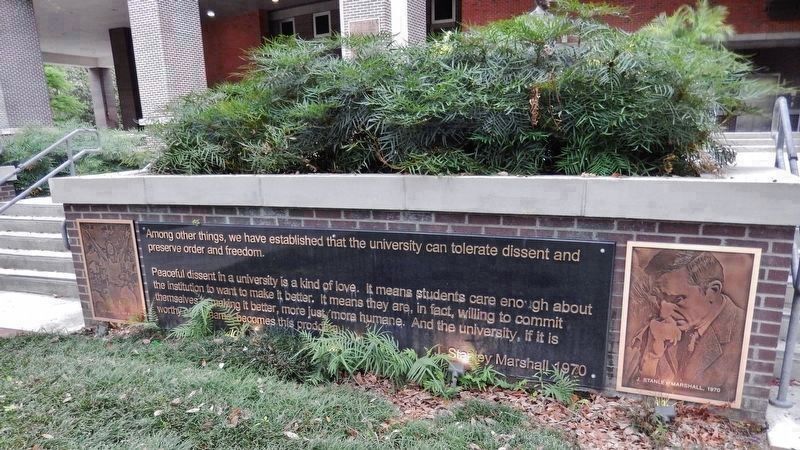
Dr. J. Stanley Marshall-History and Quote


Dr. J. Stanley Marshall


J. Stanley Marshall quote, 1970 image. Click for full size.

Photographed By Cosmos Mariner, May 2, 2021
8. J. Stanley Marshall quote, 1970
Among other things, we have established that the university can tolerate dissent and preserve order and freedom.

Peaceful dissent in a university is a kind of love. It means students care enough about the institution to want to make it better. It means they are, in fact, willing to commit themselves to making it better, more just, more humane. And the university, if it is worthy of its name, becomes this prodding.
— J. Stanley Marshall 1970


Marshall was president of FSU from 1969 to 1976. After his presidency, he founded and operated an electronic security company; ran unsuccessfully for state education commissioner (1986); and founded the James Madison Institute (1987), a conservative think tank. Marshall served on the Florida Constitutional Revision Commission, the first Board of Trustees for FSU, the Bethune-Cookman University Board of Trustees and the state Board of Governors, which oversees Florida's 11 state universities

"His legacy is that he was a Renaissance Man," said Robert McClure, president and CEO of the James Madison Institute. "He was a tremendous influence and mentor. And always a gentleman regardless of the political stripe of people he was dealing with. He cast a large, broad shadow."

James Stanley Marshall's tenure as FSU president coincided with the rise of student activism at FSU — which earned FSU the title "Berkeley of the South" because of the proliferation of student demonstrations and protests.


Marshall, a political conservative, disagreed with student demonstrators on almost all issues, but prided himself on respecting students' First Amendment rights. He listened calmly to their protests, whether they were marching on his president's house or trying to take over his administrative offices in Westcott Hall — while often infuriating them with his refusal to accede to their demands.

As he wrote in his 2006 memoir, "The Tumultuous Sixties. Campus Unrest and Student Life at a Southern University," his goal was to maintain order on campus.

"My charge seemed clear: Keep the University open and operating in a close to normal manner," Marshall wrote. "I was mindful of the disorder that had caused destruction of property, the loss of life and the breakdown of education services at other universities and I saw nothing in the picture at FSU to convince me it couldn't not happen here."

Many FSU faculty and students of the era dispute Marshall's view that FSU was close to the disorder that marred other campuses. The most famous student leader of Marshall's tenure, "Radical Jack" Lieberman said FSU was "never close to violence," and that protesters at FSU were "always a minority, unfortunately."

Marshall and Lieberman clashed often. Lieberman infamously taught a class in FSU's free Center for Participant Education, "How To Make A Revolution in the U.S.A." In fall 1970, after Lieberman led a sit-in against military recruiters on campus, Marshall over-ruled a student court and expelled Lieberman — making him what is believed to be the only student ever expelled from a Florida university for political protest.

"Though we had big disagreements and he treated me too harshly, I think he was a good person who wanted to do well," Lieberman said from Miami, where he runs a business that makes political signs and merchandise. "He did what he thought was right and I did what I thought was right. Sometimes good people have conflicts."

Marshall also had a stormy relationship with the FSU faculty, many of whom criticized his lack of communication and opposed changes he instituted. Among other things, Marshall closed the school's longtime College of Engineering; broke up the College of Arts & Sciences, the university's largest academic division, and fired its popular dean; and reorganized the administration, creating a six-provost system.

The six-provost system was later scrapped. The College of Engineering was reborn in 1982 as a joint venture with Florida A&M University. FSU continues to have a College of Social Sciences, comprised of disciplines separated from Arts & Sciences.

"The fact of the matter is he wasn't popular with the faculty; he called (meetings of) the faculty senate "the Children's Hour,' " said Leo Sandon, retired professor of religion (1969-2003) and a former president of the faculty senate. "But I suppose Stan did bring a certain amount of decency and order to campus. He was not afraid of power and its use."

Marshall's tenure covered more than student tumult and faculty dissatisfaction.

Marshall was an early supporter of computer technology and computer-based teaching. During his presidency, FSU installed a major computer system and recruited national leaders in computer-managed education.

In 1971, Marshall negotiated two of the first major financial gifts to the decade-old FSU Foundation, landing six-figure donations of property from Miami businessman Izzy Hecht and Tallahassee philanthropist Ruby Diamond. Those donations helped boost an FSU Foundation endowment that has now grown to nearly $500 million.

A one-time high school basketball and track coach, Marshall played a significant role in improving FSU athletics. In 1972, Marshall challenged community leaders to raise money to deal with FSU's $300,000 athletics deficit — a challenge that led to the creation of the wildly successful Seminole Boosters Inc. In January 1976, he made FSU's most momentous hire: FSU football coach Bobby Bowden, a former FSU assistant who Marshall had passed over as coach when he hired Larry Jones in 1970.

"I was a student at FSU in the 1970s when he was president and under his leadership, FSU flourished," said Allan Bense, chair of the FSU Trustees. "He was known by so many across the state and nation for his dedication to the people and causes he cared about. We will all miss him dearly."

Marshall joined the FSU faculty in 1958. A former high school science teacher, he had taught physics at the State University of New York-Cortland, and was hired at FSU to establish a new Department of Science Education.

Marshall quickly rose through administrative ranks to become Dean of the College of Education in 1967. On Feb. 12, 1969, he was tapped as FSU's first executive vice president by President John Champion.

A week later, Champion resigned following a tumultuous nine months in which his attempt to censor an obscenity-filled story ("Pig Knife") in the student literary magazine brought student and faculty protests. It was followed by continued clashes between Champion and the faculty as well as student demonstrations.

Under fire and fighting fire

Following Champion's resignation in February, the Board of Regents, which oversaw state universities, elevated Marshall to Acting President. In June, 1969, the BOR chose Marshall as FSU's 9th president.

Marshall's presidency met immediate challenges. On April 27, 1969, a fire of undetermined origin broke out in Westcott Hall, forcing the administration to be housed in temporary offices all over campus for four years while the structure was rebuilt. On March 4, 1969, an attempt by the SDS to defy a court injunction and use a Student Union meeting room was quelled by Leon County sheriff's deputies carrying unloaded, bayonet-tipped M-1 rifles. The incident, known as "Night of the Bayonets," produced no violence though 58 students were arrested.

In his book, Marshall claimed the potential existed that night for FSU to become "Kent State of the South." He wrote he approved the armed resistance because:

"We were determined to see that lawful order was carried out ... (and) the sincere outreach (I) had made to the SDS over the past two weeks must not be seen as reluctance to stand behind (my) decision denying them the right to use University facilities, even if doing so meant using force."

"What I considered to be one of his hallmarks was he operated during extremely difficult times," said Marie Cowart, retired Dean of the FSU College of Social Sciences. "He just seemed to keep the university together as a whole and make it work."

He served in World War II as an Army medic.

He was married to the former Shirley Slade. They have five children and 13 grandchildren. The Marshalls own a 250-acre farm in southwest Georgia, where Marshall, an avid bicyclist and fierce tennis player, retreated for rigorous outdoor work.

Over the past 20 years, Marshall was a regular attendee at FSU symposiums, celebrations and alumni events. He spoke often of his love for the university and took great pride in having served as president.

"The last thought in my mind when I came to FSU was that someday I would be president," Marshall said in a 2001 interview. "(But) there was not a day I did not respect and enjoy the opportunity to be president of FSU."

James Stanley Marshall

• Born: Jan. 27, 1923, Cheswick, Pa.

• Education: B.A., Slippery Rock State University (1947); masters (1950), Ph. D. (1956), Syracuse University.

• FSU faculty: 1958 to 1967, Department of Science Education

• Dean FSU College of Education: 1967-1969

• FSU president: 1969-1976

• Sonitrol security company (founder/president): 1978-1987

• James Madison Institute (founder): 1987-2014

• Florida Constitutional Revision Commission: 1997-1998

• FSU Board of Trustees: 2002-2005

• Florida Board of Governors: 2004-2012.

Thursday, December 1, 2022

'Supreme optimism': FSU President Richard McCullough delivers 2nd State of the University address


FSU State of the University Address - November 30, 2022

 'Supreme optimism': FSU President Richard McCullough delivers 2nd State of the University address


“I can tell you now that after being here for 15 months, I come before you with supreme optimism about the ability of Florida State to move to even greater heights,” McCullough said. “We’re already ahead of the game.”

A brief video clip steered the audience’s attention to some of FSU's highlights from the past year, which includes having the best six-year graduation rate in the university’s history, having a record-breaking number of about 80,00 applications for 6,000 slots, opening the Student Union Building as a “community-driven centerpiece,” breaking ground on the College of Business’s Legacy Hall and securing $125 million from the Florida Legislature for a new health center.


Many new hires have been made throughout the year in McCullough’s leadership team, including Provost and Executive Vice President for Academic Affairs James Clark and Vice President for Research Stacey Patterson. There are more to come within the realms of the faculty following 150 new members who joined the FSU family this fall.

The upcoming new hires include the appointment of a new dean for the College of Medicine in the coming days, McCullough said, telling the audience to stay tuned for the announcement.


The search for the College of Medicine’s next dean comes after John P. Fogarty’s retirement from the position this year, which has led to three finalists being chosen — Leon McDougle from Ohio State University, Nicholas Verne from the University of Tennessee and Terry Steyer from the University of South Carolina.

With additional faculty members joining the university, expanding FSU’s research portfolio and funding is a goal on McCullough’s checklist that he hopes will be met by doing a better job of promoting faculty to help them secure awards and grants.


“There's a new sheriff in town, and we're going to take care of you," McCullough told the faculty members. "We want to make sure that you're rewarded, and we're going to do it in ways to make sure that you don't leave this great university.”

He added that this year’s salary increase has been the most significant one for faculty and staff in FSU’s history. A new three-year contract agreement resulted in an increase of 4%, plus a .75% merit increase decided by departments and a .50% merit increase decided by deans.

Chicken said that overall, the faculty is “really happy with Dr. McCullough” and likes the direction the university is headed in.

“We’re excited about all the goals that he discussed, and we’re really eager to engage him and work with him to make sure that we can attain them,” Chicken told the Tallahassee Democrat. “I wouldn’t change anything. I think the goals are quite comprehensive.”

While addressing student success at the university, McCullough proudly stated the university’s is seeing an 84% graduation rate and 95% freshman retention rate. He also heralded athletic achievements that include FSU’s women’s soccer team advancing to the College Cup and the football team climbing in the playoff polls after winning their nail-biting game against the University of Florida.

“We are in relentless pursuit of excellence, and we continue to gain national attention by our efforts,” McCullough said.

The big achievements come along with McCullough’s fundraising goals that include redoubling the university’s efforts to get 10,000 new undergraduate alumni donors by June after losing thousands of donors last year, which he says was greatly impacted by the COVID-19 pandemic.

“I think it's very clear that our time is now,” McCullough said. “We have a lot of work to do, but I promise you, the first lady and I will work tirelessly to make sure that this great university is even better tomorrow than it is today.”


Friday, October 14, 2022

FSU Board of Trustees Meeting - September 23, 2022


FSU Board of Trustees approves $2.36 billion operating budget for 2022-2023

The Florida State University Board of Trustees on Wednesday approved the university operating budget for the 2022-2023 fiscal year. 

This year’s operating budget of $2.36 billion increased by 9% over last year. 

The budget, estimated to be larger than that of 85 countries, includes new state funding for operational enhancements including the management of the State of Florida Data Center, the FAMU-FSU College of Engineering, the Institute of Politics and the National High Magnetic Field Laboratory. 

The 2022-2023 Annual Capital Outlay Budget includes allocations for the College of Business’ Legacy Hall, which is anticipated to break ground this fall, a new Football Operations Facility, a new Interdisciplinary Research and Commercialization building, a new Student Union, and funds to begin planning a new Academic Health Center. The budget also allocates funds for work in life-safety and deferred maintenance of campus facilities.  

The university’s operating budget injects an estimated $12 billion into the local and state economies annually, according to the FSU Center for Economic Forecasting and Analysis. That estimate includes over $4 billion in direct revenue or sales and over $81 million in spending by non-resident students, as well as $8 billion in lifetime earnings by recent (FY19-20) FSU graduates, based on the latest draft of the center’s annual report. 


FSU’s graduation rates continue to soar

Florida State University’s strategic investments in student success continue to pay dividends as students are graduating with their bachelor’s degrees at the highest rate in school history.

The latest cohort of students (2016-2022) posted the best six-year graduation rate in university history at 85 percent, according to data that will be part of the State University System’s 2023 Accountability Plan.

FSU Board of Trustees Meeting - September 23, 2022

Florida State’s most recent four-year graduation rate tied its previous record of 74%.

The university’s commitment to student success also has fueled Florida State’s rapid rise in the U.S. News & World Report “Best Colleges” rankings over the past several years. On Sept. 12, U.S. News recognized FSU as the No. 19 public university in the nation —the fourth consecutive year it has placed in the Top 20.

O’Shea said FSU’s focus on continuous improvement in student success areas is not going to change.

“We want to do the best we possibly can for the students, their families, and our state and our country,” he said. “And we’re never going to stop. That’s a continuous mission for FSU, and I’m really proud to be part of a university that prioritizes students and does everything it can to help them be successful.”


Actually hit $5.2 for Champions Club


Campus Notes: Florida State, FAMU, TCC score millions in record $101.5 billion state budget


Here are other items included in the 2021-2022 state budget:

Florida State University:

  • Grants and Aids; $521,672,660
  • Lottery fund; $71,303,155
  • College of Medicine: $51,190,268
  • FSU College of Business Building (Legacy Hall): $30,500,000 (PECO funding)
  • Interdisciplinary Research Commercialization Building:  $23,492,086 (PECO funding)
  • Nationally Ranked Operational Enhancement: $15 million
  • Institute for Child Welfare: $10 million
  • FSU College of Medicine (Autism Program): $1.2 million
  • Institute of Politics: $1 million
  • College of Medicine, Lottery funds; $824,574
  • Student Veterans Center: $500,000  
  • Florida Diagnostic and Learning Resources Centers; $450,000
  • Boys and Girls State Housing: $200,000    
  • Cultural and Museum grants: $193,328