The FSU Board of Trustees met virtually Dec. 22 to approve a Les and Ruth Akers Community Hall within the College of Music as well as the Price Family Team Building, which is the new name of the soccer and softball building – a shared facility between the university’s soccer and softball complexes on campus that is made up of locker rooms and offices.
When it comes to the Les and Ruth Akers Community Hall, the name comes as the philanthropic couple have a total lifetime giving of about $10 million, according to FSU College of Music Dean Todd Queen.
FSU facility bears family name of ‘long-standing giver’
Besides the renaming of the College of Music’s community hall, the soccer and softball building’s new name is a result of the the Price family's $1 million donation to the university, where $500,000 has already been paid while the remaining committed amount will be paid at a later date.
Scott Price, a second-generation FSU College of Business alumnus and Tampa native, received both his bachelor’s and master’s degrees in accounting from the university in 1997. He is founder and CEO of Tampa-based A-LIGN, a prominent and award-winning global cybersecurity company.
The Herbert Wertheim Center for Business Excellence.
Florida State University’s College of Business will take a monumental step in advancing its reputation as one of the top public business schools in the nation thanks to a $65 million philanthropic investment from Dr. Herbert Wertheim.
Wertheim is a billionaire optometrist, inventor, businessman, philanthropist and the founder and president of Brain Power Incorporated (BPI), the world’s largest manufacturer of optical tints. He is renowned for his extensive philanthropic and leadership efforts, particularly in public education, health, and the arts, as chairman of his Family’s Foundation.
Wertheim’s commitment includes financial support to endow and name the college the Herbert Wertheim College of Business and rename Legacy Hall, the college’s world-class new building, the Herbert Wertheim Center for Business Excellence. His investment is the largest philanthropic endowment gift in FSU’s history and the second-largest philanthropic gift FSU has ever received.
“My belief in the transformative power of education and healthcare inspires me every day, and I am truly excited to partner with Florida State University to help lift the College of Business to new heights,” Wertheim said. “Together, we will empower students and future leaders to drive meaningful progress, advance innovation in healthcare and business, and create lasting opportunities that benefit our communities and the world.”
“My belief in the transformative power of education and healthcare inspires me every day, and I am truly excited to partner with Florida State University to help lift the College of Business to new heights. Together, we will empower students and future leaders to drive meaningful progress, advance innovation in healthcare and business, and create lasting opportunities that benefit our communities and the world.” — Dr. Herbert Wertheim
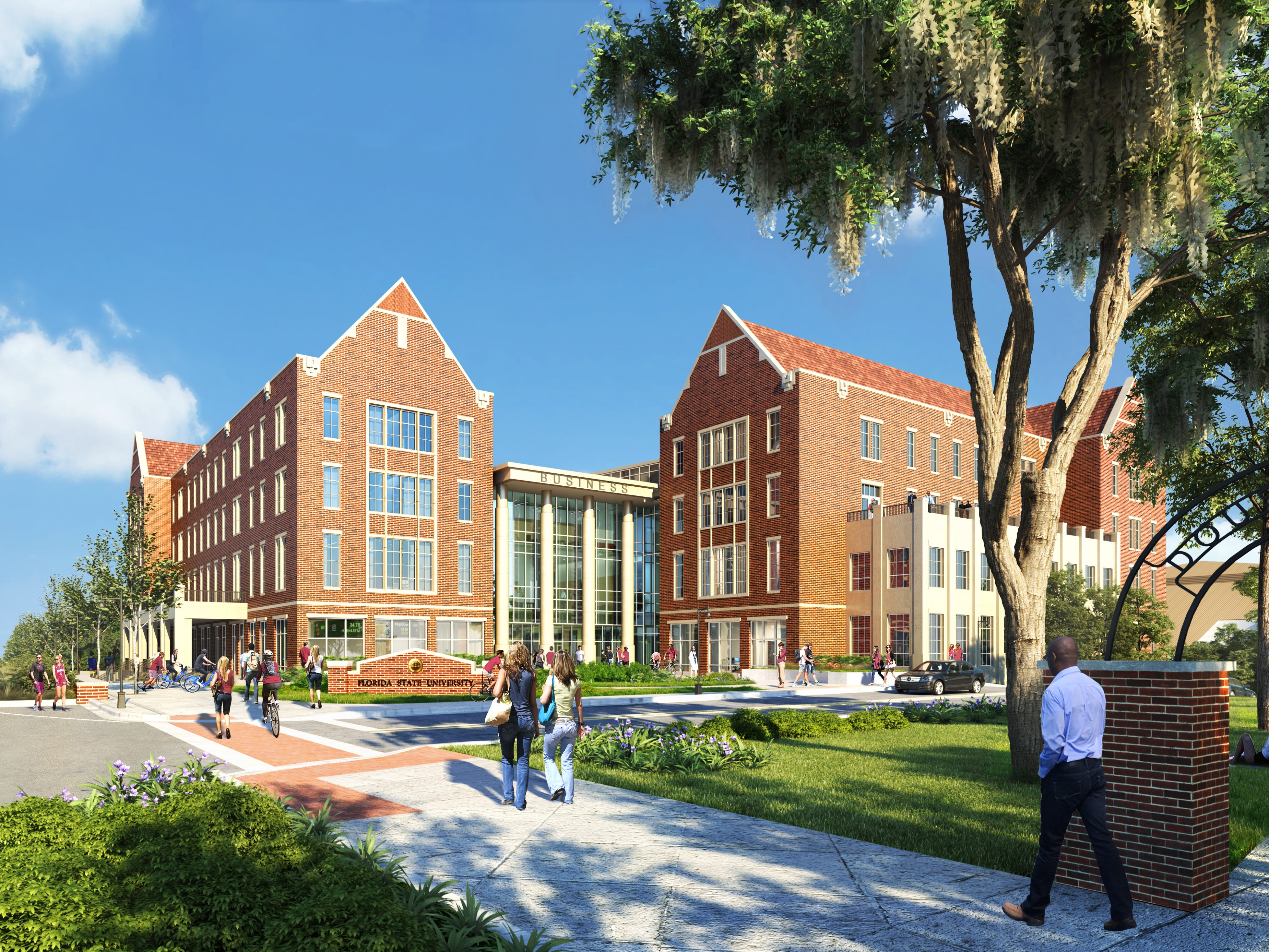
Significantly, Wertheim’s remarkable investment comes as the college moves into its new facility, located just south of the Donald L. Tucker Civic Center, and celebrates its 75th anniversary as a separate academic unit. Also, college officials expect a record 10,000 students for the spring semester.
“We are extremely grateful and humbled by the incredible generosity of Dr. Wertheim,” said FSU President Richard McCullough. “This transformational philanthropic investment will propel the college forward and empower generations of future leaders in the global marketplace.”
In addition to naming the college, the philanthropic investment creates several endowed funds to support various initiatives within the college, including faculty development, Horatio Alger scholarships and other scholarships for undergraduate and graduate students, student professional development opportunities, funding to support preeminence and emerging trends, and a new Wertheim Business of Healthcare Initiative.
The Wertheim Business of Healthcare Initiative will train business students to fill critical gaps in the healthcare business workforce and work with leaders in the healthcare industry to solve its most vexing problems.
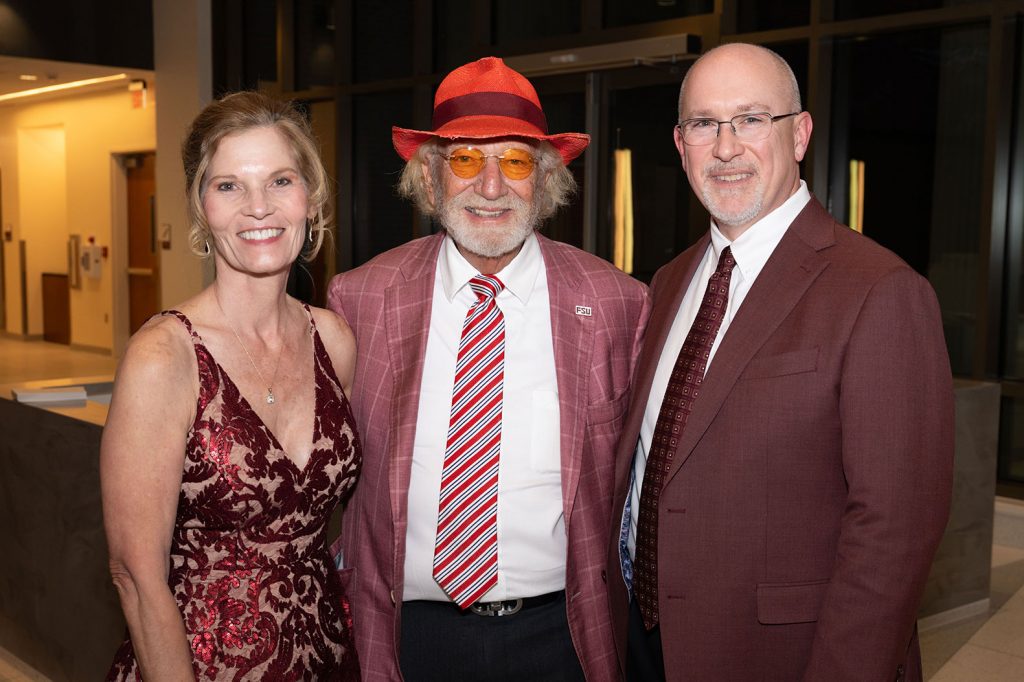
Dr. Herbert Wertheim (middle) with Dean Michael Hartline and Marsha Hartline.
Wertheim’s investment establishes two endowed chairs: the Herbert Wertheim Chair in Health Systems Operations and the Herbert Wertheim Chair in Healthcare Workforce Leadership. These chairs will support faculty members whose scholarship and teaching are dedicated to the continuous improvement of healthcare operations and systems, as well as workforce modernization in healthcare settings. These efforts align with the university’s bold new FSU Health initiative and its emphasis on healthcare in academic programs, research, and investment, including the Wertheim College’s new MBA major in healthcare administration and its annual Business of Healthcare Summit.
“This initiative will train business students to fill critical gaps in the healthcare business workforce and work with leaders in the healthcare industry and government to tackle pressing healthcare issues now representing more than 17% and $4.5 trillion dollars of the U.S. economy,” Dr. Wertheim said.
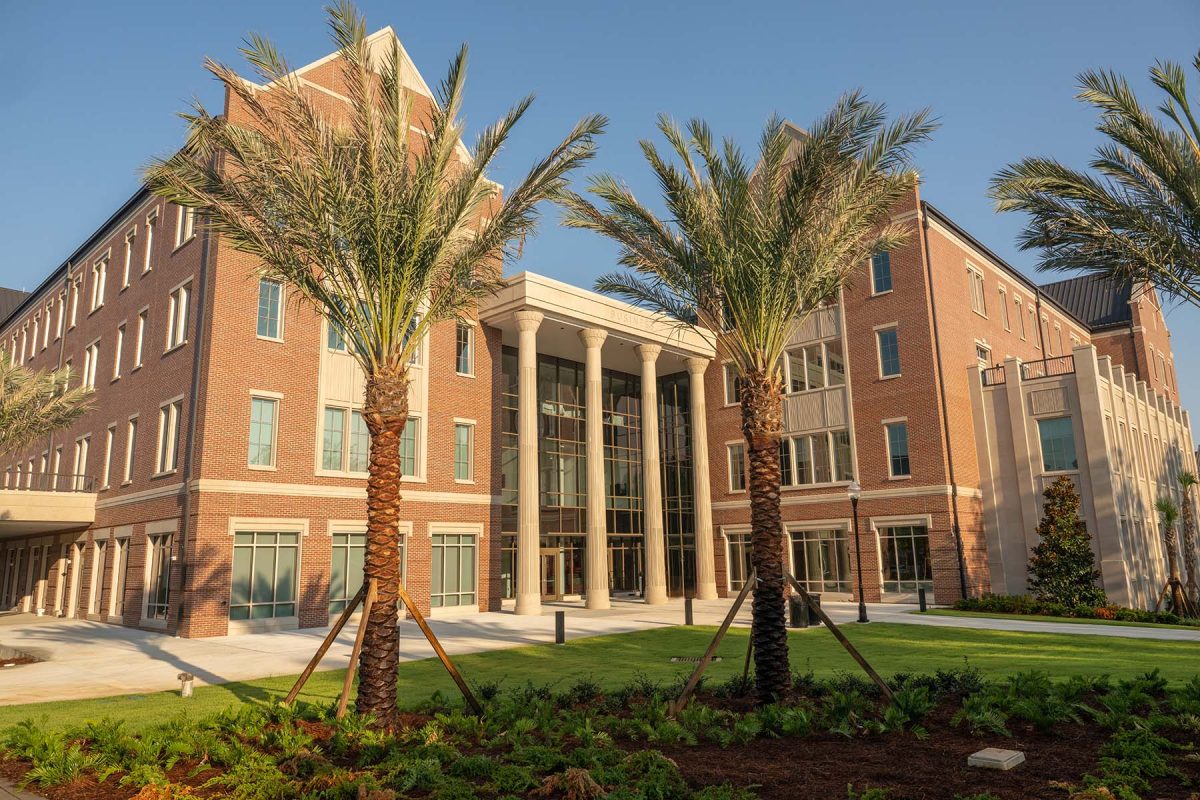
Part of the total philanthropic investment will name the college’s new facility, which stands as the largest academic building in FSU’s history. The Herbert Wertheim Center for Business Excellence will host its first classes in January, with a ribbon-cutting ceremony set for January 6.
“Generations from now, we will point to this monumental investment as profoundly pivotal in both the trajectory and impact of the college,” said Michael Hartline, dean of the Herbert Wertheim College of Business. “We will continue to generate innovative research and equip graduates to lead in the global marketplace, knowing this infusion of new financial support will allow us to strengthen our best work while also launching important new initiatives.”
Dr. Wertheim’s $65 million catalytic philanthropic investment is part of $431 million in investments made by the state, private donors, corporations and foundations that will allow the Wertheim College, university and the FSU Health initiative to pursue excellence at the highest level and inspire future philanthropic investments from other donors.
The Herbert Wertheim College of Business and the Herbert Wertheim Center for Business Excellence will serve as lasting tributes to the stature and business prominence of Dr. Wertheim.
Wertheim’s transformative contributions have led to the establishment of seven additional named academic institutions in Florida and California: the Herbert Wertheim College of Medicine, the Wertheim College of Nursing & Health Sciences and Wertheim School of Music & Performing Arts at Florida International University; the Herbert Wertheim College of Engineering and the Herbert Wertheim UF Scripps Institute for Biomedical Innovation & Technology at the University of Florida; the Herbert Wertheim School of Public Health and Human Longevity Science at the University of California San Diego; and the Herbert Wertheim School of Optometry and Vision Science at the University of California Berkeley.
A self-made Horatio Alger recipient and Forbes 400 billionaire, Dr. Wertheim holds the conviction that education serves as a means of dismantling societal obstacles, thereby enhancing the overall well-being of the community and humanity. His gifts and benefactions create formal and informal opportunities for the local and global community that help address some of the most pressing healthcare challenges facing society today.
Born into a working-class family, Dr. Wertheim overcame early academic challenges and pursued an education in optometry and optical engineering, driven by a passion for science and an innate curiosity.
In 1971, Dr. Wertheim founded Brain Power Incorporated (BPI), a pioneering company in optical color tints, chemicals and scientific instruments and materials, which has played a critical role in the advancement of eye health for more than 50 years. He is the first doctor to indicate and promote the danger of UV light to the eye and to prescribe his breakthrough invention of UV light absorbers for lenses that has prevented millions from potential diseases and blindness.
Florida State University's College of Business is being named after philanthropist Herbert Wertheim following a $65 million gift.
The donation is the largest philanthropic endowment gift in the university's history.
The new business school building, formerly known as Legacy Hall, will also be named after Wertheim.
As the College of Business and Legacy Hall – a $160 million project – will be named after Wertheim, it comes after the university completed the business school’s new building a few months ago and will open it up to the FSU community for use in the spring.
Wertheim’s investment to FSU is the largest philanthropic endowment gift in the university's history and the second-largest philanthropic gift FSU has ever received.
$15 mil for business school operation, another $50 million towards endowment (largest ever, I believe, or close to it. $15 mil to faculty, $10 mil to undergraduate scholarships, $25 mil discretionary fund college of business).
The first-largest philanthropic gift was made when Jan Moran and The Jim Moran Foundation gifted a record $100 million to the university in 2015, where part of the donation was used to create the Jim Moran College of Entrepreneurship in downtown Tallahassee in 2018.
A database released by the United States Small Business Administration includes Seminole Boosters, Inc., on its list of 82,708 small businesses or non-profit organizations that have received a million dollars or more in funding from the Paycheck Protection Program.
The program was enacted this spring during the coronavirus pandemic to allow these businesses and organizations to continue paying their employees.
According to the database listing, Seminole Boosters was approved for a loan between $1 million to $2 million on April 14 in order to continue to support 54 jobs during the pandemic.
Andy Miller, President and CEO of Seminole Boosters, confirmed to the Democrat that the organization received $1,017,455 through the Payroll Protection Program, but later returned $130,430 after a further review of the terms of the loan.
"Florida State athletics director David Coburn and various administrators found solutions to the fiscal year’s budget through cost-cutting and is now balanced thanks to a $6.15 million additional transfer from Seminole Boosters, Inc. The Booster transfer will be funded by the liquidation of real estate held by the Boosters for such a need. Coburn and the FSU athletics board met on Wednesday afternoon and approved a proposed 2019-20 budget of $108.07 million – an increase from $106.95 million in 2018-19. – The projected ACC distribution for 2019-20 is $32,076,073, an increase of $2.37 million from the projected 2018-19 distribution. The additional revenue factors in money expected from the new ACC Network. Then-FSU athletic director Stan Wilcox had said in 2017 that revenue would jump by $8 million – $10 million annually but Coburn said that number is not accurate. – FSU will receive $4 million to buy gear from Nike, up from a $2.8 million allowance in 2018-19. – Ross Cobb has been hired from the University of Arizona to be FSU’s new Chief Financial Officer. Longtime FSU athletics administrators Bernie Waxman (Associate AD for Facilities and Event Management) and Dr. Greg Beaumont (Senior Associate AD for Student-Athlete Academic Services) are retiring this summer.
Again great investigation by HokieMark. Even during these times when NOTHING is going on, FSU's own media doesn't look into these topics. Really is a head scatcher here.
Power 5 — Top 15 1. Texas — $156 million 2. Georgia — $123 million 3. Michigan — $122 million 4. Notre Dame — $116 million 5. Ohio State — $115 million 6. Penn State — $100 million 7. Auburn — $95 million 8. Oklahoma — $94.8 million 9. Alabama — $94.6 million 10. Nebraska — $94.3 million 11. LSU — $92 million 12. Tennessee — $91 million 13. Wisconsin — $90 million 14. Florida — $85 million 15. Washington — $84 million
ACC 1. Florida State — $69 million 2. Clemson — $61 million 3. Miami — $56 million 4. NC State — $46 million 5. Syracuse — $44 million
Something weird's going on in Tallahassee. Florida State reported EADA revenue for the 2018-19 athletic year of nearly $200 million - enough to rank 3rd among all college athletic departments in revenue for that year. Yet Seminole fans will tell you their school is strapped for cash. What gives? Let's see if we can figure it out...
Equity in Athletics Data (EADA)
Here's the EADA data for the last 2 years, which is broken out by sport:
Year
2017-18
2018-19
Baseball Revenue
$6,076,428
$7,466,680
Basketball Revenue
$23,550,761
$24,453,445
Beach Volleyball Revenue
$930,014
$1,060,193
All Track Combined Revenue
$5,181,616
$5,619,389
Football Revenue
$87,510,028
$68,893,857
Golf Revenue
$3,940,685
$3,340,678
Soccer (W) Revenue
$2,590,332
$3,192,377
Softball Revenue
$2,444,750
$2,860,820
Swimming Revenue
$2,977,495
$3,576,912
Tennis Revenue
$2,379,907
$2,637,520
Volleyball (W) Revenue
$1,593,290
$1,983,171
Total Men's Teams Revenue
$117,887,541
$100,569,860
Total Women's Teams Revenue
$21,287,765
$24,515,182
Not Allocated by Gender/Sport Revenue
$38,337,644
$73,322,159
Grand Total Revenue
$177,512,950
$198,407,201
In other words, despite a drop in football revenue, the total revenue for the athletic department increased by about $21 million. Also, while there were small increases in revenue for baseball (+$1.4M), basketball (+$1M), track, soccer, softball and swimming (each about +$0.5M), the vast majority of the increase came from "non-allocated" revenue.
What is "Revenues Not Allocated by Gender/Sport"? From the 2019 EADA user's Guide, it includes "any revenue which cannot be tied to a particular sport", such as:
alumni contributions to the athletic department (not targeted to a particular sport)
investment interest income
athletic conference money
radio and advertising sales
royalties
signage or other sponsorships
fundraising activities
institutional, state or other government support
Were these revenues one-time, or recurring? We just don't have enough information to know.
USA Today College Finances
Here's the USA-Today data, which is broken out by category, not by sport:
The 2018-19 season isn't posted yet, and the 2017-18 total revenue, while close, is not an exact match for the EADA number (differs by about $9 million). That said, there are some interesting trends we see in this table, such as:
ticket sales revenue remains strong compared to pre-2012 revenue
contributions are way up from previous years - more than double 2015, in fact!
FSU enjoyed a huge bump in rights and licensing last year (up $10 million)
Assuming these trends held for 2018-19, it's at least plausible that the $198 million revenue is real...
That said, throwing more money at a problem just makes it a more expensive problem. Or, would it have made Willie Taggart a better coach if FSU had paid him more? What's the missing piece? https://csnbbs.com/thread-897219.html
001.) The University of Texas at Austin - $215,829,101 002.) Ohio State University-Main Campus - $209,102,666 003.) Florida State University - $198,407,201 004.) University of Michigan-Ann Arbor - $175,006,632 005.) University of Georgia - $174,042,482 006.) University of Notre Dame - $169,547,625 007.) The University of Alabama - $166,812,799 008.) Pennsylvania State University-Main Campus - $164,529,325 009.) Texas A & M University-College Station - $160,101,611 010.) University of Oklahoma-Norman Campus - $159,286,136
011.) Louisiana State University and Agricultural & Mechanical College - $157,787,780 012.) Auburn University - $152,455,418 013.) University of Wisconsin-Madison - $151,369,153 014.) University of Louisville - $148,667,940 015.) University of Iowa - $144,070,825 016.) University of Florida - $143,627,997 017.) University of Kentucky - $143,481,480 018.) University of South Carolina-Columbia - $140,295,659 019.) University of Arkansas - $139,504,649 020.) Stanford University - $139,390,932
021.) The University of Tennessee-Knoxville - $135,818,717 022.) University of Nebraska-Lincoln - $130,313,578 023.) University of California-Los Angeles - $127,339,042 024.) University of Miami - $127,170,251 025.) Indiana University-Bloomington - $126,358,047 026.) Clemson University - $124,601,614 027.) University of Minnesota-Twin Cities - $122,667,963 028.) University of Kansas - $119,768,008 029.) University of Southern California - $118,687,120 030.) Texas Christian University - $118,496,653
031.) Michigan State University - $116,186,933 032.) University of Washington-Seattle Campus - $116,048,869 033.) Duke University - $116,021,513 034.) Northwestern University - $111,421,226 035.) Purdue University-Main Campus - $110,844,907 036.) University of Virginia-Main Campus - $108,854,006 037.) University of Maryland-College Park - $108,796,303 038.) University of Oregon - $108,500,370 039.) University of North Carolina at Chapel Hill - $105,407,867 040.) University of Arizona - $102,275,918
041.) Arizona State University-Tempe - $101,836,361 042.) Mississippi State University - $101,454,439 043.) Baylor University - $101,243,920 044.) West Virginia University - $101,095,223 045.) University of Illinois at Urbana-Champaign - $100,156,079 046.) Syracuse University - $99,815,688 047.) University of Pittsburgh-Pittsburgh Campus - $98,866,362 048.) University of Colorado Boulder - $98,413,285 049.) University of Mississippi - $96,790,426 050.) University of California-Berkeley - $94,646,123
And even though he and his wife, Judy, had already given more than $20 million to Florida State University over the past decade for various projects, this new gift proposal -- one seeking a $20 million donation to help build a new standalone football facility -- would take things to a whole new level.