.@BKoepka becomes the first player to win the @WGCFedEx when entering the week as the FedExCup points leader since @TigerWoods in 2013. @PGATOUR
— PGA TOUR Communications (@PGATOURComms) July 28, 2019
With @BKoepka win at @WGCFedEx, he becomes the 5th player to win a World Golf Championships event and a major in the same season, joining @TigerWoods (1999-2002, 2005-2008), Geoff Ogilvy (2006), @McIlroyRory (2014) and @DJohnsonPGA (2016). @PGATOUR
— PGA TOUR Communications (@PGATOURComms) July 28, 2019
• 2014 Turkish Airlines
• 2015 Waste Management
• 2017 US Open
• 2018 US Open
• 2018 PGA Championship
• 2018 CJ Cup
• 2019 PGA Championship
• 2019 @WGCFedEx
.@BKoepka joins Jack Nicklaus, Tiger Woods and Jordan Spieth as the only people to finish inside the top five in all four majors in a single season. pic.twitter.com/aW29Rkyt4j
He becomes just the fourth golfer ever to finish in the Top 4️⃣ in all four majors in a calendar year, joining Jack Nicklaus, Tiger Woods and Jordan Spieth #FSUGolfpic.twitter.com/TidrYCrmdA
Florida State’s 2014 team, which lost decisively against Oregon in the inaugural College Football Playoff, took the third spot. The Florida Gators snagged No. 5 for their 1996 team that won the national title.
Also of note is the 2002 Ohio State Buckeyes cracking the list at No. 7. That Buckeyes team was known for the infamous late pass interference call that helped them knock out the Hurricanes in the national title game.
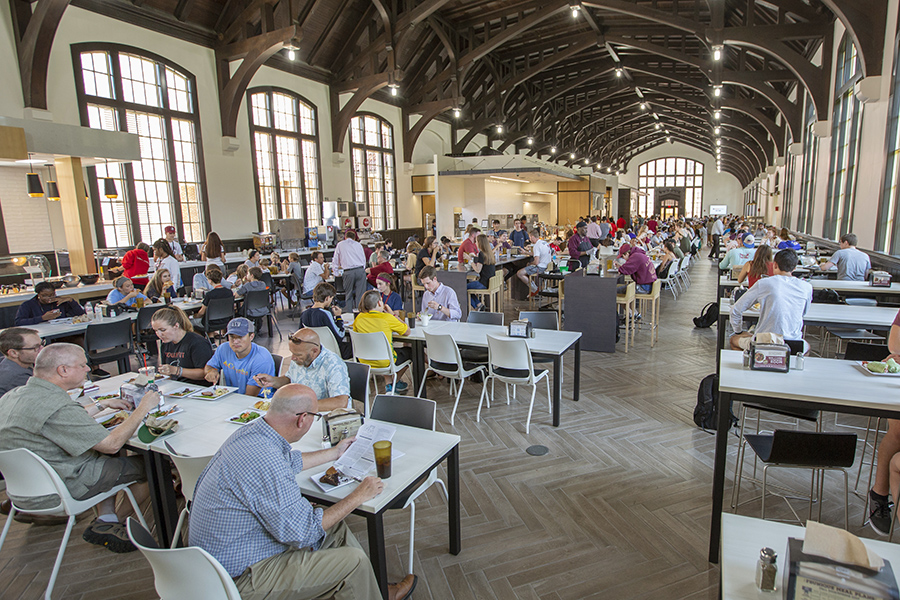
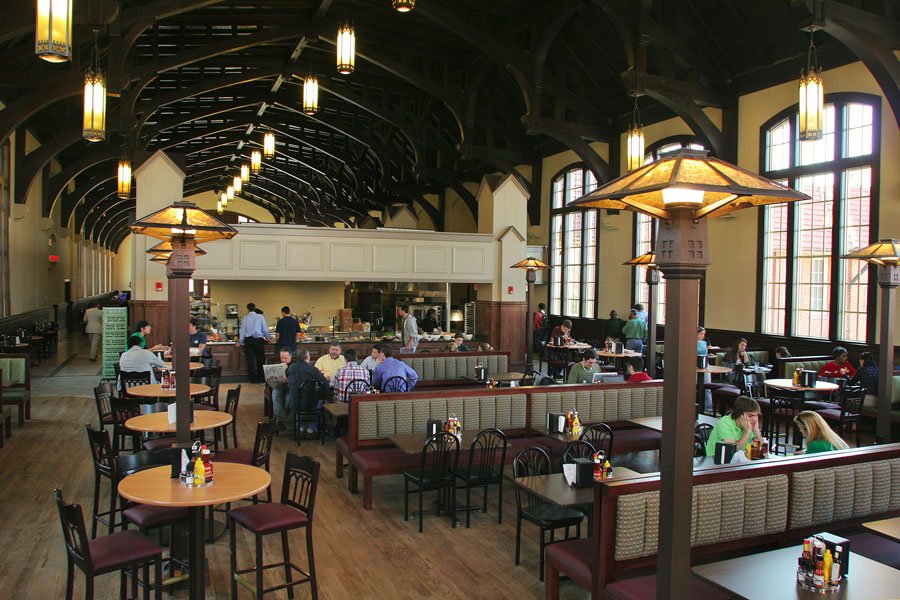
Florida State University’s renovation of the historic Suwannee Room has earned national recognition from the National Association of College and University Food Services (NACUFS).
The Suwannee Room earned national recognition from the National Association of College and University Food Services.
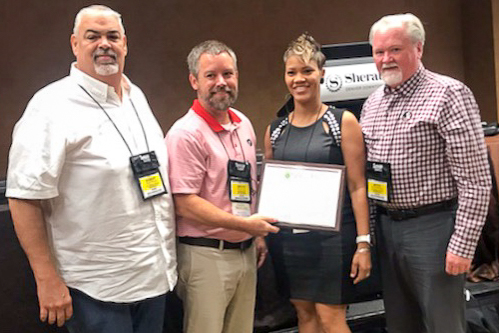
Florida State’s Seminole Dining — operated by food service provider Sodexo — picked up a silver award in the Loyal E. Horton Dining Awards program July 11 at the NACUFS annual conference in Denver. FSU was recognized in the Residential Dining Facility category, large school, for its renovation of the Suwannee Room in 2018.
“Florida State University is so pleased to earn this very special distinction,” said Vice President for Finance and Administration Kyle Clark. “This award further demonstrates our commitment to enhancing overall student success and our drive for the Top 25 by providing students with a quality dining experience that is among the very best in the nation. We are excited to continue to bring new variety, including ‘Fresh from Florida’ produce, a full-service bakery and other exciting interactive culinary stations.”
Not only did the transformation enhance the century-old Suwannee Room’s amenities and appearance, it also improved the menu.
The construction team preserved the dining hall’s essential character by safeguarding important historical features, such as the vaulted ceilings and elegantly carved Gothic arches, while creating a brighter, more open space with modernized food stations.
In addition, Suwannee reopened with an expanded menu that elevated the quality of meals, incorporated nutritious locally grown foods and offered an enclosed pantry to accommodate students with food allergies or dietary restrictions.
The My Zone area is free of tree nut, peanut and gluten-containing ingredients and products. (FSU Photography Services)
Seminole Dining dietitian Jessica Brooks said Florida State has made it a priority to provide safe, healthy meals as food allergies have become more prevalent in society.
“In Suwannee Room, we offer My Zone — a gluten-free, nut-free pantry offering items you would find in your pantry at home, such as breads, snacks and desserts that meet our thorough guidelines,” Brooks said. “Suwannee Room is designed to give all of our students the same dining experience, and that includes the social aspect of college life. We want students with food allergies to be able to enjoy eating meals with friends, and they are invited to discuss their specific food needs with our dining team.”
The Loyal E. Horton Dining Awards are described as the ultimate professional tribute to celebrate culinary innovation. Awardees in six categories are recognized as national examples of excellence in food service.
1) Our colors are Garnet and Gold. And we’re better
at football than the schools in the green (USF) yellow (UCF) and most
importantly, the school in the blue (UF). Ten points for Gryffindor!
2) The Suwannee room looks like the Great Hall. Sometimes
you may even secretly wish Dumbledore would show up to make an announcement
before you finish eating.
3) Instead of a sorting hat, we just call it rush.
4)
In the library, I once heard someone say “I would NEVER call anyone a mudblood. That’s like, calling someone the N word. So offensive.”
5)You have to be careful or the dementors creeping
around the bars will steal your soul/dignity with potent drinks and sloppy kisses.
6) Harry Potter World is just down the road in
Orlando where you can see that kid from bio lab waltzing around with a cape and
wand for their summer job.
7)
We may not have a forbidden forest, but we have Frenchtown on the edge of campus.
8)
And last but not least, we have a quidditch team.
So if you’re ever sad that the books and movies
are over, just take a trip to Tallahassee. Who knows, you may actually see Harry Potter wasted at the strip blaming his actions on the polyjuice potion or Hermione taking up an entire section of the library during finals week. That Bitch.
Muggles far and wide come to Florida State each year to see the Suwannee Dining Hall on campus tours. Just ask any University Ambassador what the old dining hall looks like and they’ll tell you Suwannee “looks just like the Great Hall thing from Harry Potter.”
However, the university’s decision to renovate Suwannee and temporarily move the buffet to the Union has Potterheads worried that the resemblance to the fictional dining hall will soon be lost.
“It’s a complete outrage! I refuse to believe this is happening,” said Melanie Jennings, a fifth-year senior at FSU. “The whole reason I came to this school and continue to attend is to support Suwannee’s aesthetic.”
Since 1913, the Suwannee dining hall has been the principal dining location on the FSU campus. However, despite all the memories that might have been made there, any 105-year-old establishment is inevitably going to require maintenance and even renovations from time to time. The decision to renovate the building has brought nostalgia to the forefront.
“Since the 3rd grade, I’ve been a huge Potterhead,” said Melanie. “Hermione Granger has always been my role model. Eating on campus just doesn’t feel the same now.”
Perhaps even more distraught than the self-proclaimed “muggles” at FSU is the school’s official quidditch team. Although it’s a sport entirely inspired by the Harry Potter series, the variant of quidditch played on campus doesn’t require flying on broomsticks. Naturally, tempers flared when the most prominent Potter-like building on campus was slated to be refurbished.
“It feels like a slap in the face,” said Bludger captain Jacob Wellingworth, as he snapped in half a broomstick with “Firebolt 3000” written in Sharpie. “Not enough of this school’s architecture takes after Hogwarts. Thrasher seriously pulled our rug by taking this away from us. I bet he thinks of himself as some golden snitch.”
Florida State Harry Potter fans are disappointed because the redesign of Suwannee means that there could possibly be one less Hogwarts-esque establishment on campus. Other students are more critical of the fact they have to eat in the less dignified Union for the time being.
According to FSU’s news website, the renovations are working to improve Suwannee’s “culinary experience”, while the building’s interior Gothic architecture will remain intact. Like it or not, meal plans are non-refundable.
Thanks to @TDOnline for letting me write about our record-breaking year — $233.6M in research funding — and the positive economic benefits that brings to our area. https://t.co/Phzs5b6uZV
— Gary K. Ostrander (@FSU_VP_Research) July 22, 2019
This past fiscal year, Florida State University researchers attracted $233.6 million in research funding from federal, state and private sources. This includes money to research cardiovascular disease, climate change, the local oyster population and so much more.
Over the past few years, FSU has consistently been among the top patent producers in the world, according to the National Academy of Inventors and Intellectual Property Owners Association. This past year, we ranked No. 69 among all universities in the world for the number of patents granted, up from No. 79 the year prior.
What’s even more valuable is when we can turn these patents into viable business opportunities through licensing agreements or startup companies. In the past few years, the university has licensed about 10 new technologies per year to companies.
One of these technologies is a next-generation foam developed by Chad Zeng, a researcher at FSU’s High-Performance Materials Institute. The foam was the product of a two-year project funded by the U.S. Department of Veterans Affairs, which was interested in creating more comfortable prosthetics. It also turned out to have some commercial applications because it has the novel property of expanding on impact.
This foam was licensed by a Florida-based company called Auxadyne, which has been using the foam to make safer athletic equipment, including better football helmets. The company was recently recognized by the National Football League’s health and safety initiative.
Another example is the work conducted by Professor Michael Blaber at the FSU College of Medicine. Blaber, with the help of funding from the National Institutes of Health, has developed an artificial human protein for stimulating cell growth that could help provide relief for an incurable eye condition called Fuchs’ Dystrophy. This technology has been licensed by Trefoil Therapeutics, a biopharmaceutical company that has attracted significant investment from venture capitalist firms and recently received $28 million from investors.
We have extraordinary researchers at FSU working on so many different types of projects, and we are beginning to see the fruits of their labors reflected in the federal, state and private grants received this past fiscal year. But that is only the start of their stories here at FSU.
In the next few years, we will see what they will develop to help solve questions in health, technology, the environment and other areas. And we will also see how those innovations can make a dent in the marketplace, bringing greater benefits to the Big Bend Region and the state of Florida.
Gary Ostrander is the vice-president for research for Florida State University.
Florida State University researchers received a record level of funding from federal, state and private sources in the 2019 fiscal year, bringing in $233.6 million to the university to support investigations into areas such as health sciences, high energy physics and marine biology.
This is a $7 million increase over the prior fiscal year.
The university is also one of the state’s leaders in funding from the National Institutes of Health. FSU ranks fifth in the state for NIH dollars, ahead of research heavyweights such as the H. Lee Moffitt Cancer Center and Mayo Clinic in Jacksonville. These dollars support traditional biomedical research into diseases and conditions such as stroke, the flu and cancer, in addition to behavioral health issues and neurological disorders such as learning disabilities.
FSU’s record year of funding 2014 when researchers brought in $230.1 million. However, that total was boosted by federal stimulus dollars that had to be used during a certain period.
With a new grant from the National Institutes of Health, researchers at the Florida State University-headquartered National High Magnetic Field Laboratory will study the main mechanism behind one of the top causes of disability: migraines.
The $3.3 million, five-year grant continues a collaboration that includes Sam Grant, a MagLab researcher and associate professor in the FAMU-FSU College of Engineering. Grant is partnering with Dr. Michael Harrington, director of neurosciences at Huntington Medical Research Institute (HMRI) in Pasadena, California, and Linda Petzold, a professor of computer science and mechanical engineering at the University of California, Santa Barbara (UCSB).
Using the MagLab’s world-record MRI machine, the team has been working for years to shed light on why migraines occur and how they propagate to different brain areas, which is still not well understood.
However, the researchers have identified a likely suspect — sodium — and have been building a case for the role it plays in these painful episodes. In research published earlier this year, for example, they described how sodium distribution in the brain is disturbed in mammals even before symptoms of an oncoming migraine begin. They also described how those sodium increases can be blocked.
“If we can discover a way to treat it by correcting these sodium-led changes, it offers a lot of hope,” said Nastaren Abad, a co-author of the paper and a doctoral student in biomedical engineering at FSU who will be part of the new project.
Different stimuli can trigger migraines, depending on the patient. But no matter what origins, the team believes the process may unfold in the same way. Specifically, their research points to a sodium imbalance that begins in an area of the brain called the choroid plexus and is spread via the cerebrospinal fluid.
The NIH grant will allow the team to better understand what happens along that pathway and in turn develop more effective strategies to treat migraines.
Interrupting this pathway could prevent or mitigate migraines, Grant said. The team plans to test sodium pump blockers, which have been effective in previous studies, and compare their performance to both common and experimental migraine drugs.
Each institution is contributing in a unique way, according to Grant. The HMRI team is conducting behavioral and tissue studies using animal models; the UCSB group is developing computer models of sodium transport in the brain; and at the MagLab, Grant’s team is running high-field sodium magnetic resonance imaging (MRI) and metabolic spectroscopy experiments.
By combining these methods, they hope to fully understand how migraines become ingrained through sodium.
Story in the AJC today discussing the cable/satellite companies that have not yet agreed to carry the ACC Network. This is stuff we already knew about, and realistically some will probably sign-on by the time football season kicks off.
What is interesting are the revenue figures thrown out in the story, and the first year projection confirmed by the CFO for Georgia Tech athletics. First, Tech is projecting just a $28 million distribution for 2019 from the ACC. If that's accurate it's a decline of around $1.5 million from the last cycle for 2018 which saw an average distribution of $29.5 million.
Next, the associate AD is confirms a "conservative" projection of a $1 million bump in year one from the ACC Network. So the projected distribution for 2020 is $31.8 million ($1 million coming from the ACCN).
In its initial budget forecast for the 2020 fiscal year (which began July 1), Georgia Tech was counting on $31.8 million in distribution from the ACC, a healthy bump from the $28.0 million it was projecting for fiscal year 2019 (which ended on Saturday) when all the bookkeeping was completed. Of the $3.8 million increase, $1 million was expected to be the fruit of the ESPN-owned network, which launches Aug. 22.
The positive is that by 2023 the projection gets bumped up to $101.3 million from the network, or about $6.7 million per school. But that's obviously years away and there's a lot of speculation involved that far out.
Pointing out this story because there were some very unrealistic projections when the ACCN was first announced. A couple years ago a former FSU AD made a ridiculous projection of $8-10 million from the network the first couple years and $10-15 million after that.
Eleven of Florida’s 12 state universities have been allotted their share of the $560 million available for performance-based funding, with the University of Florida taking in the largest haul, or $99.9 million, including $52.6 million of its own money.
Florida State University is receiving a total of $88.9 million, including $46.8 million of its own institutional investment, along with $42 million from the state.
Florida A&M University is receiving a total of $29 million, including $13.7 million from the state and $15.3 million from its own investment.
The scores and allotments were approved Thursday by the Board of Governors as they wrapped up three days of meetings at the University of South Florida.
The State University System’s Performance Funding Model includes 10 metrics that evaluate the institutions on a range of issues. Two of the 10 metrics are choice metrics; one picked by the Board and one by the universities' boards of trustees.
The system’s newest university, Florida Polytechnic, is not yet eligible for the state funding.
The initial funding pot of $200 million coming from the state universities and the legislature in 2014-2015 has grown to $560 million this fiscal year. Of that, $265 million comes from the state and $295 million comes from university investments.
Florida State
Florida State University scored fourth among the universities this year, with 88 points. That is despite improving in eight of the 10 performance-based metrics and meeting all 12 of its preeminence metrics.
“Student success is Florida State’s top priority, and we’re thrilled that our strategic investments in this area over the years are paying dividends,” President John Thrasher said.
Florida State this week continued to receive accolades for leading the State University System with its 71.5% four-year graduation rate, a key metric for the Board of Governors.
While acknowledging each university has shown improvement, the governors want to see others raising the bar for four-year graduates.
The University of Florida has the second best four-year-graduation rate at 67.1%.
New model puts universities on notice
Besides eliminating the “bottom three” designation, the board maintained universities must earn at least 51 points to receive their institutional investment, which is the current policy.
Changes in performance-based funding allocation included:
•Universities that increase their score over the last year receive 100% of their allocation of the state investments.
•A university’s score that decreases only 1 year receives 100% of their allocation of the state investment.
•If a university’s score decreases or remains the same two consecutive years, it may receive 100% of its state allocation after presenting and completing a student success plan. Under this proposal, if the plan is approved by the board, the university may receive up to 50% of its allocation in August or September.
•If goals in the plan are met, it may receive up to the balance of its share of state investment six months after the student success plan is presented.
•Beginning with the 2021-22 appropriation, schools scoring below 70 could receive up to 50% of the state investment after presenting/completing a student success plan:
•If the plan is accepted, the university may receive up to half, or 25% of their allocation in August or September.
•If goals are met, the university may receive up to the balance of their allocation six months after the student success plan is submitted in March.
How universities scored
A breakdown on how universities scored in meeting performance metrics their share of total performance funding, which includes what each contributed to the $265-million total from their own investments, plus $295-million from the state)
University of Florida (95 points; $99,916,894)
University of West Florida (94 points; $22,066,426)
University of South Florida (92 points; $77,142,361)
Florida State University (88 points ; $88,933,412)
University of Central Florida (88 points; 77,682,252)
Florida International University (87 points ; $64,367,597)
Florida Atlantic University (86 points; $43,357,774)
Florida Gulf Coast University (81 points; $23,023,665)
University of North Florida (78 points; $26,115,521)
Florida State University’s Board of Trustees Friday voted to approve a $1.9 billion university spending plan for next year.
The approved operating budget represents a 6-percent increase, or $103 million more than the current budget. As is the case within the State University system, there is no tuition increase.
The university is keeping its focus on student success initiatives as part of its goal to break into the Top 25 of major public universities this year.
“This budget will allow us to continue the university’s upward trajectory as one of the best public universities in the nation, FSU President John Thrasher said.
“Student success, that’s been our mantra for the past several years, and those assets that we have put toward student success and continue for the university’s national rise, I think is very important for the university community and the state of Florida.”
The university was able to build in the budget increase although it received less funding in this year’s state budget and no new performance-based funding from the state. A 3-percent decrease in Education and General funds this year from the state resulted in a loss of $17 million, according to university documents.
State support accounts for 29.87% of the 2019-2020 budget.
A change in performance-based funding enacted by the Board of Governors this year —including removing any loss for the three lowest-performing universities — meant no new performance-based funding.
Despite this, FSU was able to free up extra money by reducing expenses by 4%, or $3 million. It also realized an increase in auxiliary funds of 4% or $9 million attributed to increased financial support from the Seminole Boosters to the Athletics Department and building improvements underway in housing.
Other money came from federal grants and contracts, increases in state grants and increased giving through private gifts.
Another factor is the increase in capital funds of 41%, or $69 million. Construction project underway include the Earth Ocean Atmospheric Sciences Building, Student Union and the STEAM building at Florida High.
The 2019-2020 construction budget totals $238.7 million.
Performance-based funding and preeminence funding in 2018-2019
Each year, Florida’s 11 public universities receive extra funding based on their performance on 10 yardsticks, or metrics, established by the state. That is called “performance-based funding.”
Using mostly different yardsticks, universities that meet or exceed 11 of 12 metrics are also entitled to receive additional funding as “preeminent research universities.”
Only three schools got the preeminent designation this year.
Note: The University of Central Florida received $1.54 million as an “emerging preeminent university” because it met or exceeded seven of the 12 metrics. Source: State university system Emily Wunderlich | The Crow’s Nest