Most 9+ Win Seasons since 1962:— Pick Six Previews (@PickSixPreviews) January 18, 2018
48- Nebraska
36- Alabama, Ohio State
33- OU, PSU
32- Michigan
31- Auburn, FSU
29- Texas
28- USC
27- Florida, UGA
26- Miami
25- LSU, Notre Dame, Tennessee
Thursday, January 18, 2018
Most 9+ Win Seasons since 1962

FSU PC campus adds new degrees with Navy grant
FSU Panama City to offer new engineering programs from @FAMUFSUCOE. With demand from NW Fla. industries, a U.S. Navy base, Tyndall Air Force Base, GKN Aerospace and others, @fsupc is in the right place! ✈️ 🚀https://t.co/6mnzll2Vxa pic.twitter.com/diOMDuzbRX— Florida State University (@floridastate) January 19, 2018
http://news.fsu.edu/news/university-news/2018/01/18/fsu-panama-city-offer-new-engineering-programs-famu-fsu-college-engineering/
FSU Panama City announced it will add two new engineering programs in fall 2018.
The university will begin offering a bachelor’s degree in mechanical engineering and a master’s degree in systems engineering. The announcement came during a meeting of the FSU Board of Trustees today.
“These new programs are coming to FSU Panama City because of strong demand from local industry and support from the FAMU-FSU College of Engineering,” said Randy Hanna, dean of FSU Panama City. “With community partners, such as the U.S. Navy base, Tyndall Air Force Base and GKN Aerospace, our students will have unlimited options.”
Both programs represent an expansion of the FAMU-FSU College of Engineering. The mechanical engineering program teaches contemporary engineering practices used to develop products from concept to marketplace. Courses focus on thermal and fluid systems, mechanical systems, mechanics and materials, dynamic systems and engineering design.
The systems engineering program integrates engineering disciplines with techniques to streamline and improve efficiency of manufacturing and industrial organizations. Students will design and manage complex technical systems and processes.
The FAMU-FSU Department of Industrial and Manufacturing Engineering and FSU Panama City developed the program with support from the Naval Surface Warfare Center Panama City Division.
“We are excited to expand collaboration with FSU Panama City and the community,” said Murray Gibson, dean of the FAMU-FSU College of Engineering. “When we looked at where there would be growth in engineering opportunities in Florida, Northwest Florida was a natural choice.”
A proposal to begin a bachelor’s degree program in biomedical engineering is also in development and could start as soon as fall 2018.
The FSU Board of Trustees Academic Affairs Committee has given preliminary approval for a Master of Science in Systems Engineering for the FSU PC campus— Eryn Dion (@PCNHErynDion) January 18, 2018
The plan is to get that program up and running for fall 2018. The Navy has offered a $900k grant over 3 years to help develop curriculum— Eryn Dion (@PCNHErynDion) January 18, 2018
The Navy is actually a big driver for this, particularly NSA PC. Their engineers often leave to get degrees they need to advance and don't come back— Eryn Dion (@PCNHErynDion) January 18, 2018
.@fsupc Dean Randy Hanna and Dean Gibson announce an undergrad mechanical engineering program to start in Fall 2018— Eryn Dion (@PCNHErynDion) January 18, 2018
The committee has also approved to explore a Bachelor of Science in Financial Planning and Services for the PC campus— Eryn Dion (@PCNHErynDion) January 18, 2018
This program, if implemented, would be the first of its kind in the state— Eryn Dion (@PCNHErynDion) January 18, 2018
Wednesday, January 17, 2018


Facilities update
http://www.tallahassee.com/story/sports/college/fsu/2018/01/16/florida-state-starting-complete-redo-dick-howser-stadium/1035329001/
FSU is currently in the process of fundraising for a roughly $25 million project designed by Gensler architects along with EMI Architects to completely update the stadium.
The administration has the option to do the renovations in $5 million phases, but there is also the option to do more than one phase at a time.
"It’s been 15 years since we’ve done anything substantial so we’re due for upgrades. It’s just time."
FSU is currently in the process of putting in a new video board for the stadium as a part of phase one of the renovations.
The new Panasonic video board measures 60.5 feet wide and 32.75 feet tall, offering 1,981 square feet of video, nearly seven times larger than the previous video portion of the scoreboard that had been in place since the 2004 season.
Only Mississippi State has a larger video board in college baseball.
But that is just one of many changes to come.
Over the next few years -- depending on the fundraising -- FSU's renovations will include:
*New seats in the grandstands.
*Updating the open-air suites along the first base side.
*Improving the dugout suites.
*Improved lighting.
*Updating the concession stands.
*Renovating the weight room and the Tradition Room, updating the dugouts and the clubhouse.
*Renovating the concourses.
Beyond the left field wall, FSU is planning to build visitor locker room -- something that the stadium currently does not have -- and also planning to build out the ticket booth that is facing the softball stadium.
FSU plans to put in a hospitality area over the ticket booth that will overlook the stadium.
FSU also wants to add standing-room-only area along the right-field line and behind the screen. It will be built up so fans can stand behind the screen and watch the game from that area.
“It touches on improving the look of the area in right field to make it blend a little more comfortably with the rest of campus," Waxman said.
Underneath the standing-room-only area, FSU plans to build a facility that will serve as the Seminoles' bullpen on game day.
FSU will also build a separate facility behind the right field bleachers that will be used for infield drills and a batting cage.
“They currently don’t have any space to do infield drills," Waxman said.
"We’re talking about potentially creating a space for that that could double as a bullpen, that could double as a batting cage. It’s a really extensive plan that first seeks to give the baseball players what they need to continue their trade.”
Basically, the only thing that won't be changing in Dick Howser Stadium is the dimensions of Mike Martin Field.
The Don Veller Seminole Golf Course — where both the men's and women's golf teams play — is going to be reconstructed by Nicklaus Design, which is run by golf legend Jack Nicklaus and his son Jack Nicklaus Jr.
Nicklaus Jr. is leading the design team for the renovations.
"We’re still looking at the golf project with the Nicklaus design team with the hop - but not a guarantee because we still have to raise some money - that we can start to do something this fall," said FSU Deputy Athletics Director for External Operations Karl Hicks.
"To time the construction on a golf course with grass growing season in Florida, you have to start construction sometime between September and November to ensure the course is ready to be played the following fall."
The design for the course has been completed, but that doesn't mean that it will be exactly like the completed project.
“There’s a plan in place for the 18 holes, but when they start doing the course, Jack or his son will come out and make small changes depending on what they see," FSU Associate Athletics Director for Facilities and Event Management Bernie Waxman, who is leading the project for FSU, told the Tallahassee Democrat.
The project is going to cost FSU roughly $10 million -- $6 million for the course and $4 million for the clubhouse and practice area -- but the fundraising is almost complete.
Softball and soccer will also be receiving new scoreboards, but both venues will also be receiving shading enhancements.
The Seminole Softball Complex will also be undergoing significant changes.
FSU is increasing the width and depth of the dugouts, and building out the practice deck so that the program can have its own hospitality area.
The Tucker Civic Center -- where both the FSU men's and women's basketball programs play -- is getting a players lounge on the second floor.
“It’s a meeting space. It’s a hospitality space," Hicks said.
"The women had talked about having a video breakdown area. It will be a really nice amenity for both teams. Fans won’t necessarily see that, but people that are coming into the program will because they’ll be visiting the coaches there.”
It's the second phase of the process of renovating the Tucker Center. The first saw a complete redesign of the inside of the arena as well as new locker rooms for both teams.
All facilities will be undergoing wiring changes as FSU prepares for the launch of the ACC network in 2019.
The facilities will be getting fiber optic cable to help with the HD signals that will be coming back to Seminole Production's command center in the Coyle E. Moore Athletic Center.
FSU will also be adding extra camera platforms for the different venues.
“We’re already operating a quasi-television network," Hicks said.
"The quasi-television network that we’re operating right now is mostly digital and board shows. We’re producing things for ESPN 3 and ACC Network Extra and we will be morphing to one that’s going to produce events for cable distribution."
Tuesday, January 16, 2018
FSU Football facility update & fundraising
http://www.tallahassee.com/story/sports/college/fsu/football/2018/01/16/florida-states-football-only-facility-project-gets-reboot/1035328001/
FSU is in the process of completing a feasibility study to decide whether to renovate the Coyle E. Moore Athletics Center — where the FSU football program is currently based — or creating a new facility.
The Moore Athletics Center has been updated recently — with the addition of the players lounge on the second floor and renovated locker rooms — but it hasn't undergone a major renovation since 2004.
“This feasibility study is not ‘let’s just draw the nicest rendering of a building that we can,'" FSU Senior Associate Athletics Director for Governance and Compliance Jim Curry told the Tallahassee Democrat.
"We’re really getting into the finer points of this. If we do option one, what’s the impact? What’s the financials? Is there potential disruption of department operations? And let’s look at option two and ask ourselves the same questions.
"It’s a much deeper dive than just where can we put a shiny new building and what do those renderings look like."
A football-only facility, or an updated facility in the Moore Athletics Center, is something many believe is desperately needed.
FSU's facilities are much smaller than comparable programs around the Southeast, and that's something that the administration is taking into account.
“We have an academic support space that’s about 14,000 square feet," Curry said.
"You look at Louisville, who’s got 43,000. Can we expand our training table? Our current space is about 2,800 square feet. When you go out to Florida, it’s over 13,000 square feet.
"Right now our weight room is about 12,000 square feet and shared amongst all sports. But if you go out to Florida or Clemson, they’ve got football-only weight rooms that are about 20,000 and 27,000 square feet respectively."
Taggart met with architects last Friday to discuss his vision for what he believes that the FSU football program needs to be successful.
Taggart has a unique view on the issue after spending a year coaching Oregon. The Ducks have nearly every facility imaginable -- including one of the country's first football-only facilities at the collegiate level -- courtesy of Nike co-founder Phil Knight.
Taggart was able to draw on what he liked about Oregon's facility, and what he thought could be improved.
FSU's project is going to affect far more than just football operations.
Nearly every other sport at FSU is based out of the Moore Athletics Center. It also houses the athletic department, the College of Communications and Seminole Productions, which handles many of the professional video production needs for FSU athletics.
If the administration does decide to go with the renovation of the Moore Athletics Center rather than a new stand-alone football facility, it still could displace the other programs. How FSU accommodates those programs still must be answered.
FSU is exploring all options before moving forward with the project.
“Can we do some things with this project that positions football for sustained success long term and able to compete for championships, but also address some things in our department that can benefit not only football but all of our student-athletes?" Curry said.
"If we address those three areas that’s a win for all sports, including football.”
Since Taggart’s introduction at FSU on Dec. 6, the organization has signed $3 million in leadership commitments earmarked for an upcoming investment in day-to-day football operations space.
Seminole Boosters is encouraged by positive conversations with a number of interested major gift donor prospects.
The group received its first seven-figure leadership gift for the football-only facility a few days prior to coach Jimbo Fisher’s departure to Texas A&M.
The organization annually transfers approximately $22 million to the athletics department to help fund its annual budget.
It also pays approximately $10 million a year in bond debt on previously built facilities and raises money for future facilities and endowed scholarship funds.
Last year, the Boosters’ major gift team – it focuses on gifts $50,000 and higher -- generated $19.5 million in pledges, cash, real estate and deferred gifts, according to Dasher.
Dasher said that number could reach between $20 to $22 million by Jan. 31, when the organization’s fundraising year ends. (The fiscal year ends in July).
That excitement also has spilled into the sale of football season tickets.
As of Wednesday, FSU had sold 806 new football season tickets, 121 in the Dunlap Champions Club.
Last year at this time, FSU had sold less than 500 new season tickets (440 regular/50 Champions Club) despite tickets going on sale a month earlier.
“It has been a huge turnaround, a very, very positive interaction,” Mark Cameron, director of ticket sales at FSU, said of the Taggart transition.
“The conversation pretty much changed overnight.”
Greg Hulen joined Seminole Boosters, Inc., last July as its Executive Vice President.
The FSU graduate was hired away after 12 years at Tennessee, where he served as the associate athletic director and chief development officer for the Tennessee athletic department.
Hulen, who served in FSU’s Sports Information Department while a student in the late 1990s, agreed that Taggart’s arrival has been a rallying point for boosters and fans.
Hulen also pointed to the Seminoles’ entertaining home football schedule next fall and the strong working relationship between the athletics department and Seminole Boosters, Inc., as ways to help maximize fundraising opportunities.
“Our cash contributed is over double what it was at this time a year ago,” Hulen said
New baseball video board
The new baseball video board should be completed by the end of January. It will measure 60.5 feet wide and 32.75 feet tall. https://t.co/wBSINVAbvs. pic.twitter.com/1cZT4v7XrH— Warchant.com (@Warchant) January 16, 2018
Monday, January 15, 2018
Final agreement for Cascades Project
Final agreements reached for Cascades Project https://t.co/hml1u36Wul— Hammond Design Group (@HDGarchitects) January 15, 2018
http://www.tallahassee.com/story/news/money/2018/01/14/final-agreements-reached-cascades-project/1031326001/
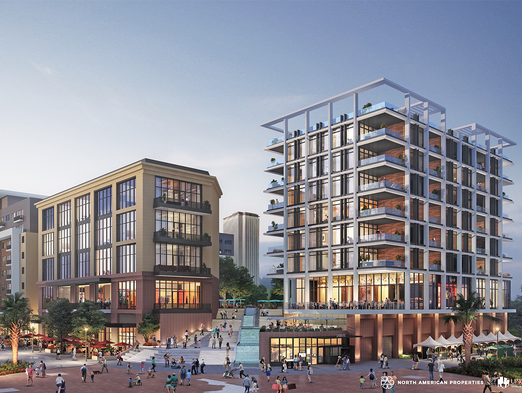
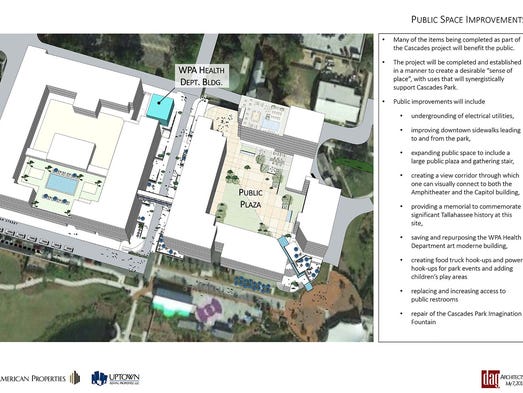
The developer has signed the last five documents with the Tallahassee Community Redevelopment Agency to build its Cascades Project on the hem of the city's 24-acre public park.
Two city blocks that are home to the Firestone and Bloxham Annex buildings will be leveled to make room for the North American Properties development, which is the largest of any downtown CRA project in Tallahassee's history. The mixed-use plans include apartments, brownstones, retail, restaurants, a hotel, a gym and a $353.6 million total economic impact.
"This is a major step in the creation of a transformational, $150,000,000 project," Manning wrote. "Thanks to the CRA board’s leadership and vision, we are looking forward to the creation of a project which will enhance Tallahassee’s downtown with a new activity center adjacent to Cascades Park."
If all goes well, McIntyre said he hopes to break ground this summer. The grand opening is slated for November 2020.
When early rendering designs of the massive project were unveiled for the public, the reaction was a mixture of strong support and stinging criticism. The signature projects resembles nothing like any existing structure in Tallahassee, a city eager to discard its image as a football-centric government town.
According to Tallahassee-Leon County Office of Economic Vitality and Florida State's Center for Economic Forecasting and Analysis, the Cascades Project will spur 2,209 construction-related jobs and an estimated $94.6 million in income and wages.
Manning, in her email, said the project's permanent impact is expected to create roughly 700 jobs, representing nearly $23.2 million in annual income or wages and more than $64.4 million in total economic output including sales and revenues.

Subscribe to:
Posts (Atom)