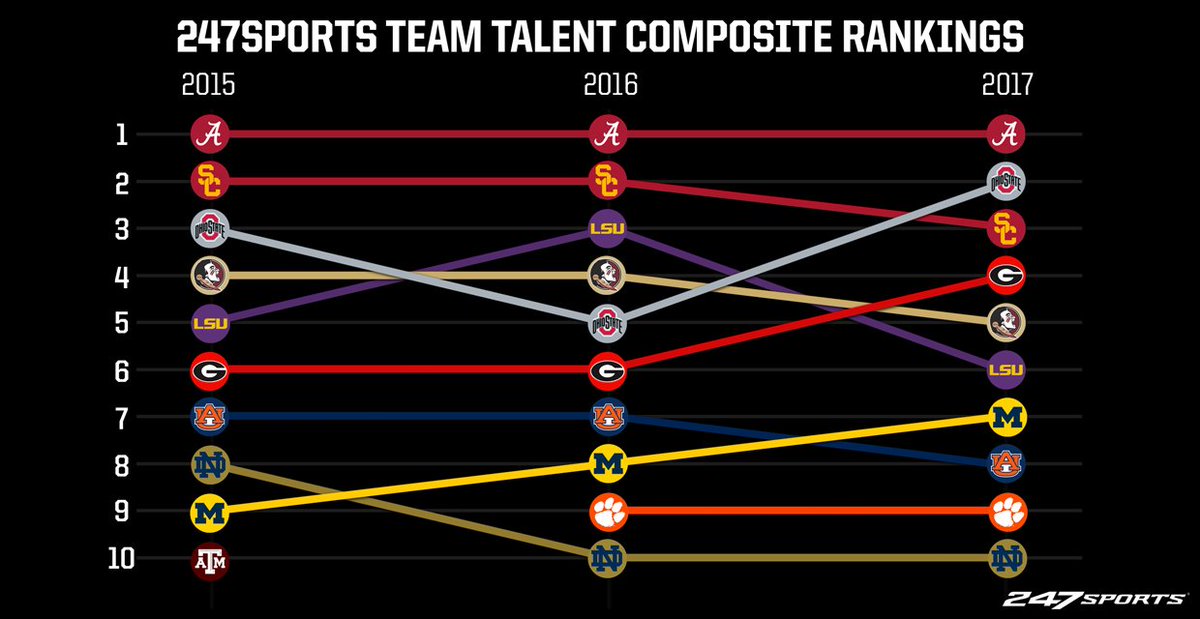
As for Florida State, the Seminoles grade out with 924.97 points and 10 five-star recruits; the latter mark is more than No. 2 Ohio State and No. 3 USC. Despite slipping in the Team Talent Composite rankings, Florida State in fact has a much higher score than it did in 2016 (902.46).
Two Florida State University alumni are committing at least half a million dollars over the next five years to help the College of Social Work establish a new center to benefit communities, families and children.
The Center for the Study and Promotion of Communities, Families and Children will be created with support from The Stoops Family Foundation Inc. Beginning in September, the center will receive $100,000 a year for the next five years from the foundation started by Aggie and Jeff Stoops.
The foundation also committed to matching up to $75,000 in charitable contributions made to the center each year.
“This is a transformative gift that will significantly ramp up our ability to accomplish significant research, education and service,” said Jim Clark, dean of the FSU College of Social Work.
The center was created to serve as an umbrella organization for several of the College of Social Work’s initiatives and centers. Clark said he hopes to enlist others to contribute to the work of the college’s latest endeavor.
The center will oversee the operations of the Institute for Family Violence Studies, the Trinity Institute for Addictions, the Multidisciplinary Evaluation and Consulting Center and other college resources. This fall, the College of Social Work will establish the center’s advisory council and hire its executive director.
Aggie and Jeff Stoops and the Stoops Family Foundation are longtime supporters of Florida State University and the Seminole Boosters. In 2004, Aggie and Jeff endowed two professorships, one at the College of Law (the Jeffrey A. Stoops Professorship) and another at the College of Social Work (the Agnes Flaherty Stoops Professor in Child Welfare).
In 2015, the Stoops Family Foundation endowed a scholarship program at the College of Law for exemplary students committed to pursuing business law.
Aggie and Jeff Stoops are both two-time graduates of Florida State. Aggie earned her bachelor’s degree in social work in 1982 and completed her master’s degree the following year. She is the chairwoman of the board for the Stoops Family Foundation, a private organization focused on medical, social services, educational and children’s causes.
Aggie also serves on the board of directors of HomeSafe, a South Florida-based nonprofit organization focused on protecting and advancing the interests of victims of child abuse and domestic violence.
Jeff Stoops earned a bachelor’s degree in political science from FSU and went on to receive his law degree from the FSU College of Law in 1984. He serves as president and chief executive officer of SBA Communications Corporation, an S&P 500 company based in Boca Raton.
Ruby Diamond Concert Hall is a historic auditorium that was first built in 1911 and serves as the primary performance venue for Florida State University in Tallahassee. With a capacity of about 1,200 seats, the state-of-the-art facility supports a wide variety of university and community performances and events. I recently spoke with F.S.U.’s Specialist in the Arts, Mike Shapiro, about upgrading the historic hall with a new Avid VENUE | S6L system.
Mike Shapiro at front of house with their recently-installed S6L (photo by Bill Lax)
DH: Tell me about what challenges you were facing before you acquired the S6L. What was the process by which you decided on the new desk? MS: The F.S.U. College of Music completed a major renovation of our concert hall about six years ago and the console we had at the time was limited for the productions we were doing. Eventually, we’d need something more robust and rider friendly. We were looking for something that had deeper capabilities and something that could handle the larger more demanding productions. Our musical events range from classical to rock to jazz to opera. With such diverse productions it was crucial to find something that was more flexible and had adaptability to produce whatever show was booked for that particular day.
We started looking around for a desk that could fill that void. I went to InfoComm 2015 in Orlando and was looking at several consoles. Avid had just announced the new S6L line so I had to check it out. While I was comparing the different consoles, the search kept leading back to the new S6L. The desk was in a beta type state and the Avid team was still working hard on it but you could tell it was going to be a great addition to the Venue line. Another deciding factor was a seamless integration with our [Pro Tools] HD rig. We use a lot of Dante devices from Focusrite’s RedNet line and it was paramount that the new console fit in to our current infrastructure. Plus, we really wanted to boost the sample rate to 96KHz. The S6L was exactly what we were looking for. I don’t want to say we got lucky because I trust Avid products. We ended up purchasing an S6L 32-D with the E6L-192 engine in the summer of 2016. We also upgraded the E6L with (2) AVB cards, a MADI card and expanded the Stage 64’s I/O.
Ruby Diamond is a medium-size, 1,200 seat performance concert hall that serves as one of the main performing arts venue for community (photo by Ray Stanyard)
DH: What kinds of acts and events do you support at Ruby Diamond Concert Hall? MS: Our College of Music orchestras, wind ensembles, bands, choirs, opera, world music and jazz programs perform in the hall year round as well as national touring acts. The University performing arts series brings in guests such as Yo-Yo Ma, Tony Bennett, Jazz at Lincoln Center (with Wynton Marsalis) and Smokey Robinson. We also host a lot of non-musical events such as dance productions, graduation ceremonies, guest lecturers, film screenings and various student organization functions.
Ruby Diamond also serves as the main performing arts venue for community organizations that do not fit in the Civic Center, amphitheaters or smaller clubs. We’re a medium-size, 1,200 seat performance hall, so anything in that audience size, comes here.
(photo by Ray Stanyard)
DH: Do you archive all performances—what all do you use the desk for besides mixing the performances? MS: The College of Music archives the final mixes in our music library. I also back up the complete session files in two separate archives. I haven’t used the console for anything beyond live performances to this point, but I can see definite advantages of remixing through it. Also, the virtual sound check is something I plan on utilizing in the very near future to hone mixes.
The S6L and Venue software is super flexible. That was what we were looking for and it’s handled all of the punches we’ve thrown so far. It has thoroughly exceeded our expectations with more features still to come. Avid really knocked it out of the park with the S6L, and I feel like I’ve just scratched the surface.
From the beginning, medical students at Florida State University’s College of Medicine have been trained to be part of their patients’ medical team. Starting now, the college is training other members of that team as well — as the doors officially open for the School of Physician Assistant Practice.
“What is unique about the PA program is that you get an opportunity to have this interdisciplinary team early on in training,” said Assistant Professor Susan Salahshor, who also is president of the Florida Academy of Physician Assistants. “It affords us that ability to help them be better team-based professionals because the med students and PAs are here together and are developing a rapport with each other.”
Physician assistants work under a physician’s supervision and in close partnership with nurses, physical therapists, occupational therapists, behavioral health professionals, administrators and others. At FSU, students will spend 27 months learning within the same network of faculty physicians who teach FSU medical students.
“The community aspect of this program really drew me here,” said student Annaelle Scanlan. “We have a learning community where we can all be together. And in addition to that, we have the opportunity to work with med students, which is important since we will be working with them the rest of our lives. It’s nice that we get to interact with them — and we can see what they go through, and they know what we go through — to prepare us for working together in the future.”
Since its creation in 2000, the College of Medicine has addressed the need for more physicians in Florida, especially those who will serve in primary-care specialties and work with elder, rural, minority and underserved populations. PAs will provide another layer of primary care, further strengthening the medical school’s commitment to its mission.
“The Legislature, visionaries and pioneers for our program recognized that the Panhandle and other parts of Florida are underserved areas for providers,” said Ben Smith, director of Didactic Education. “Our focus is to help address that need.”
Students in the program are heavily recruited out of Florida with the hope that they’ll stay and practice in underserved communities within the state. Scanlan, for example, came from Ave Maria, a small town near Immokalee in southwest Florida.
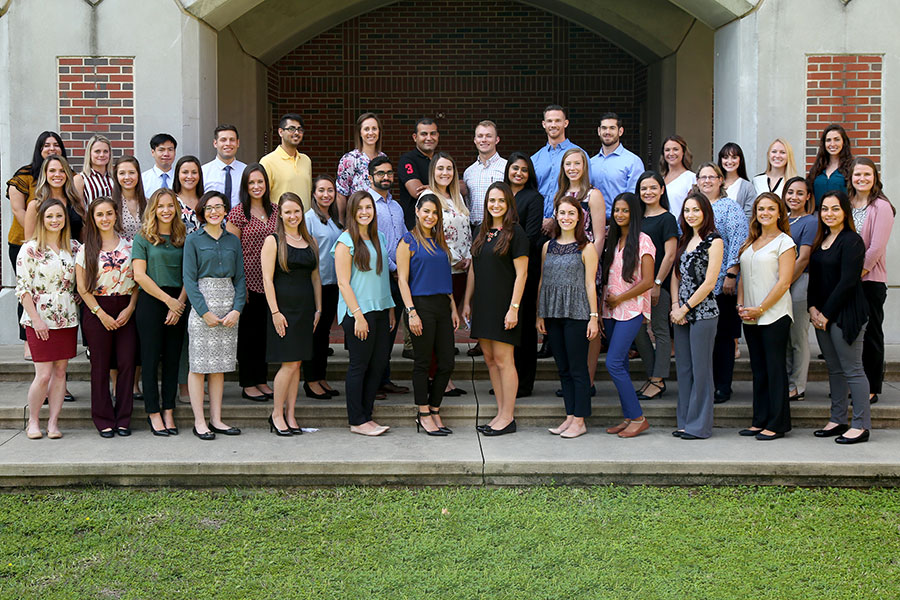
FSU welcomed its inaugural class of 40 PA students for orientation Aug. 22. Enrollment is scheduled to increase to 50 next year and then be capped at 60 thereafter.
The program’s structure is similar to that of FSU’s M.D. program. In their first year, PA students will build a strong foundation in biomedical sciences through courses in anatomy, physiology, pharmacology and nutrition. During their final year, they’ll complete clinical rotations at one of the medical school’s six regional campuses. Through an apprenticeship model, they’ll work one-on-one with a physician or PA throughout each rotation.
“Community-based medical education — as opposed to almost entirely hospital-based education, as most medical schools do it — has been very successful at providing a high-quality clinical education to our M.D. students, and at helping to influence our graduates to eventually practice in these communities,” said College of Medicine Dean John P. Fogarty. “The PA program is built along the same principles, and we expect similar results. We’re excited to have PA students helping us achieve our mission.”
The first FSU PAs will graduate in December 2019 with a Master of Science in Physician Assistant Practice. They’ll then be eligible to sit for the Physician Assistant National Certifying Exam and apply for state licensure to begin practice.
The PA students at FSU are new, but the program has been in the works for several years. Jim Zedaker, its founding director, arrived in January 2016 and began building the program and undergoing the rigorous process involved in accreditation. Provisional accreditation was granted in April of this year.
“The accrediting agency noted that we had zero areas of noncompliance with the accreditation standards, which is a testament to everyone at the College of Medicine,” Zedaker said.
There’s a lot of demand for these PA slots. While the accreditation process was underway, more than 800 prospective students applied to a PA school that — at the time — existed only on paper. The program is on pace to more than double the number of applicants next year.
“I think people had faith seeing the program’s progression as we’ve gotten started — and knowing the reputation of Florida State and the College of Medicine gave them more confidence,” Zedaker said. “It’s all about building a reputation and letting people know who we are. My goal is for this to eventually become a top nationally recognized program.”
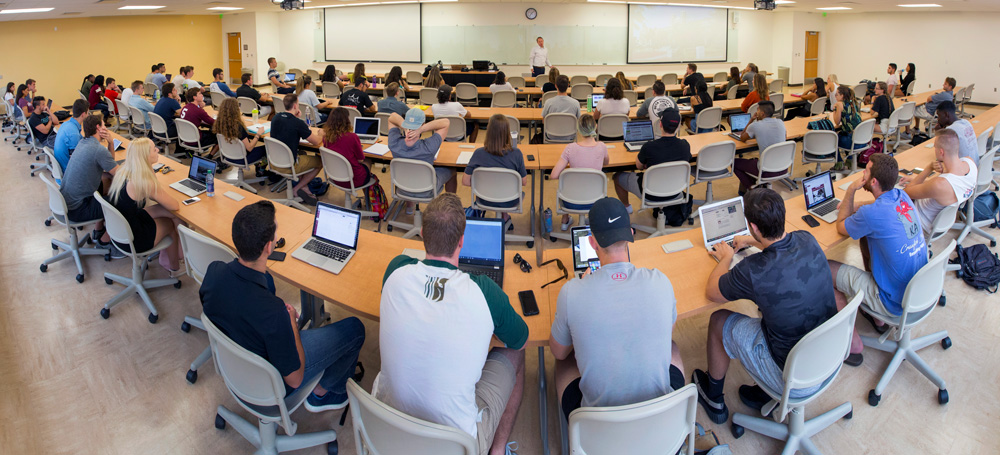
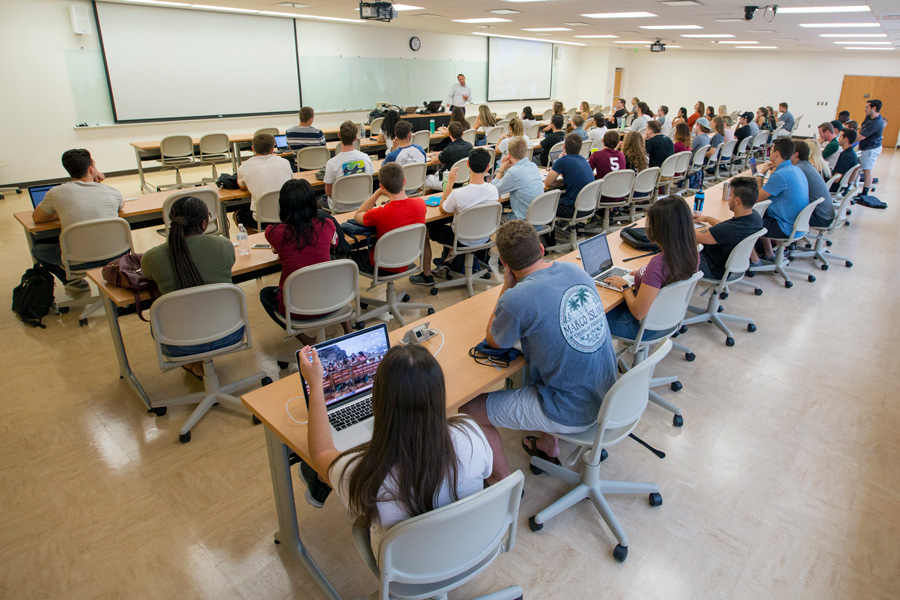
The first class of the Jim Moran School of Entrepreneurship is held on Monday, Aug. 28, 2017, in FSU's Health and Wellness Center. It is the first and only entrepreneurship program in the nation operating outside a college of business at a public institution. (FSU Photography Services)John Breed just couldn’t stay away.
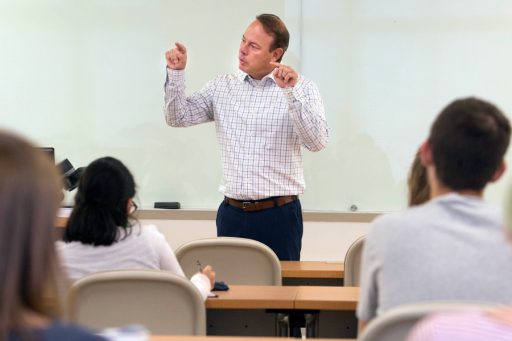
The former Florida State University entrepreneurship faculty member, a successful entrepreneur himself in the private sector, is back teaching at FSU after working the past year at a large IT company. John Breed returned to teaching at FSU because of the unique opportunity to build the Jim Moran School of Entrepreneurship from the start. “This is an opportunity to create inside a large university setting, so how could you not be excited?” (FSU Photography Services)
The opportunity to help launch FSU’s Jim Moran School of Entrepreneurship was irresistible for someone with an entrepreneurial penchant like Breed.
“We like startups and new ventures, so how could you not be excited,” Breed said. “I came back to teach because of the positive impacts you can have teaching entrepreneurship and innovation. I could not think of a better, more fun academic setting to be in.”
The Jim Moran School of Entrepreneurship welcomes its first class of 80 juniors this fall, including several at the FSU Panama City campus. Sixty students enrolled in the commercial entrepreneurship major and 20 selected social entrepreneurship.
“We’re off to a fabulous start,” said Professor Susan Fiorito, school director and entrepreneur in residence. “Students are registered, faculty members are excited, classrooms are booked. It’s our own creative and innovative company within the university. It’s a machine now, and we’re moving forward. We built this.”
Florida State built the Jim Moran School with the help of a record $100 million gift from Jan Moran and The Jim Moran Foundation in 2015. Over the past year and a half, faculty members and entrepreneurs developed a unique core curriculum designed to prepare students for real-world challenges in their own businesses and existing companies.
Fiorito has helped transform the program from just an idea — a vision of entrepreneurial education from the late Jim Moran and his wife, Jan — to a dynamic school that becomes the first and only in the nation operating outside a college of business at a public institution.
That distinction gives the Jim Moran School a clear advantage in the educational marketplace.
“Operating outside FSU’s College of Business, we can accept more students,” Fiorito said. “The college had to restrict its number of entrepreneurship students because it had a limited amount of resources and room for faculty and programs. To grow the entrepreneurship program, we had to be our own entity. Now we can keep building to serve many more students.” Breed says it’s often the little conversations with students that can have a big impact. “You have opportunities to help students pick up skills and, more importantly, maybe make some better decisions on the front end of their careers. Wow. And you get paid for it. Are you kidding me?” (FSU Photography Services)Rachel Collins is one of the students in the first class. Both of her parents are entrepreneurs — her mother owns a human resource consulting firm and her father owns a chain of physical therapy clinics — so entrepreneurship is kind of like the family business.
Collins understands and appreciates the entrepreneurial mindset, which she sees in professors and peers in the Jim Moran School of Entrepreneurship.
“The program surrounds you with people who are just as driven as you are,” Collins said. “They are real winners with the same kind of passion and drive to create their own value and wealth in the world. That’s so unique.”
Incoming classes will continue to grow each year. By 2022, the program expects to have a total of 500 students. The current staff includes five full-time faculty members, more than 25 entrepreneurs in residence across campus and other instructional faculty.
The ultimate goal is to make the Jim Moran School the best school of entrepreneurship in the nation.
“We’re reaching across the university and the community to teach our courses where there is an interest and a need,” Fiorito said.
Fiorito has guided the program to an early start. Under the original terms of the $100 million gift agreement, classes were not scheduled to start until fall 2018.
“We’re starting with two majors,” Fiorito added. “Hopefully by the fall of 2018, we’ll have three majors and more minors.”
Kirsten Frandsen, the school’s program coordinator, is fielding lots of calls from students and parents. Most ask about the difference between an entrepreneurship major and a more traditional one in the College of Business, such as accounting or finance.
Frandsen tells them entrepreneurship offers broader business training and it’s available to anyone. Students in any major can learn how to run an entire business.
“We teach them innovative thinking so they can see a problem and figure out a solution on their own,” Frandsen said. “We teach them entrepreneurial thinking in a more hands-on way than has been done in the past. Students are required to build their own business so they get that experience and also learn from their successes and failures, instead of just reading about it in books.”
To learn more about the Jim Moran School of Entrepreneurship, visit http://jimmoranschool.fsu.edu/