This is an interesting read. Many will take it as good news. And there is some....but there are some concerning issues as well:
"above the profitable, if disappointing, baseline set by the Pac-12 Network."
Not exactly a warm fuzzy. If anywhere near the B1G, then, yes, great news. Just way too much uncertainty for a network taking a decade to create. Thought with that much time, the whole point was less uncertainty.
Just doesn't smell right.
https://www.forbes.com/sites/chrissmith/2017/05/10/even-as-espn-cuts-costs-an-acc-network-could-be-money-well-spent/#40035d9a4cea
Some of the biggest news coming out of the sports world has nothing to do with what's happening on the field, but rather with the biggest network covering it. ESPN recently laid off
around 100 of its employees, many of whom were long-time and well-regarded staffers. The terminations are purportedly a cost-cutting measure for the sports media empire that has committed billions of dollars to TV rights agreements but is watching as
subscribers flee in record numbers.
My colleague Maury Brown has provided a
more detailed breakdown of the issues at hand, but that unfortunate situation - huge longterm TV contracts coupled with falling subscribership - has put ESPN in a position where it may need to start curtailing its future TV rights spending. And that brings us to the ACC Network. Last summer
it was announced that ESPN and the ACC would partner on a new, conference-specific cable network that will launch in August 2019. But some have begun wondering if ESPN's latest round of layoffs might indicate a possible lack of commitment toward investing in the planned network.
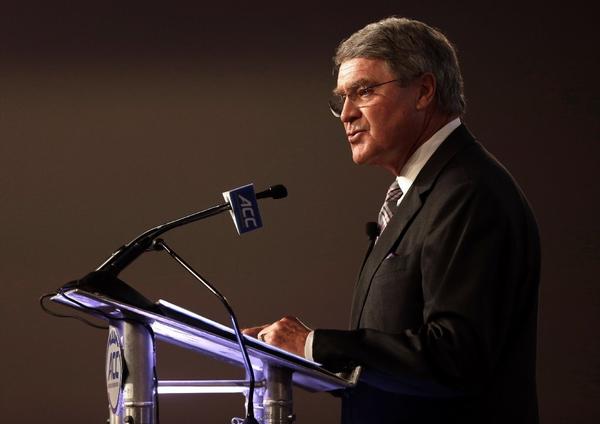
ACC commissioner John Swofford has
reassured conference members that ESPN intends to proceed with its ACC Network plans, and an ESPN spokesperson tells
Forbes that nothing has changed: "Both sides remain committed to launching a dedicated platform for ACC fans in 2019 as previously announced and as planned." Whether or not that turns out to be true - it seems to be an
ongoing debate among those in the know - the ultimate question that remains is whether it's a smart idea for ESPN to provide financial backing to a new TV property. We're in no place to tell the future, but some current indicators suggest that while the ACC Network may be a risky venture - ESPN will own the property and thus be responsible for all expenses and potential losses - it may not be such a bad bet.
Right now three college conferences, the SEC, Big Ten and Pac-12, have their own conference-specific cable networks. The SEC Network (wholly owned by ESPN) and Big Ten Network (owned near-equally by Fox and the Big Ten) have both been tremendously successful thus far, and we estimate that network distributions from both have put the SEC and Big Ten
in a class of their own even among the Power Five. The Pac-12 Network, meanwhile, has struggled to meet expectations. It's profitable, but just barely: Pac-12 schools received just $1.4 million apiece in 2015. It's still not available on DirecTV, and there
has been talk, even from a Pac-12 athletic director, about selling a stake in the network (the conference owns 100% of the property and is thus on the hook for all expenses).
So how does the ACC stack up against its conference peers? To find out we looked to football, which moves the needle far more than any other sport. Thanks to the folks at
Sports Media Watch, we were able to compile viewership figures for
every nationally televised regular season college football game over the last two years. We then averaged each school's national TV viewership numbers to get a sense of its general popularity:
On the whole, average ACC team viewership is a fair bit behind both the SEC and Big Ten. The ACC's top team, Clemson, would rank fifth in the Big Ten and seventh in the SEC. A simple glance at the above chart would suggest that an ACC Network would land somewhere between the Big Ten Network and Pac-12 Network in terms of national demand - not a bad place to be, but hardly reason enough for ESPN to pony up millions of dollars at a time when it's trying to scale back.
But what's important to note is that conference networks carry third-tier games, or the match-ups that have been passed over for national broadcasts. In other words, the best of the bunch are rarely available, so it's the less popular teams that will get the most real estate on a conference network. Alabama, for instance, played just one game on the SEC Network last season - a 48-0 drubbing of Kent State - while Vanderbilt played seven.
For a conference network to succeed, then, it requires a depth of drawing power. It's little surprise that the SEC thrives in that category - Kentucky, Missouri and Vanderbilt are the SEC's least-watched teams, but all would all be around the middle of the pack in either the Big Ten or ACC. That depth may help explain why the SEC Network had little trouble picking up distribution, and the network now counts 62 million subscribers according to Disney's most recent annual report (Disney owns 80% of ESPN).
What may be surprising, however, is that the Big Ten and ACC actually look pretty similar from the waist down. In fact, the bottom eight teams for each conference have an average viewership of 1.4 million per game over the last two seasons. Ohio State and Michigan are both massive draws, but they played just a single conference game apiece on the Big Ten Network. The Big Ten's six least-watched teams, on the other hand, averaged nearly five games each on the conference network.
That's of course not to say a dedicated network for the ACC would instantly match the success of the Big Ten's. Last year the Big Ten Network still aired eight games that featured one of the conference's top four teams, each of which would lead the ACC in average viewership. Plus it's worth noting that the ACC gets a boost here from five guaranteed games against Notre Dame, one of the nation's most popular teams. None of those games against the Irish will migrate to the ACC Network, since every Notre Dame game is typically broadcast nationally.
But the ACC doesn't appear to be too far behind its Midwestern peer, and the numbers above are hardly the full story. We've limited our scope to football, and many will be quick to point out that the ACC is mainly a basketball conference. That's no cure-all, since basketball draws far fewer viewers than football and the top teams will again largely play on national TV, but it would suggest the above numbers likely fail to fully represent the ACC's drawing power. Plus the ACC brings some major markets to the table, with schools in Boston (No. 7 TV market in the US), Atlanta (No. 8) and Miami (No. 16); other ACC markets, like Raleigh and Louisville, are packed to the brim with college sports fans. That's an important factor - the Big Ten brought on Maryland and Rutgers in 2012 largely
because of their home TV markets.
The ultimate takeaway here isn't that an ACC Network is a sure thing. After all, it seems there's no such thing these days, with even the untouchable NFL starting to feel the effects of cord cutting. But it's also hardly a doomed property. The ACC clearly stacks up well against the Pac-12, so at the very least an ACC Network should live above the profitable, if disappointing, baseline set by the Pac-12 Network. And it looks far more likely that it could approach what the Big Ten has accomplished. So despite ESPN's apparent desire to cut costs, funding the ACC Network could be money well spent.
http://www.charlotteobserver.com/sports/college/article150545082.html
Here's a look, though, at potential talking points over the next few days:
1. The state of the ACC Network given ESPN's continued (relative) struggles.
At these same meetings last year, ACC officials and ESPN executives arranged a
covert-ops-like rendezvous at the Ritz, where over several secret meetings-within-the-meetings, they wrapped up a deal to at least announce the creation of the ACC Network, which will launch in 2019.
We know the network is coming in a few years. Swofford, after all, recently sent a statement to each of the league's 15 schools to reassure them that the channel will in fact launch, despite ESPN's continued troubles. Even so, ESPN's troubles are real, indeed, and are perhaps growing.
The network recently laid off approximately 100 employees, many of them high-profile television personalities and/or writers with whom ESPN’s audience had long grown familiar. To many in the sports journalism industry, the news and sight of those layoffs provided a cold reality that there is no safe haven – not even ESPN – in today's rapidly changing media world.
The layoffs, which came after years of declining revenue while ESPN continues to lose subscribers as consumers cut their cable packages, raise questions about ESPN's future, its business model and how it will continue to cover what it covers. As it relates to the ACC, we know the ESPN-backed ACC Network is coming in 2019.
Beyond that, we don't know much about how such a channel will work, what it will be filled with (aside from the obvious) and how the ACC and ESPN plan to position it for maximum success in a digital world that's evolving by the day. We're only a couple of years away from 2019, but the way the public consumes live sports could change dramatically between now and then – and that will continue to change.
2. Is the college sports bubble about to burst?
The fact that these meetings are held annually at the Ritz – where you, too, can reserve a room tonight for, oh, $509 – tells you all you need to know about the health of major college sports. Business continues to boom while the money continues to roll in (and even if it wasn't all too rosy, these meetings would likely go on at the Ritz, anyway, as has become the tradition).
There are signs, though, that the college sports bubble is about to burst. Wall Street 2008 this is not. And remember: the ACC's deal with ESPN is set for nearly the next 20 years – through 2036. But if college sports were a stock right now, would anyone be buying? Or has the financial growth reached such a massive high that the only place to go is down?
As we've learned recently, not even ESPN is immune to difficult financial realities, and the vitality of the network gives life to its broadcast partners. For a while now, life has been good. Television revenues have continued to grow, and that growth has created wealth in college sports that might have been unimaginable a decade ago.
But now there isn't as much growth. ESPN is trying to figure things out. The money tree that has been ever-growing rights fees is attempting to stay upright in a storm that's likely to only become more fierce. The media landscape is changing dramatically, and when your business model is built on profiting from huge media rights deals, that's problematic.
The question is where any of this goes from here, and that’s a question that’s impossible to answer. For now, at least, it appears as though the days of massive, skyrocketing revenue growth are over. And that could lead to an uncomfortable reality for people so accustomed to their business simply printing money.
3. The state of college basketball in an evolving media world.
The recent layoffs at ESPN educated us about a lot of realities in sports media these days and one of them was this: the network cares less and less about college basketball coverage. There's simply no other way to spin it, based on the people the network decided to let go.
ESPN laid off the core of its college basketball reporting team. Sure, the network is still going to cover games. It will still promo the North Carolina-Duke rivalry endlessly when it's time to do that, and it'll still broadcast championship week from tiny gyms around the country. But it's clear, too, that ESPN won't emphasize college basketball coverage the way it has in the past.
Maybe that's a problem for the ACC and maybe it isn't. This is a league, though, that was built on college basketball – and one that has attempted to stay true to those roots as much as possible in this football-first world. The moves ESPN made have to be of concern for the league's basketball coaches, especially for those who aren't as high-profile, perhaps, as Roy Williams or Mike Krzyzewski.
Those guys would probably be OK with less of a media spotlight. There are others, though, who embrace coverage and depend on it, to a degree, because their programs need the attention. Now there are several fewer national college writers and reporters to provide it and, beyond that, ESPN's personnel decisions show that day-to-day college basketball coverage isn't a priority.
That's bad news for a sport that has already become a distant afterthought to football.
4. How to capitalize on the league's football emergence.
You can make an argument that the ACC is the best football conference in the country. Five years ago that would have been a laughable assertion to make. About seven or eight years ago, when the league was struggling to win prominent bowl games, you could have more reasonably argued the conference was on the brink of collapse (though those arguments were always silly, as well).
The question now is how the ACC further strengthens itself in football. The most important part of that equation can only happen on the field. There are other things the league can do, though, to help. David Teel reported the league this week
will likely discuss enhancing the Week 1 football schedule in effort to provide a more enticing product in time for the launch of the ACC Network.
Speaking of scheduling, I'd take this a step further: The ACC should follow an SEC-like scheduling model in which some of the games are played year after the year at the same point in the schedule. Florida and Tennessee, for example, always play on the third Saturday in September. Alabama and LSU usually always play during the first week of November. In time such familiarity breeds tradition.
The ACC also has to figure out a way for cross-divisional teams to play more often. The league didn't discuss this at the spring meetings last year, and might not this year, but the lack of cross-divisional action – outside of the designated rivalry game – hurts the ACC's ability to develop compelling conference games.
Take UNC's dramatic victory at Florida State last season, for instance. It was thrilling, captivating theater, with Nick Weiler making a 54-yard field goal as time expired. When the kick sailed through the uprights, Weiler tomahawk-chopped his way around the field while his teammates chased him. Undoubtedly the Seminoles will have that on their minds during the rematch in … 2021.