Tuesday, April 7, 2015

ACC To Make Almost $35 Million from 2015 NCAA Tournament


This is good news for the ACC.....unfortunately, the basketball centric ACC won't likely put it into context.

Here is what I mean....."That’s $5.78 million per year for the conference".....by comparison, the college football playoff provides $50 million per year for the conference......not counting ANOTHER $6 million for a participating team.


This is a good thing for the ACC.....I just worry the conference sees it as affirmation to the focus on football, when it only highlights that even a historically rich reward, by NCAA Tourney standards, is peanuts compared to an average football year.

It is about football...end of story.


ACC To Make Almost $35 Million from 2015 NCAA Tournament


"This year’s big winner among Power 5 conferences in money earned from the NCAA Tournament is the ACC. The conference will make about $35 million in the next six years for their performance in this year’s tournament.
The NCAA distributes money to conferences based on how their teams perform in the NCAA Tournament over a six-year rolling period. In any given year, the NCAA pays a conference an amount of money known as an “NCAA Tournament Unit” for each game the teams from a conference play in the tournament in the most recent six years. (Championship games are excluded.)
This year, the value of an NCAA Tournament unit is $260,525, per this Forbes article by Chris Smith. So, for example, if ACC teams have played a total of 89 games in the last six NCAA tournaments (a made-up number, so no criticism in the comments field, please), the conference will receive a check for 89 x $260,525, or about $23.2 million.
This year, teams from the ACC played in a total of 21 tournament-unit eligible games. For the next six years, the NCAA will pay the ACC 21 times the value of a tournament unit, for their performance in the 2015 tournament.
The value this year is $260k, but that value goes up every year. According to Chris Smith’s article linked above, a single tournament game played will be worth a total of $1.65 million to the ACC over the next six years.
Multiply that $1.65 million times 21, and you get that the ACC will be paid about $34.7 million over the next six years for their 2015 tournament units. That’s $5.78 million per year for the conference, or an average of $385,000 per year for each of the conference’s 15 schools over the next six years. Multiply $385k by six, and you get a total value per school of $2.31 million over six years.
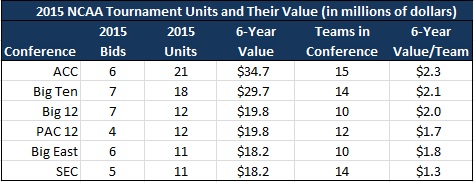
Here are the number of NCAA Tournament units earned (number of tournament games played, excluding the championship game) by each of the Power 5 conferences (and the Big East, since they received six bids) this year, and the estimated total value over the next six years of those units. The total value is then divided by the number of teams in the conference, which gives the total value per team over the next six years.
2015 NCAA Tourney Units
The only conference to come close to the ACC in total dollars was the Big Ten, which of course sent two teams to the Final Four (Michigan State and Wisconsin). And even after you factor in the number of teams in each conference, the per-school take by the ACC exceeds every other conference.
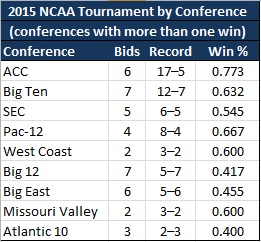
What about performance on the court? Follow the money: the ACC didn’t have the most teams in the tournament, but it had the most wins (by far) and the best record (table copied from Wikipedia).
2015 NCAA Tourney Record by Conference
Teams in the ACC have now won four of the last seven NCAA Tournaments.
  • 2009: North Carolina
  • 2010: Duke
  • 2013: Louisville (members of the Big East at the time)
  • 2015: Duke
ACC teams will, of course, be strong contenders again in 2016. ESPN bracketologist Joe Lunardi has released his first bracket for 2016, and it features seven ACC teams, including two #1 seeds: Virginia and North Carolina. Other ACC teams Lunardi projects to make the tournament are Duke (2 seed), Notre Dame (5), Louisville (5), NC State (6), and Miami (7)."

Monday, April 6, 2015

FSU draft record?


Perry Kostidakis @perrykos 26 minutes ago
nice little tidbit from punt pass and pork, on if FSU gets 11 players drafted


Embedded image permalink

Friday, April 3, 2015

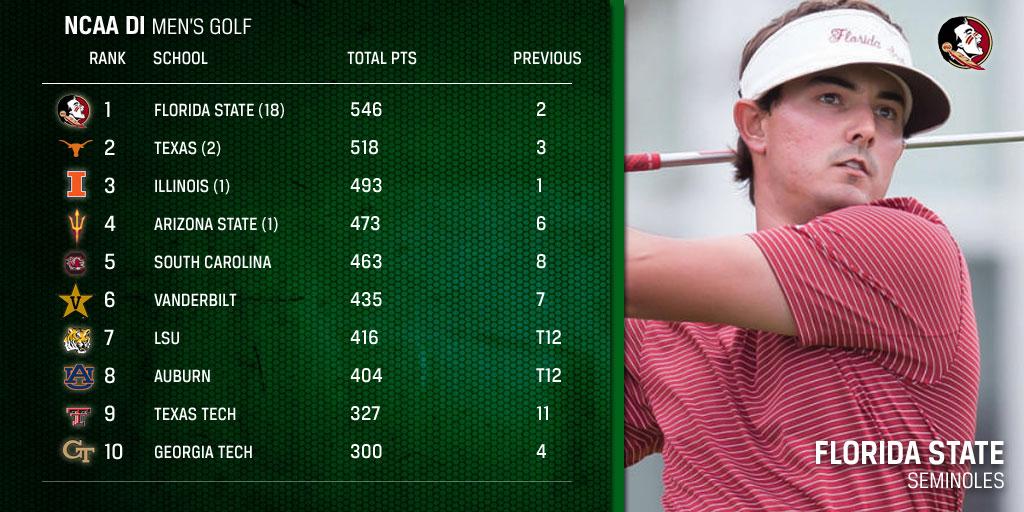
FSU Golf #1


Embedded image permalink

The Cinematic Railroading of Jameis Winston


The Cinematic Railroading of Jameis Winston


"The Hunting Ground joins the movement to ruin a man’s career for the sake of an ideological agenda. A movement is afoot to destroy the career of a young black man whom a young white woman with overwhelming, well-documented credibility problems has accused of raping her. Three separate investigations, including a Florida State Code of Conduct hearing, have found former Florida State quarterback and Heisman Trophy winner Jameis Winston not to be a rapist. But now The Hunting Ground, a much-touted documentary on campus sexual assault, features his previously anonymous accuser presenting her case publicly for the first time. Senator Claire McCaskill (D., Mo.) has warned that NFL teams had better “watch this movie before they draft him.” The movie, co-produced by CNN and created by Emmy-winning director Kirby Dick and Oscar-nominated producer Amy Ziering, has already aired at the White House, the Sundance Festival, many campuses, and in New York and Los Angeles. It will air on March 13 in other major cities, including Washington, D.C. The film’s longest segment — 15 full minutes — is designed to prove that Winston raped former classmate Erica Kinsman and got away with it because of bad police work and college administrators’ greed and favoritism toward football stars. The film “throws down a challenge of a sort for the National Football League with a not-so-subtle suggestion that teams should think twice about drafting one of the top college prospects, Jameis Winston,” as the New York Times enthused. The 103-minute film shows dozens of college women telling heartbreaking stories of being raped by male students and then further victimized by callous college officials who, the film alleges, cover up the crimes to avoid bad publicity. Campus rape is a serious problem, and the film helps activists gain for it the attention it deserves. But the film also “traffics in alarmist statistics and terrifying assertions,” as Emily Yoffe details in Slate. Like President Obama, it uses “studies that don’t hold up to scrutiny” to claim that 20 percent or more of college women are sexually assaulted while in college. Careful research by the Bureau of Justice Statistics suggests that the number is closer to 0.6 percent. Still far too many, but hardly an “epidemic.” Indeed, the rape rate for college women is “significantly lower than the rate experienced by women that age who don’t attend college,” as the criminologist Callie Marie Rennison has noted. More to the point, it’s fair to wonder whether the exclusion from The Hunting Ground of facts that cast grave doubt on the credibility of Kinsman, the most celebrated alleged victim featured in the film, may be representative of the work as a whole. In making its case against Winston, the film conceals from viewers how Kinsman’s story conflicts with the physical evidence, other witnesses, and her own past statements. It also distorts why the three investigations all found that the evidence does not prove that Winston raped Kinsman. In these respects, the film is strikingly similar to the gross, systematic distortions of the evidence by the New York Times to portray Kinsman as a truth-teller and Winston as a clearly guilty rapist. The first investigation, by Tallahassee police, was deeply flawed by errors including the failure of investigators to find and interview a taxi driver who could have been a significant witness, failure to find and preserve possibly relevant videotapes, and failure to find out more quickly that the alleged rapist was Winston and seek a timely interview. The second investigation, however, by State Attorney William Meggs, was thorough and careful. Meggs publicly concluded that Kinsman was not “a witness that we believed we could put on the stand and vouch for” — a polite way of saying she had little credibility. And in the third investigation, for Florida State, former Florida supreme-court justice Major Harding reviewed a file of more than 1,000 pages. After conducting a meticulous, thorough, and fair two-day hearing, he found that Winston’s claim that Kinsman consented to sex was as credible as her oft-revised claim that he raped her. The film does not disclose Meggs’s or Harding’s findings that Kinsman was less than credible, or the reasons for their conclusions, or the extent to which Florida State went to give Kinsman a chance to prove her case. In The Hunting Ground, Kinsman tells of going on December 6, 2012, as a Florida State freshman, to a popular off-campus bar where an unknown man gave her a “shot” of liquor that she believes was drugged. “I’m fairly certain that there was something in that drink,” she says, adding that it soon rendered her “incompetent.” Kinsman says she then remembers somehow finding herself in a cab with three men she did not know — Winston, his roommate, and a third football player. Next she recalls finding herself in someone’s (Winston’s) apartment, where “this guy was sexually assaulting me, he was raping me.” She says that she protested, “Please stop,” and that Winston’s roommate came through the broken bedroom door “saying, ‘Dude, stop, she’s telling you to stop.’” Then Winston carried her into the bathroom, locked the door, and raped her more violently there, pinning her arms down and pushing her face into the tile floor. But according to testimony ignored by the filmmakers, Winston’s friend says that he came into the bedroom hoping to join the sex and that, when Kinsman shouted for him to leave, he left. He and Winston’s other friend, also an eyewitness to part of the sex, said that Kinsman’s actions and statements showed clearly that she was a willing participant. More important, the film does not mention the critical fact that two different police-ordered toxicology reports of Kinsman’s blood showed that no known date-rape or other known drug (and not much alcohol) was in her system. The second test, done by the prominent Dr. Bruce Goldberger of the University of Florida pathology laboratories after Kinsman’s lawyer refused to believe the first, was negative for 172 different drugs and their metabolites. This virtually proves that Kinsman’s claim in the film that she was drugged was false, and she must have known it. Obviously she knew the test results. And obviously the filmmakers knew if they were the least bit careful. Also omitted from the film is the stunning fact that in her 28 pages of testimony to Justice Harding last December 2, she never suggested that she had been drugged or made “incompetent.” (Given the film’s release date, apparently her testimony came after her on-camera interview.) Perhaps these striking changes in her story reflect that on December 2, Kinsman was giving sworn testimony to a retired state supreme-court justice who knew from the toxicology reports that she had not been drugged. Indeed, Kinsman herself implied at the hearing that she had not been drugged. Also contradicting what she implied in the film, Kinsman at the December 2 hearing stated for the first time that “I’m pretty sure that the guy who gave me a shot of liquor” was Winston, and she omitted any implication that the drink was drugged. Describing how, outside the bar, she got into the cab with the three men, she acknowledged that she did so without protesting or resisting and that she proceeded to Winston’s apartment and into his bedroom. Kinsman testified that she got into the cab with the three men because she was “scared” of them. The film does not disclose Harding’s conclusion that this was less than credible given that she had entered the cab in front of a crowd of people and never sought any help. Nor could she cite anything Winston or his friends did to frighten her or force her to go with them. Then there is the stark contradiction — also entirely omitted from the film — between Kinsman’s initial report of an assault, which a friend phoned in on her behalf to Florida State police, and every one of Kinsman’s shifting accounts since then. The friend told police that Kinsman “said she thinks she was hit on like the back of the head,” kept “blacking out,” and had no recollection of how she got to Winston’s bedroom. The film starts playing the 3: 22 a.m. recorded phone report to campus police but omits the part about Kinsman’s being hit on the head. It’s not hard to imagine why filmmakers bent on portraying Kinsman as a truth-teller cut that out: In a report on her medical exam of Kinsman, a sexual-assault nurse made no mention of any sign of a blow to the head. Since then, Kinsman has never repeated that claim. Tallahassee police later reported that prosecution of Winston was unwarranted “given the conflicting statements between what the victim told her friends and what was reported to police.” (Kinsman and her friend suggested at the December 2 hearing that she had never told anyone she had been hit in the head and blacked out. The recorded evidence, and a separate Kinsman statement to another friend, suggest otherwise.) The film presents Kinsman saying that police “were watching bruises appear as I was laying in the hospital bed.” She and the filmmakers do not disclose that the sexual-assault nurse indicated in her report that the only recently incurred marks on Kinsman’s body (aside from mild vaginal redness and swelling, which the nurse said could have come from either consensual sex or an assault) were “mild redness on both . . . knees below the kneecap” and on the top of Kinsman’s right foot. As Justice Harding found, these red marks were at least as consistent with the claims by Winston and his two friends that Kinsman had been on her knees, voluntarily giving Winston oral sex, as with her story of a rape in which Winston pinned down her arms and pushed her face against the tile floor. There was, however, no finding of any recent bruising or lacerations to her face, arms, or genital area. Kinsman further tars Winston in the film by saying that a victim’s advocate told her that “we just want you to know that there’s another victim from him.” This appears to be a reference to an unidentified Florida State student who, according to the New York Times, did not accuse Winston of rape or sexual assault but rather sought counseling because she was upset about some unspecified experience with him. The film also omits the fact that Kinsman impeded the State Attorney’s investigation by refusing to tell an investigator the source of a second semen stain — not Winston’s — on her pants. The investigator had to divert time to find the source without her cooperation. It turned out to be a boyfriend who attended college in Ohio. The film makes no mention of Kinsman’s strong financial incentive to conceal the evidence supporting Winston’s claim that she consented. She had filed a lawsuit against Florida State for violating her civil rights and is expected to sue Winston for millions. Winston’s lawyers assert that in a phone conversation on January 14, 2014, Kinsman’s first lawyer, her aunt, Patricia Carroll, demanded $7 million, plus an insurance policy to pay Kinsman in case Winston got injured, in exchange for a promise that her client would never speak out publicly against Winston. Florida State president John Thrasher has denounced as false the film’s claim that he, among other university leaders, “declined to be interviewed for this film.” Thrasher said the filmmakers never notified him that the film would focus on Kinsman, Winston, and Florida State. We will probably never know exactly what happened that night between Winston and Kinsman. We do know that director Kirby Dick’s claim in one interview that “for us first is accuracy“ is far from accurate."

Factoid of the Day


Embedded image permalink

More stadium renovation info from Jerry Kutz


Re: Jam or Jerry....stadium question for ya.

"The night the stadium was opened in 1950, Bobby Bowden was the starting quarterback for Howard College (now Sanford).
Doak turns 65 this year and like a lot of us in our 60s is in need of more than cosmetic surgery.

She needs orthopedic work and some gastrointestinal as well. Doak is at that age where maintenance includes foundation work, rust abatement and other expensive repairs. What makes it so costly is that you have to remove all that electrical wiring and plumbing stuff up under the stadium in order to sandblast the rust before you can paint. The top side is relatively easy as all you have to remove are bleachers. The underside is very labor intensive.

We started looking at options three years ago with various stadium design/build teams including HKS who built ATT stadium, TCU and many others. We commissioned them to look at a comprehensive stadium plan, whether renovate or rebuild, and they came to us with several options that included partial and full replacement plans that each featured the endzone club seat project as the first phase, then a continuation of that design down the east and west sidelines.

The design/build team (EMI, Childers, Rosser International) that is building the Champions Club has designed it to be compatible with east and west sideline experience that will not block sight lines. While we don't know the time frame for when phase 2 and 3 will be viable, we wanted the plan to be in place for when that time comes. 

The good news is that much of the really expensive stuff in the stadium complex is built as part of the University Center Complex and would not have to be rebuilt, things like the pressbox and skyboxes are on top of the UCC buildings. The coaches offices and athletic center are free standing on the North Side and the University Center Club and Champions Club are also either free standing or will be built on solid structure.

All we need to do to renovate or replace is the metal structure in between those four buildings and concessions and bathrooms. That's still a big project -- most likely $60-70 million to renovate and about $200 million to replace -- but it would be far more if we had to include the skyboxes and all the other stuff.

There are two clear choices that the Boosters, Athletics Department, and President's office have to consider. The Board of Trustees asked if we had a plan for replacement as well as repair and we were able to answer affirmatively.

Money is always a factor. The state, nor the university, can spend money on an athletic facility so it comes down to funding the project privately through a bond issue funded by ticket prices, booster priority requirements and capital campaign gifts.

A painted stadium will improve the fan experience and help justify increased ticket and Booster priority requirements. A redesigned stadium would optimize revenue generation as it would allow FSU to add mid-level skyboxes and sideline club seats, which both drive a lot of revenue, and maximize capacity with more space per seat not to mention improved concession and merchandising space. There are financial models that point toward re-design which could be all new or part new and part renovated.

In either case, the optimum fan experience in our remote market, with our local infrastructure of hotels, roads leading to and from stadium, parking and airport is 70-75k capacity. It is challenging to get to that number when you meet all code requirements, ADA requirements and provide your fan with a wider seat and more leg room. 

We are pursuing the ultimate answer with the leaders in the industry. We don't have the bonding capacity to borrow all of the money that we need at once so we are approaching it in phases. Our Champions Club project is phase 1. The Board of Trustees scrutinized our pro-forma for that section before approving the plan which requires bond financing. The fact we had more than 1500 seats already reserved with cash payments at that time proved to the BOT that there is an appetite for premium seating from our fans. Having the money in hand spoke louder than past surveys. In June we go before the Board of Governors and the Legislature to approve the plan and the bonding. We now have more than 1850 seats reserved which will also demonstrate demand from our fans and help justify our projections.

If sales of Phase 1 continues to be successful it will encourage a more-aggressive vision. The sales process certainly has created many conversations with our customers, and prospective customers, and given us a true survey of what people want and what they are willing and able to pay for, not just what they say they want. The most accurate survey is when the customer has his pen and checkbook in hand.

We are making all the required safety improvements to Doak this summer for the upcoming season and plan to have a course charted later this summer as to a timeline for Phase 1 and 2.

The interim step is to repair and paint what we need to for 2016 while building and continuing to sell Phase 1 (Champions Club). As we sell phase 1 we will continue to asses interest for Phase 2 and fundraise for stadium enhancement.

Someone asked about adding inches to each seat as an interim improvement. Yes, that is being considered. While an improvement, it is a capacity eater, requires a re-seating, and does not resolve the knees in your back which we can't fix until we build a stadium with 30 inches or more between rows (re-design and re-build).

This decision is being made in every stadium across the nation, college and pro. Fans are demanding a "man cave" experience and will stay home if that is a better experience than the stadium experience. It fall's into that category: To not decide is to decide.

If you don't renovate or build,  you will lose customers and revenue and spend marketing dollars trying to replace them which in our minds makes the decision urgent."


"The new Champions Club gives us two new ballrooms bigger than the one we have now on the third floor (which will almost be doubled in size) so we will have the capacity to do a lot of things we've never been able to do before including business conferences. We're adding some 50,000 square feet of indoor space plus 32,000 square feet of covered rooftop terraces that are also awesome spaces. It will be one of the best rental spaces in all of North Florida and have a helluva view for Seminole related events.

Your ideas are among the ideas we have not only for the football weekend experience for Champions Club members and their guests but year round for all Boosters and UCC members and fans when space allows.

I see the possibility of the Champions Club becoming a 6,000 seat ampitheater during the year with the stage located about where the Marching Chiefs sit during the game. You'd have an amazing indoor/outdoor entertainment experience. There are many revenue-generating possibilities and with College Town right next door. With Seminole Boosters partnership with Club Corps of America (University Center Club) we can provide food and beverage year in the spaces year round.

Its going to be fun... and may be unique in college football.   "
Thursday, April 2, 2015

CLC Names Top Selling Universities and Manufacturers for Second Quarter of Fiscal Year 2014-15


CLC Names Top Selling Universities and Manufacturers for Second Quarter of Fiscal Year 2014-15


ATLANTA, Ga. – The Collegiate Licensing Company is pleased to announce its top-selling institutions and manufacturers for the second quarter of the 2014-15 fiscal year. These rankings represent royalties reported July 1, 2014 through December 31, 2014 on all collegiate merchandise sold.

Top 75-Universities

1. Alabama26. Arizona51. Georgia Tech
2. Texas27. Louisville52. Vanderbilt
3. Notre Dame28. Mississippi53. Pittsburgh
4. Michigan29. Washington54. Montana
5. Georgia30. Minnesota55. Louisiana-Lafayette 
6. Texas A&M31. Virginia Tech56. Rutgers
7. LSU32. Syracuse57. UCF
8. Florida33. Illinois58. Boston College
9.  Nebraska34. UCLA59. Fresno State
10. Tennessee35. Oregon State60. Wyoming
11. Auburn36. Stanford61. U.S. Military Academy 
12. Florida State37. California62. Northwestern
13. North Carolina38. Duke63. Montana State 
14. South Carolina39. Utah64. New Mexico
15. Oklahoma40. Virginia65. Georgetown 
16. Arkansas41. Washington State66. Texas State
17. Wisconsin42. Purdue67. South Florida 
18. Penn State43. Maryland68. Nevada
19. Missouri44. Connecticut69. Marshall
20. Texas Tech45. Cincinnati70. Villanova
21. West Virginia46. TCU71. James Madison
22. Clemson47. Colorado72. North Texas
23. Kansas48. Boise State73. Wake Forest
24. Oklahoma State49. BYU74. Gonzaga
25. Arizona State50. East Carolina 75. Delaware