Tuesday, April 14, 2015
Florida State's Jimbo Fisher has built an NFL pipeline in Tallahassee
Florida State's Jimbo Fisher has built an NFL pipeline in Tallahassee
"Jimbo Fisher looked out on the Dunlap Athletic Training Facility, surveying both what he had created -- and lost.
The circus that was the Jameis Winston-fueled pro day was packing up. Twenty-nine other Seminoles had a chance to preen before scouts. Like a high-end auction, if you didn't come away with what you wanted there were plenty of other items to choose from.
That's the beauty of Fisher's first five seasons. The pipeline is being restocked before it's emptied.
"We're not done with these young men until they go through their pro days," Florida State's coach said late last month. "[We're] never done with them. They're part of our family.
"If we have 10 drafted, we tie the record. If we have 11, we break the record for three-year period. To me that's a culmination of what we're trying to do."
Record? What record? It's not just the games or recruiting or spring practice or the fall at Fisher's FSU, it's also the draft now. The NFL's annual meat market summit that starts later this month will likely elevate the program to a new level.
This well-researched report suggests FSU's coach is on the brink of a talent-rich milestone.
Fisher has had 18 total players drafted over the past two seasons. With 11 more this year -- not an outrageous projection -- the Noles would beat out Miami (2002-04) and USC (2008-10) for most draftees in a three-year period (29). The Canes and Trojans had 28.
Why do we not think of Florida State today, the way we did Miami and USC then? It may that this dynasty is just getting started. Have we forgotten the Noles are one game removed from a 29-game winning streak?
Have we forgotten that Fisher is just getting started? The College Football Playoff semifinalist that lost Winston, its top receiver (Rashad Greene) and No. 2 rusher (Karlos Williams) also has a veteran defense returning infused with a top-five recruiting class.
In those five seasons Fisher has won one national championship, three ACC titles and 58 total games. The only comparison to be made is to the guy he replaced. Bobby Bowden was 44-14 in his first five seasons at FSU with a Tangerine Bowl win (as well as two Orange Bowl losses).
"They've capitalized and expanded upon the success," said Rob Rang, CBSSports.com draft expert. "Not many say that after following a legend. FSU deserves some credit how they built and kept it going on lot of the same principles."
There's an old saying in coaching: Never be the guy to follow the guy. Almost 4 ½ years after Bowden exited with a 13-point win over West Virginia in the Gator Bowl, Fisher is the man. Less a Nick Saban protégé, more a distinct flavor.
Fisher recently admitted NFL teams have reached out to gauge his interest. Never say never, he said diplomatically, but how could Fisher be any happier?
His team plays in a conference it can dominate, looking more like an SEC than ACC power. His program is one of the most pro-friendly in existence. It caters to recruits' most basic desires, winning championships and getting players to the NFL, quickly. As the projected No. 1 pick, Winston has less than two seasons' experience as a starter.
It doesn't matter in the minds of most here. He's ready. At least on the field.
"I never saw that stuff, whether it was immaturity I don't know," said longtime Fisher associate, Trevor Moawad, Winston's mental conditioning coach. "My interaction was on the field, the night before games, between the lines. We try to edutain - half educate, half entertainment."
The program is back. This is not exactly news but watching it happen reminds us of the degree of difficulty.
Less than a year removed from NCAA probation, USC played a game last year with 44 scholarship players. Penn State is still digging out from Sandusky hell. Oklahoma and Texas have taken dips. All FSU did was transition from the second-winningest all-time coach - we can argue about vacated wins later -- to someone who is establishing his own legacy.
The current record for FSU draftees in a three-year span is 22. It took Bowden 30 years to get to that point (2004-2006). Fisher matched that number in his fifth season.
"[Our players] go to the NFL with a system that still wins games," he said.
This year's 11 potential FSU draft picks have yet to be judged. Miami's three-year run included 15 first-rounders. USC had seven. Those were legendary teams. Miami had a 34-game winning streak stopped in 2002. Pete Carroll's last three USC teams produced two Rose Bowls and almost 30 draftees.
FSU has four combined first-rounders the last two years, five total under Fisher. This year we're talking up to five first-round picks, including Jameis. That includes defensive lineman Mario Edwards Jr. who appears to be killing it.
If the biggest raps on Fisher have been his vigorous defense of the misbehaving Winston and [lack of] victory margin last season, bring it on.
"You talk about Kentucky basketball and the ability to win the close ones," Moawad said. "but nobody viewed that positively as it related to FSU which I thought was fascinating. It was like it was a negative."
That was evident when the College Football Playoff Selection Committee dropped the nation's only undefeated team to No. 4 late in the season.
As for those draft classes they are best judged like wine, cheese and Justin Bieber's career. It's wise to let things age a bit. For now, Florida State is back on top. The brand is renewed.
If Jameis never wins a championship as a pro - or something worse -- he and his coach will have participated in an reawakening.
The circus has just started."

ESPN Ranks Jimbo Fisher #1 coach under 50
"Roughly half the 127 FBS coaches -- 47.2 percent -- are under the age of 50. Among the Power 5 conferences, 43.1 percent (28 of 65 coaches) are in their 30s and 40s.
Who are the best young coaches? In their final appearance in the best-under-50 list, the two coaches whose teams played for the BCS title two years ago have had the most success before their 50th birthdays.
FSU’s Jimbo Fisher and Auburn’s Gus Malzahn, who will both hit 5-0 in October, lead the conversation of the top coaches under 50.
1. Jimbo Fisher, FSU (49)
Fisher has his national title. He’s the best example of a coach-in-waiting situation that worked out well -- or as well as it can. In fact, the way Fisher handled -- and worked through -- the awkwardness surrounding Bobby Bowden’s final chapter is one of the finer points on his resume, right up there with the crystal football. How many people would have been able to survive that, let alone excel in the aftermath of the turmoil? Fisher did so nimbly. His recent assistant hires have also been outstanding, and that’s the mark of a good head coach.
4. Dabo Swinney, Clemson (45)
Chad Morris, the new SMU coach who was Clemson’s OC, said he learned a great deal from Swinney, in terms of how to make good, smart decisions as a head coach. “He does all the little things really, really well,” Morris said. It’s all pretty incredible, considering Swinney was thrust into the role as the interim after Tommy Bowden was fired. He had never even been a coordinator to that point and was only a few years removed from a real estate gig. Swinney, though, proved to be a natural in terms of management and consistent messaging and marketing. In today’s college football, those things are as important as they’ve ever been, and they're why Swinney (61-26) has been steady."
Friday, April 10, 2015
Top coaching records-wins per year over last 5 years
Ariya Massoudi
Top 5 (minimum 5 years):
1. Fisher (FSU)-11.60
2. Petersen (Wash.)-11.11
3. Meyer (OSU)-10.85
3. Meyer (OSU)-10.85
4. Stoops (OU)-10.50
5. Richt (UGA)-9.71
At Least 15 Athletics Programs to Offer More Than $4,000 in Extra Aid to Athletes
This won't end up well for anyone.
The ACC will likely just get outbid for athletes, with the revenue gap becoming more of an issue.
At Least 15 Athletics Programs to Offer More Than $4,000 in Extra Aid to Athletes
1. Tennessee: $5,666 SEC
2. Auburn: $5,586 SEC
3. Louisville: $5,202 ACC
4. Mississippi State: $5,126 SEC
5. Texas Tech: $5,100 Big XII
6. Penn State: $4,788 B1G
7. TCU: $4,700 Big XII
8. Oklahoma: $4,614 Big XII
9. Oklahoma State: $4,560 Big XII
10. Ole Miss: $4,500 SEC
11. Wisconsin: $4,316 B1G
12. Texas: $4,310 Big XII
13. South Carolina: $4,151 SEC
14. Kansas State: $4,112 Big XII
15. Arkansas: $4,002 SEC
"The University of Tennessee and four other major-college athletics departments are set to offer players an additional $5,000 or more in scholarship assistance starting this fall, according to a Chronicle analysis of financial-aid allowances at the 65 wealthiest NCAA institutions. Ten other athletics programs have plans to distribute at least $4,000 more in aid.
The money, part of a new spending allowance approved in January by the five biggest conferences, allows Division I colleges to cover the full cost of players’ scholarships. Previously, colleges could cover only the cost of a basic scholarship — tuition, fees, room and board, and books.
The change was designed to direct more money to players as television money has expanded. But disparities in what programs can offer has put new pressure on college budgets and altered the dynamics of recruiting.
Spending power among the five biggest conferences — the Atlantic Coast, Big Ten, Big 12, Pacific-12, and Southeastern — varies greatly.
Three of the top four programs are from the Southeastern Conference: Tennessee ($5,666), Auburn University ($5,586), and Mississippi State ($5,126). A total of seven SEC programs are among the top 20, according to the analysis, which included a review of institutions’ financial-aid websites and cost-of-attendance figures that the colleges report to the federal government.
The University of Louisville, from the Atlantic Coast Conference, has the third-highest number ($5,202).
The Big 12 Conference also has seven programs in the top 20, led by Texas Tech ($5,100), Texas Christian University ($4,700), and the University of Oklahoma ($4,614).
Beginning in August, Tennessee can start providing players with about $630 more a month than it does now, according to its cost-of-attendance figures. The extra money is designed to help cover athletes’ out-of-pocket expenses, including travel and cellphone bills. (The numbers are based on a nine-month academic calendar. Players who stay for summer school could receive three more months of payments.)
Not everyone has as much to give. Three private colleges have the lowest cost-of-attendance numbers among the 65: Boston College ($1,400), the University of Southern California ($1,580), and Syracuse University ($1,632).
Boston College voted against the cost-of-attendance measure at this year’s NCAA convention. It was the lone dissenter, citing concerns about recruiting advantages that certain institutions would gain as a result of the change. The college did not immediately respond to a Chronicle inquiry about whether it would offer the additional aid to players.
Elite private institutions sometimes underestimate students’ personal expenses in their published cost of attendance as a way of limiting the sticker shock that can accompany their tuition bills.
Last week, before the final rounds of the NCAA men’s basketball tournament, in Indianapolis, athletics officials from several programs told The Chronicle that they have had conversations with campus admissions and financial-aid officials about raising their institutions' cost-of-attendance figures.
Having a higher number means they would have more money to offer players, which can be crucial in recruiting. Some recruits have already mentioned cost-of-attendance differences as being a factor in their decisions.
Colleges are given great latitude in calculating the numbers. But at least one athletics official said that it would be difficult to persuade the admissions office to increase the university’s cost-of-attendance allowance, even if it would benefit the athletics department.
"If we’re talking about a few-hundred athletes versus 5,000 or 10,000 incoming students, who do you think is going to win that battle?" said the official, who requested anonymity because of the sensitivity of the discussions. "The admissions department is going to put their number up there because they’re marketing the school."
The ACC will likely just get outbid for athletes, with the revenue gap becoming more of an issue.
At Least 15 Athletics Programs to Offer More Than $4,000 in Extra Aid to Athletes
1. Tennessee: $5,666 SEC
2. Auburn: $5,586 SEC
3. Louisville: $5,202 ACC
4. Mississippi State: $5,126 SEC
5. Texas Tech: $5,100 Big XII
6. Penn State: $4,788 B1G
7. TCU: $4,700 Big XII
8. Oklahoma: $4,614 Big XII
9. Oklahoma State: $4,560 Big XII
10. Ole Miss: $4,500 SEC
11. Wisconsin: $4,316 B1G
12. Texas: $4,310 Big XII
13. South Carolina: $4,151 SEC
14. Kansas State: $4,112 Big XII
15. Arkansas: $4,002 SEC
"The University of Tennessee and four other major-college athletics departments are set to offer players an additional $5,000 or more in scholarship assistance starting this fall, according to a Chronicle analysis of financial-aid allowances at the 65 wealthiest NCAA institutions. Ten other athletics programs have plans to distribute at least $4,000 more in aid.
The money, part of a new spending allowance approved in January by the five biggest conferences, allows Division I colleges to cover the full cost of players’ scholarships. Previously, colleges could cover only the cost of a basic scholarship — tuition, fees, room and board, and books.
The change was designed to direct more money to players as television money has expanded. But disparities in what programs can offer has put new pressure on college budgets and altered the dynamics of recruiting.
Spending power among the five biggest conferences — the Atlantic Coast, Big Ten, Big 12, Pacific-12, and Southeastern — varies greatly.
Three of the top four programs are from the Southeastern Conference: Tennessee ($5,666), Auburn University ($5,586), and Mississippi State ($5,126). A total of seven SEC programs are among the top 20, according to the analysis, which included a review of institutions’ financial-aid websites and cost-of-attendance figures that the colleges report to the federal government.
The University of Louisville, from the Atlantic Coast Conference, has the third-highest number ($5,202).
The Big 12 Conference also has seven programs in the top 20, led by Texas Tech ($5,100), Texas Christian University ($4,700), and the University of Oklahoma ($4,614).
Beginning in August, Tennessee can start providing players with about $630 more a month than it does now, according to its cost-of-attendance figures. The extra money is designed to help cover athletes’ out-of-pocket expenses, including travel and cellphone bills. (The numbers are based on a nine-month academic calendar. Players who stay for summer school could receive three more months of payments.)
Not everyone has as much to give. Three private colleges have the lowest cost-of-attendance numbers among the 65: Boston College ($1,400), the University of Southern California ($1,580), and Syracuse University ($1,632).
Boston College voted against the cost-of-attendance measure at this year’s NCAA convention. It was the lone dissenter, citing concerns about recruiting advantages that certain institutions would gain as a result of the change. The college did not immediately respond to a Chronicle inquiry about whether it would offer the additional aid to players.
Elite private institutions sometimes underestimate students’ personal expenses in their published cost of attendance as a way of limiting the sticker shock that can accompany their tuition bills.
Last week, before the final rounds of the NCAA men’s basketball tournament, in Indianapolis, athletics officials from several programs told The Chronicle that they have had conversations with campus admissions and financial-aid officials about raising their institutions' cost-of-attendance figures.
Having a higher number means they would have more money to offer players, which can be crucial in recruiting. Some recruits have already mentioned cost-of-attendance differences as being a factor in their decisions.
Colleges are given great latitude in calculating the numbers. But at least one athletics official said that it would be difficult to persuade the admissions office to increase the university’s cost-of-attendance allowance, even if it would benefit the athletics department.
"If we’re talking about a few-hundred athletes versus 5,000 or 10,000 incoming students, who do you think is going to win that battle?" said the official, who requested anonymity because of the sensitivity of the discussions. "The admissions department is going to put their number up there because they’re marketing the school."
Tuesday, April 7, 2015
ACC To Make Almost $35 Million from 2015 NCAA Tournament
This is good news for the ACC.....unfortunately, the basketball centric ACC won't likely put it into context.
Here is what I mean....."That’s $5.78 million per year for the conference".....by comparison, the college football playoff provides $50 million per year for the conference......not counting ANOTHER $6 million for a participating team.
This is a good thing for the ACC.....I just worry the conference sees it as affirmation to the focus on football, when it only highlights that even a historically rich reward, by NCAA Tourney standards, is peanuts compared to an average football year.
It is about football...end of story.
ACC To Make Almost $35 Million from 2015 NCAA Tournament
"This year’s big winner among Power 5 conferences in money earned from the NCAA Tournament is the ACC. The conference will make about $35 million in the next six years for their performance in this year’s tournament.
The NCAA distributes money to conferences based on how their teams perform in the NCAA Tournament over a six-year rolling period. In any given year, the NCAA pays a conference an amount of money known as an “NCAA Tournament Unit” for each game the teams from a conference play in the tournament in the most recent six years. (Championship games are excluded.)
This year, the value of an NCAA Tournament unit is $260,525, per this Forbes article by Chris Smith. So, for example, if ACC teams have played a total of 89 games in the last six NCAA tournaments (a made-up number, so no criticism in the comments field, please), the conference will receive a check for 89 x $260,525, or about $23.2 million.
This year, teams from the ACC played in a total of 21 tournament-unit eligible games. For the next six years, the NCAA will pay the ACC 21 times the value of a tournament unit, for their performance in the 2015 tournament.
The value this year is $260k, but that value goes up every year. According to Chris Smith’s article linked above, a single tournament game played will be worth a total of $1.65 million to the ACC over the next six years.
Multiply that $1.65 million times 21, and you get that the ACC will be paid about $34.7 million over the next six years for their 2015 tournament units. That’s $5.78 million per year for the conference, or an average of $385,000 per year for each of the conference’s 15 schools over the next six years. Multiply $385k by six, and you get a total value per school of $2.31 million over six years.
Here are the number of NCAA Tournament units earned (number of tournament games played, excluding the championship game) by each of the Power 5 conferences (and the Big East, since they received six bids) this year, and the estimated total value over the next six years of those units. The total value is then divided by the number of teams in the conference, which gives the total value per team over the next six years.
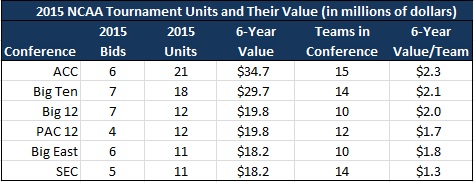
The only conference to come close to the ACC in total dollars was the Big Ten, which of course sent two teams to the Final Four (Michigan State and Wisconsin). And even after you factor in the number of teams in each conference, the per-school take by the ACC exceeds every other conference.
What about performance on the court? Follow the money: the ACC didn’t have the most teams in the tournament, but it had the most wins (by far) and the best record (table copied from Wikipedia).
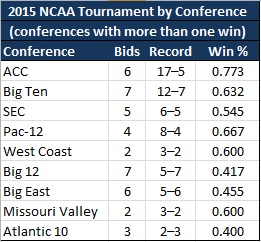
Teams in the ACC have now won four of the last seven NCAA Tournaments.
- 2009: North Carolina
- 2010: Duke
- 2013: Louisville (members of the Big East at the time)
- 2015: Duke
Monday, April 6, 2015
FSU draft record?
Perry Kostidakis
nice little tidbit from @Andy_Staples punt pass and pork, on if FSU gets 11 players drafted

Friday, April 3, 2015
Subscribe to:
Posts (Atom)