Sunday, January 11, 2015

Saturday, January 10, 2015
Proof That College Football Refs Are Riddled With Bias
For the 2.3 folks that read this blog........this is just one of many facts that address the dysfunction of the ACC and how it is run. Basically, FSU pays the bills for the ACC while the conference actively works against it. When will this conference figure it out?
"ACC refs, on the other hand, were flagged for favoring home teams, betting-line underdogs, and long-time conference members such as Duke and North Carolina."
"Perhaps the study’s oddest finding is that ACC refs may have hurt the conference’s strongest squads despite incentives to do the opposite. That might be due to the conference’s historical identification with basketball and the influence of its four founding North Carolina-based members: “Internal ACC power may be threatened by non-founding schools with strong football that drive much of its revenue," the paper notes. Nonfounders include Florida State, which won the NCAA football title last year.
After submitting the study for possible presentation at the MIT Sloan Sports Analytics Conference next month, Brymer sat down and crunched officiating data for 2013-14. In those two years, Florida State’s championship happened to correspond with ACC refs halting their apparent favoritism of conference underdogs. “And strangely," Brymer says, "the SEC picked that bias up."
Proof That College Football Refs Are Riddled With Bias
"On further review, the zebras are biased.
As Oregon and Ohio State prepare to battle for the NCAA football championship, a new study offers what may be the first empirical evidence that something other than rule infractions influences the referees employed by the biggest athletic conferences. Based on a complex analysis of penalty yards assessed over the course of eight seasons, the study by professors at Miami University of Ohio and Florida State University suggests, for instance, that ACC and Big 12 refs tend to penalize home teams less during games between conference rivals. Favored Big Ten teams are penalized fewer yards when playing nonconference teams, the study says, while Big 12 officials appear to punish teams that play faster—a potential concern for the go-go Ducks on Monday night.
These and other examples of bias indicate “considerable variance” in officiating across conferences, the study concludes, even as the monetary stakes mushroom with college football’s new four-team playoff. The researchers urge the NCAA to consider creating a national officiating body rather than have refs hired, fired, and evaluated by conferences.
Unfortunately for college football’s legions of conspiracy theorists (including this writer), the refereeing study does not support the notion that officials secretly help their conference’s strongest teams so the conference can reap the prestige and jackpots offered by bowl games and national titles. “We expected to find that but didn’t,” says Rhett Brymer, the Miami University strategic management professor who led the study. The SEC, which won seven of the eight NCAA championships during the period under review, was found to have officials essentially devoid of bias. ACC refs, on the other hand, were flagged for favoring home teams, betting-line underdogs, and long-time conference members such as Duke and North Carolina.
Indeed, the guys in stripes may not be the scheming power freaks that some fans imagine but mere mortals who carry biases they may be unaware of. The researchers studied officiating in the SEC, Big Ten, Big 12, Pac 12, ACC, and now-defunct Big East conferences from 2005 through 2012. They analyzed the penalty yards assessed in games between conference teams—all of which are officiated by conference refs—then compared that with yards per game levied in games between teams from different conferences. Evidence of bias comes from significant differences in the yards assessed during in-conference games vs. nonconference, measured against such variables as home field, betting-line favorites, and total plays. For instance, the study says, “ACC and Big 12 teams can expect 6.28 and 4.36 fewer penalty yards per game when playing in-conference games at home, but no such advantage when playing out-of-conference games at home.”
Big 12 refs—who will be officiating Monday's first championship game following a playoff—assessed more penalty yards per play in games with more plays than officials from other conferences. In theory, that could be a problem for Oregon’s hurry-up offense, which ran, on average, 77.4 plays per game this season vs. Ohio State’s 74.4, according to TeamRankings.com.
Officials from the ACC and Big 12 didn't respond to requests for comment. Big Ten officials weren't available. A spokeswoman for the NCAA declined to comment.
The study doesn’t account for such subjective officiating decisions as ball spots, possession calls, and pass interference penalties, nor does it attempt to single out pivotal games or evaluate individual refereeing crews. “Methodologically, this is analogous to using a weak telescope to find something in space,” Brymer says. “The fact that we did find something gives validity to something being there.”
Perhaps the study’s oddest finding is that ACC refs may have hurt the conference’s strongest squads despite incentives to do the opposite. That might be due to the conference’s historical identification with basketball and the influence of its four founding North Carolina-based members: “Internal ACC power may be threatened by non-founding schools with strong football that drive much of its revenue," the paper notes. Nonfounders include Florida State, which won the NCAA football title last year.
After submitting the study for possible presentation at the MIT Sloan Sports Analytics Conference next month, Brymer sat down and crunched officiating data for 2013-14. In those two years, Florida State’s championship happened to correspond with ACC refs halting their apparent favoritism of conference underdogs. “And strangely," Brymer says, "the SEC picked that bias up."
He and his co-authors argue that taking officiating out of conference hands and having it managed nationally—as it is in most NCAA sports—would help preserve football's integrity while guarding against potential game-fixing and other manipulation. “While centralized officiating is not devoid of partiality, one large uneven playing field is likely preferable to many uneven playing fields,” the study says.
Brymer thinks Oregon will win the title game, although the men in stripes make it a risky prediction: "If Big 12 refs are flag happy with the Ducks' fast pace, which they are prone to do, Oregon could be in trouble."
"ACC refs, on the other hand, were flagged for favoring home teams, betting-line underdogs, and long-time conference members such as Duke and North Carolina."
"Perhaps the study’s oddest finding is that ACC refs may have hurt the conference’s strongest squads despite incentives to do the opposite. That might be due to the conference’s historical identification with basketball and the influence of its four founding North Carolina-based members: “Internal ACC power may be threatened by non-founding schools with strong football that drive much of its revenue," the paper notes. Nonfounders include Florida State, which won the NCAA football title last year.
After submitting the study for possible presentation at the MIT Sloan Sports Analytics Conference next month, Brymer sat down and crunched officiating data for 2013-14. In those two years, Florida State’s championship happened to correspond with ACC refs halting their apparent favoritism of conference underdogs. “And strangely," Brymer says, "the SEC picked that bias up."
Proof That College Football Refs Are Riddled With Bias
"On further review, the zebras are biased.
As Oregon and Ohio State prepare to battle for the NCAA football championship, a new study offers what may be the first empirical evidence that something other than rule infractions influences the referees employed by the biggest athletic conferences. Based on a complex analysis of penalty yards assessed over the course of eight seasons, the study by professors at Miami University of Ohio and Florida State University suggests, for instance, that ACC and Big 12 refs tend to penalize home teams less during games between conference rivals. Favored Big Ten teams are penalized fewer yards when playing nonconference teams, the study says, while Big 12 officials appear to punish teams that play faster—a potential concern for the go-go Ducks on Monday night.
These and other examples of bias indicate “considerable variance” in officiating across conferences, the study concludes, even as the monetary stakes mushroom with college football’s new four-team playoff. The researchers urge the NCAA to consider creating a national officiating body rather than have refs hired, fired, and evaluated by conferences.
Unfortunately for college football’s legions of conspiracy theorists (including this writer), the refereeing study does not support the notion that officials secretly help their conference’s strongest teams so the conference can reap the prestige and jackpots offered by bowl games and national titles. “We expected to find that but didn’t,” says Rhett Brymer, the Miami University strategic management professor who led the study. The SEC, which won seven of the eight NCAA championships during the period under review, was found to have officials essentially devoid of bias. ACC refs, on the other hand, were flagged for favoring home teams, betting-line underdogs, and long-time conference members such as Duke and North Carolina.
Indeed, the guys in stripes may not be the scheming power freaks that some fans imagine but mere mortals who carry biases they may be unaware of. The researchers studied officiating in the SEC, Big Ten, Big 12, Pac 12, ACC, and now-defunct Big East conferences from 2005 through 2012. They analyzed the penalty yards assessed in games between conference teams—all of which are officiated by conference refs—then compared that with yards per game levied in games between teams from different conferences. Evidence of bias comes from significant differences in the yards assessed during in-conference games vs. nonconference, measured against such variables as home field, betting-line favorites, and total plays. For instance, the study says, “ACC and Big 12 teams can expect 6.28 and 4.36 fewer penalty yards per game when playing in-conference games at home, but no such advantage when playing out-of-conference games at home.”
Big 12 refs—who will be officiating Monday's first championship game following a playoff—assessed more penalty yards per play in games with more plays than officials from other conferences. In theory, that could be a problem for Oregon’s hurry-up offense, which ran, on average, 77.4 plays per game this season vs. Ohio State’s 74.4, according to TeamRankings.com.
Officials from the ACC and Big 12 didn't respond to requests for comment. Big Ten officials weren't available. A spokeswoman for the NCAA declined to comment.
The study doesn’t account for such subjective officiating decisions as ball spots, possession calls, and pass interference penalties, nor does it attempt to single out pivotal games or evaluate individual refereeing crews. “Methodologically, this is analogous to using a weak telescope to find something in space,” Brymer says. “The fact that we did find something gives validity to something being there.”
Perhaps the study’s oddest finding is that ACC refs may have hurt the conference’s strongest squads despite incentives to do the opposite. That might be due to the conference’s historical identification with basketball and the influence of its four founding North Carolina-based members: “Internal ACC power may be threatened by non-founding schools with strong football that drive much of its revenue," the paper notes. Nonfounders include Florida State, which won the NCAA football title last year.
After submitting the study for possible presentation at the MIT Sloan Sports Analytics Conference next month, Brymer sat down and crunched officiating data for 2013-14. In those two years, Florida State’s championship happened to correspond with ACC refs halting their apparent favoritism of conference underdogs. “And strangely," Brymer says, "the SEC picked that bias up."
He and his co-authors argue that taking officiating out of conference hands and having it managed nationally—as it is in most NCAA sports—would help preserve football's integrity while guarding against potential game-fixing and other manipulation. “While centralized officiating is not devoid of partiality, one large uneven playing field is likely preferable to many uneven playing fields,” the study says.
Brymer thinks Oregon will win the title game, although the men in stripes make it a risky prediction: "If Big 12 refs are flag happy with the Ducks' fast pace, which they are prone to do, Oregon could be in trouble."
Friday, January 9, 2015
Florida State University’s online graduate programs among best
Florida State University’s online graduate programs among best
"Florida State University’s online graduate programs in education, criminal justice, information technology and business are among the best in the nation, according to U.S. News & World Report’s 2015 Best Online Program Rankings.
“FSU celebrates our diverse programs listed among the nation’s very best online programs,” Interim Provost Sally McRorie said. “The high rankings make great sense when you consider that student engagement and faculty credentials — areas in which we excel — comprise fully 50 percent of the criteria used. These innovative programs will help us realize our goal of being ranked among the Top 25 public universities.”
The College of Education’s online graduate program ranks No. 2 in the nation among both public and private universities. The program currently offers degrees in educational leadership/administration, instructional systems and learning technologies and special education studies.
“The College of Education was an early pioneer in online education at FSU, and we continue to develop innovative programs that provide a quality education to students who can’t travel to campus,” said Marcy Driscoll, dean of the College of Education. “It’s exciting to see our achievements earn this recognition.”
The College of Criminology and Criminal Justice’s online graduate program was No. 7 overall, and No. 4 among public universities, in U.S. News & World Report’s first-ever ranking of online criminal justice programs. The program provides the challenge and prestige of FSU’s nationally ranked criminology program with the convenience and flexibility of a distance-learning program.
“We are pleased to see that our online master’s program is recognized as one of the top programs in the country,” said Thomas Blomberg, dean of the College of Criminology and Criminal Justice. “Our online program courses are taught exclusively by our faculty who lead the country in rankings for research and publication productivity. We strive to provide the same educational excellence online as we provide our on-campus graduate students.”
The School of Information’s online master’s degree program in information technology, housed in the College of Communication and Information, broke into the rankings for the first time at No. 20 overall, and No. 13 among public universities, in the computer information technology category. The program, which started three years ago, is completely online and prepares students for 21st century careers such as networking, large-scale data management, user-centered design and web development.
“Florida’s iSchool has a 15-year history of providing outstanding online graduate programs,” said Larry Dennis, dean of the College of Communication and Information. “This IT program was created specifically to meet the needs of IT professionals, entrepreneurs and veterans.”
The College of Business’ online graduate programs ranked No. 26 overall and No. 16 among public universities. The college offers Master of Science degrees in Management Information Systems and Risk Management and Insurance.
“We are proud of these niche programs that draw working professionals nationwide,” said David Paradice, senior associate dean and Sprint Professor of Business Administration. “We are generating new interest in our online programs, including our Master of Business Administration, now that we are able to waive the GMAT or GRE entrance exams for certain highly qualified candidates with extensive management experience.”
Florida State’s online MBA program ranked No. 62 overall and No. 47 among public universities. For the first time, U.S. News & World Report split its online graduate business rankings into two — one for online MBA programs and one for all other online graduate business programs.
U.S. News & World Report’s ranking methodology was based on several factors: student engagement; faculty credentials and training; student services and technology; peer reputation; and admissions selectivity.
“The gains we have made in the U.S. News and World Report rankings illustrate the continuing dedication of the university in providing whatever resources are needed to endow FSU students with an outstanding online education,” said Susann Rudasill, director at the Office of Distance Learning at FSU. “We continue to make enhancements to our programs and curriculum in support of our commitment to students to provide the highest quality online education possible.”
Tuesday, January 6, 2015
Stats of the day
Pick Six Previews
Most Wins last 50 years (Power 5 Conferences):
1. Nebraska 480
2. Oklahoma 447
3. Ohio State 444
4. Alabama 429
5. Michigan 428
Pick Six Previews
Most Wins last 25 years (Power 5 Conferences):
1. Florida State 240
2(tie) Nebraska 239
2(tie) Florida 239
4. Ohio State 236
5. Oklahoma 222
Most Wins last 10 years (Power 5 Conferences):
1. Oregon 106
2. LSU 103
3. Oklahoma 101
4. Wisconsin 98
5. Ohio State 97
Most Wins last 5 years (Power 5 Conferences):
1. Oregon 60
2(tie). Alabama 58
2(tie). Florida State 58
4. Stanford 54
5. Michigan State 53
Sunday, January 4, 2015
FSU evolving under Thrasher
Doubt we ever seen any true tangible move forward for FSU here (large increase in research, endowment growth, split COE, full mission med school, etc), but this story is standard fare for what satisfies FSU supporters.....basic fluff.
That said, I like Thrasher and root for him......but don't see any real direction at FSU.
FSU evolving under Thrasher
"John Thrasher did not settle into the president’s chair at Florida State University on Nov. 10 with the intention of making sweeping changes.
He spoke highly of the leadership team assembled mostly by his predecessor, Eric Barron, and vowed to capitalize on its many strengths. FSU needed stability, Thrasher said.
Change came quickly nevertheless. FSU, one of two public universities in Florida with preeminence status (University of Florida is the other) and the additional millions in resources that come with that designation, is beginning to evolve under its new leader.
Between the day FSU’s trustees selected Thrasher on Sept. 23 and his confirmation by the Board of Governors on Nov. 6, Liz Maryanski, vice president for university relations, departed after receiving an offer she couldn’t refuse from Georgia Tech.
Then Garnett Stokes, provost and executive vice president for academic affairs, was hired last month by University of Missouri for a similar position.
Florida State, now led by a 71-year-old former lawmaker, is not the same university it was 12 months ago. New top lieutenants will be joining Thrasher’s team in the months to come, but that’s not all that different.
Controlling the message
Thrasher is not simply a former legislator. He was Speaker of the Florida House of Representatives, a power broker in the Senate and chair of Gov. Rick Scott’s reelection campaign until he became a candidate for president at his alma mater.
He values image and intends to be as hands-on as possible when it comes to shaping the university’s message. Thrasher told the Tallahassee Democrat he is in no hurry to fill the vacancy atop university relations. He has, however, removed longtime FSU spokeswoman Browning Brooks from under government relations and is having her report directly to him on a daily basis.
“I wanted to remove a layer. We talk about messaging and the things I think are important to relay to our key constituent groups,” Thrasher said. “I think public relations and communication are a big, big part of this job.”
He referenced an unflattering story that appeared on the front-page of the New York Times on Friday, Nov. 14, his fifth day in office. Thrasher and Brooks crafted a response that appeared on FSU’s website later that day, but Thrasher would have preferred to have been better prepared, even if the ongoing saga of FSU football players and the treatment they have received from the city ‘s police force is not a situation that he can control.
When tragedy struck 10 days into his presidency — a late-night fatal shooting outside Strozier Library on Nov. 20 — Thrasher received high marks for quickly returning to Tallahassee from New York City and providing strong leadership.
He prides himself on telling FSU’s story. Much of his first six weeks on the job were spent crisscrossing the state he knows so well, talking to large groups of potential donors. By Dec. 12, the date of the first graduation ceremony he would preside over, Thrasher had met with FSU supporters in Miami, Fort Lauderdale (twice), Palm Beach, Jacksonville, Sarasota, Tampa and Winter Park. He also spoke to two groups in Charlotte, N.C., when FSU’s football team was there playing in the conference championship game.
“I think the enthusiasm is pretty good, pretty strong. I think people have rallied around the shooting,” Thrasher said. “I think people think the university handled it in the right way.”
Challenges await
FSU’s presidential search was rife with controversy. The job description, as advertised in The Chronicle of Higher Education, stated that extensive experience in academia was the No. 1 asset for a replacement for Barron, a widely respected climatologist who had been a professor and dean at Penn State and University of Texas at Austin.
Thrasher had been chair of the FSU Board of Trustees, but he had never taught at a university or been an administrator. He was an unconventional candidate, and there was a vocal contingent of students and faculty opposed to his candidacy. It’s unlikely any FSU president has taken office with quite the same challenges Thrasher is facing.
He met several times with Gary Tyson, a computer science professor who is president of the Faculty Senate, prior to his first day in office. He has since spoken at a luncheon meeting of the faculty union and attended his first Faculty Senate meeting.
Thrasher said repeatedly during the interview process that he wanted to improve salaries for FSU’s professors, who are paid less than their peers at UF and well below the national average. As president, he continues to talk to faculty about improving their pay while addressing the collective bargaining agreement.
Longtime music professor Cliff Madsen was one of four faculty members on the 27-member search committee. Like his three colleagues on the committee, he voted against advancing Thrasher to the Board of Trustees.
But Madsen said it is important for the faculty to support Thrasher now that he’s the university’s president. Thrasher needs to be given the opportunity to grow into his new job, Madsen said. He added that he likes what he has seen for far. And Madsen has gone out of his way to share that with Thrasher.
“I’m very impressed so far. I think every decision he’s made has been excellent,” Madsen said. “I’m very hopeful this will continue.”
Tyson, as Faculty Senate president, is a member of the Board of Trustees. He cast one of the two dissenting votes, along with Trustee Peggy Rolando, when the board voted 11-2 in September to hire Thrasher. Now Tyson is one of Thrasher’s liaisons to the faculty.
“The president’s had a good start, I think, but it’s still too early to tell,” Tyson said. “Everything he told me before, he’s followed through on. That’s good. I think the next big thing is a search for a provost.”
Thrasher is scheduled to meet with Don Gibson on Monday. Gibson, former dean of FSU’s College of Music, led the provost search that resulted in hiring Stokes in 2011.
Thrasher said he wants input from deans and other faculty before beginning a national search for a new provost. He hopes that Sally McRorie, the interim provost who held that position for seven months in 2013 while Stokes was promoted to interim president, will be a candidate for the permanent position.
“I have great confidence in Sally. I don’t think we’ll miss a beat with her,” Thrasher said.
Capitol connections
Eric Barron, Thrasher’s predecessor, needed time to figure out the rules of engagement with the Legislature, which determines much of the funding for Florida’s public universities. By 2012, with two years on the job, Barron had emerged as a leader among the state university presidents.
He was not shy about sharing his opinions or his analysis with the Board of Governors, the body that oversees the university system. BOG members regularly sought his counsel during his final year in office.
Thrasher, by comparison, needs no learning curve. He knows the power game at the Capitol as well as anyone. It was one of the qualities FSU trustees cited when they made the decision to hire him.
The 2015 legislative session doesn’t officially start until March, but for those who know how the system operates, the game is underway – and Thrasher is fully engaged.
Incoming Senate President Andy Gardner and Steve Crisafulli, the new House Speaker, both have ties to the University of Central Florida, which coincidently happens to want $210 million from the Legislature to establish a new downtown Orlando campus.
“We’re going to have to make a case for the things we need too,” Thrasher said. “I think that’s where whatever experience I have down there will serve us well.”
It was apparent at the Nov. 6 BOG meeting at Florida Atlantic University in Boca Raton that Thrasher’s fellow university presidents – not to mention BOG members and Chancellor Marshal Criser III – will be turning to him for insight into the legislative process. Tyson, FSU’s Faculty Senate president, was at that meeting and was impressed by the level of respect shown to Thrasher.
“It’s pretty clear he’s in his element representing FSU outside the university. He’s extraordinarily good at those things,” Tyson said. “I think there’s still a lot to learn at running a university, but I think he understands that.”
FSU BOT Chair Allan Bense wasn’t surprised to see the other presidents defer to Thrasher during Thrasher’s first official BOG meeting. Bense, a former House Speaker as well, is intimately familiar with the legislative process.
“When you’ve been a Speaker of the House and rules chair of the Senate, you get it,” Bense said. “I think John will help, but I’m not sure they will be leaning on him completely. I suspect they will tap him. Who wouldn’t?”
Thrasher already has begun laying the groundwork for a split of the joint FAMU-FSU College of Engineering, considered essential by FSU administrators for the university’s advancement nationally but opposed fiercely by FAMU leaders. As a senator, he helped dedicate $500,000 in April for an analysis of the college, and he helped draft a response to the initial report by the consulting group hired by BOG.
“I’m committed to working with the board, working with Elmira (FAMU President Mangum), and we’ll see where it goes,” he said. “It’s going to be an incremental thing, at best. If there are some reorganizational things we can do to make it better, to help the students, we would do that.”
Thrasher was asked during the interview process to name a university president outside of Florida who he knew personally, someone he could call if needed. He answered by saying he knew every member of Congress from Florida and could call any of them on a moment’s notice. That includes Rep. Gwen Graham, the Tallahassee Democrat who unseated Republican incumbent Steve Southerland in November. She has already visited with Thrasher in his Westcott Building office. Thrasher wanted to enlist her help lobbying the National Science Foundation to keep the National High Magnet Field Laboratory on Florida State’s campus.
“I think Gwen will do real well up there in Washington. I think she’ll fit in across the aisle,” Thrasher said. “I look forward to working with her. I like Gwen a lot.”
That said, I like Thrasher and root for him......but don't see any real direction at FSU.
FSU evolving under Thrasher
"John Thrasher did not settle into the president’s chair at Florida State University on Nov. 10 with the intention of making sweeping changes.
He spoke highly of the leadership team assembled mostly by his predecessor, Eric Barron, and vowed to capitalize on its many strengths. FSU needed stability, Thrasher said.
Change came quickly nevertheless. FSU, one of two public universities in Florida with preeminence status (University of Florida is the other) and the additional millions in resources that come with that designation, is beginning to evolve under its new leader.
Between the day FSU’s trustees selected Thrasher on Sept. 23 and his confirmation by the Board of Governors on Nov. 6, Liz Maryanski, vice president for university relations, departed after receiving an offer she couldn’t refuse from Georgia Tech.
Then Garnett Stokes, provost and executive vice president for academic affairs, was hired last month by University of Missouri for a similar position.
Florida State, now led by a 71-year-old former lawmaker, is not the same university it was 12 months ago. New top lieutenants will be joining Thrasher’s team in the months to come, but that’s not all that different.
Controlling the message
Thrasher is not simply a former legislator. He was Speaker of the Florida House of Representatives, a power broker in the Senate and chair of Gov. Rick Scott’s reelection campaign until he became a candidate for president at his alma mater.
He values image and intends to be as hands-on as possible when it comes to shaping the university’s message. Thrasher told the Tallahassee Democrat he is in no hurry to fill the vacancy atop university relations. He has, however, removed longtime FSU spokeswoman Browning Brooks from under government relations and is having her report directly to him on a daily basis.
“I wanted to remove a layer. We talk about messaging and the things I think are important to relay to our key constituent groups,” Thrasher said. “I think public relations and communication are a big, big part of this job.”
He referenced an unflattering story that appeared on the front-page of the New York Times on Friday, Nov. 14, his fifth day in office. Thrasher and Brooks crafted a response that appeared on FSU’s website later that day, but Thrasher would have preferred to have been better prepared, even if the ongoing saga of FSU football players and the treatment they have received from the city ‘s police force is not a situation that he can control.
When tragedy struck 10 days into his presidency — a late-night fatal shooting outside Strozier Library on Nov. 20 — Thrasher received high marks for quickly returning to Tallahassee from New York City and providing strong leadership.
He prides himself on telling FSU’s story. Much of his first six weeks on the job were spent crisscrossing the state he knows so well, talking to large groups of potential donors. By Dec. 12, the date of the first graduation ceremony he would preside over, Thrasher had met with FSU supporters in Miami, Fort Lauderdale (twice), Palm Beach, Jacksonville, Sarasota, Tampa and Winter Park. He also spoke to two groups in Charlotte, N.C., when FSU’s football team was there playing in the conference championship game.
“I think the enthusiasm is pretty good, pretty strong. I think people have rallied around the shooting,” Thrasher said. “I think people think the university handled it in the right way.”
Challenges await
FSU’s presidential search was rife with controversy. The job description, as advertised in The Chronicle of Higher Education, stated that extensive experience in academia was the No. 1 asset for a replacement for Barron, a widely respected climatologist who had been a professor and dean at Penn State and University of Texas at Austin.
Thrasher had been chair of the FSU Board of Trustees, but he had never taught at a university or been an administrator. He was an unconventional candidate, and there was a vocal contingent of students and faculty opposed to his candidacy. It’s unlikely any FSU president has taken office with quite the same challenges Thrasher is facing.
He met several times with Gary Tyson, a computer science professor who is president of the Faculty Senate, prior to his first day in office. He has since spoken at a luncheon meeting of the faculty union and attended his first Faculty Senate meeting.
Thrasher said repeatedly during the interview process that he wanted to improve salaries for FSU’s professors, who are paid less than their peers at UF and well below the national average. As president, he continues to talk to faculty about improving their pay while addressing the collective bargaining agreement.
Longtime music professor Cliff Madsen was one of four faculty members on the 27-member search committee. Like his three colleagues on the committee, he voted against advancing Thrasher to the Board of Trustees.
But Madsen said it is important for the faculty to support Thrasher now that he’s the university’s president. Thrasher needs to be given the opportunity to grow into his new job, Madsen said. He added that he likes what he has seen for far. And Madsen has gone out of his way to share that with Thrasher.
“I’m very impressed so far. I think every decision he’s made has been excellent,” Madsen said. “I’m very hopeful this will continue.”
Tyson, as Faculty Senate president, is a member of the Board of Trustees. He cast one of the two dissenting votes, along with Trustee Peggy Rolando, when the board voted 11-2 in September to hire Thrasher. Now Tyson is one of Thrasher’s liaisons to the faculty.
“The president’s had a good start, I think, but it’s still too early to tell,” Tyson said. “Everything he told me before, he’s followed through on. That’s good. I think the next big thing is a search for a provost.”
Thrasher is scheduled to meet with Don Gibson on Monday. Gibson, former dean of FSU’s College of Music, led the provost search that resulted in hiring Stokes in 2011.
Thrasher said he wants input from deans and other faculty before beginning a national search for a new provost. He hopes that Sally McRorie, the interim provost who held that position for seven months in 2013 while Stokes was promoted to interim president, will be a candidate for the permanent position.
“I have great confidence in Sally. I don’t think we’ll miss a beat with her,” Thrasher said.
Capitol connections
Eric Barron, Thrasher’s predecessor, needed time to figure out the rules of engagement with the Legislature, which determines much of the funding for Florida’s public universities. By 2012, with two years on the job, Barron had emerged as a leader among the state university presidents.
He was not shy about sharing his opinions or his analysis with the Board of Governors, the body that oversees the university system. BOG members regularly sought his counsel during his final year in office.
Thrasher, by comparison, needs no learning curve. He knows the power game at the Capitol as well as anyone. It was one of the qualities FSU trustees cited when they made the decision to hire him.
The 2015 legislative session doesn’t officially start until March, but for those who know how the system operates, the game is underway – and Thrasher is fully engaged.
Incoming Senate President Andy Gardner and Steve Crisafulli, the new House Speaker, both have ties to the University of Central Florida, which coincidently happens to want $210 million from the Legislature to establish a new downtown Orlando campus.
“We’re going to have to make a case for the things we need too,” Thrasher said. “I think that’s where whatever experience I have down there will serve us well.”
It was apparent at the Nov. 6 BOG meeting at Florida Atlantic University in Boca Raton that Thrasher’s fellow university presidents – not to mention BOG members and Chancellor Marshal Criser III – will be turning to him for insight into the legislative process. Tyson, FSU’s Faculty Senate president, was at that meeting and was impressed by the level of respect shown to Thrasher.
“It’s pretty clear he’s in his element representing FSU outside the university. He’s extraordinarily good at those things,” Tyson said. “I think there’s still a lot to learn at running a university, but I think he understands that.”
FSU BOT Chair Allan Bense wasn’t surprised to see the other presidents defer to Thrasher during Thrasher’s first official BOG meeting. Bense, a former House Speaker as well, is intimately familiar with the legislative process.
“When you’ve been a Speaker of the House and rules chair of the Senate, you get it,” Bense said. “I think John will help, but I’m not sure they will be leaning on him completely. I suspect they will tap him. Who wouldn’t?”
Thrasher already has begun laying the groundwork for a split of the joint FAMU-FSU College of Engineering, considered essential by FSU administrators for the university’s advancement nationally but opposed fiercely by FAMU leaders. As a senator, he helped dedicate $500,000 in April for an analysis of the college, and he helped draft a response to the initial report by the consulting group hired by BOG.
“I’m committed to working with the board, working with Elmira (FAMU President Mangum), and we’ll see where it goes,” he said. “It’s going to be an incremental thing, at best. If there are some reorganizational things we can do to make it better, to help the students, we would do that.”
Thrasher was asked during the interview process to name a university president outside of Florida who he knew personally, someone he could call if needed. He answered by saying he knew every member of Congress from Florida and could call any of them on a moment’s notice. That includes Rep. Gwen Graham, the Tallahassee Democrat who unseated Republican incumbent Steve Southerland in November. She has already visited with Thrasher in his Westcott Building office. Thrasher wanted to enlist her help lobbying the National Science Foundation to keep the National High Magnet Field Laboratory on Florida State’s campus.
“I think Gwen will do real well up there in Washington. I think she’ll fit in across the aisle,” Thrasher said. “I look forward to working with her. I like Gwen a lot.”
Saturday, January 3, 2015
Tough loss, great season
Hope FSU can grow from it and make improvements for next season.
Fact of the day:
One Florida Dynasty@OneFLDynasty 6 hours ago
@FSUnworthy Sports facts, dude. FSU more Top 25, 10, 5 wins than any other team past 30 years. Highest win percentage. Most bowl wins. Etc.
Fact of the day:
One Florida Dynasty
Thursday, January 1, 2015
It's time
The media told you to hate us, do what you are told.
#SECbias
#ESPN
#Embracethehate
#goacc
#ESPN
#ESPNsecbias
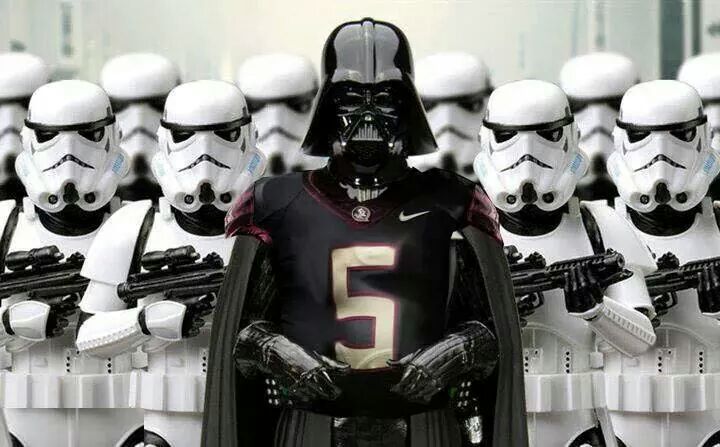
#SECbias
#ESPN
#Embracethehate
#goacc
#ESPN
#ESPNsecbias
Subscribe to:
Posts (Atom)