Thursday, October 8, 2026

Top 20 most lucrative collegiate apparel deals


MagLab Lands $18M to advance Nuclear Magnetic Resonance research


The lab will establish a new cutting-edge facility for solid-state nuclear magnetic resonance, enabling new capabilities for understanding the structure and dynamics of matter for research in biology, health, materials, and energy.

Contact: Frederic Mentink-Vigier

TALLAHASSEE, Fla. — The technology behind MRI, which has been used for generations to diagnose and treat disease, holds promise of even greater breakthroughs across scientific disciplines using stronger magnets and advanced techniques.

That’s why the FSU-headquartered National High Magnetic Field Laboratory is launching a new one-of-a-kind magnet facility to build on its world leadership in Nuclear Magnetic Resonance. The U.S. National Science Foundation has awarded $18 million to create the MagLab’s new National Facility for Ultra-High Sensitivity Solid-State NMR.

“This facility will provide previously inaccessible capabilities for understanding the structure and dynamics of matter at the atomic scale - critical to U.S. priorities in biotechnology, energy, advanced manufacturing, and health,” the NSF said in announcing the award.

New Magnet, Expanded Capabilities

The new ultra-high-sensitivity facility will center around a new 23.5 tesla NMR magnet, one of the strongest in the United States, complemented by a microwave source and state-of-the-art probes which together will accelerate data acquisition for a wide range of research.

“This grant will fund a unique instrument worldwide. It's a significant milestone and exciting news for the MagLab, FSU and the US as a whole,” said Frederic Mentink-Vigier, lead researcher for the project, MagLab Research Faculty and Affiliated Faculty in the FSU Department of Chemistry and Biochemistry.

“What this instrument is opening up is the ability to look at samples with higher sensitivity, and thus to look at the entirety of the periodic table.”

double quote sign

All this is essential to be able to understand disease and have cures.

- Frederic Mentink-Vigier

Nuclear Magnetic Resonance harnesses high magnetic fields and radio waves to figure out the 3D structures of biomolecules, uncover the mechanisms of enzymes and catalysts, and provide insights into surfaces and interfaces at scales far beyond the reach of conventional microscopes.

In biomedicine, that means detecting and understanding biologically essential elements such as iron, copper, sulfur, and calcium, along with greater study of amyloid proteins — which play a role in Alzheimer's, Parkinson's, Type II diabetes, and other diseases. The system will also allow detailed analysis of membrane proteins that act as cell gatekeepers. These mechanisms are involved in diseases including cancer, autoimmune disorders, and infectious disease.

"All this is essential to be able to understand disease and have cures," said Mentink-Vigier.

The instrument will also expand capabilities to see elements such as lithium and sodium being studied for new solid-state batteries. And scientists will be able to better detect cadmium, selenium, and lead-- important in electronics, solar cells, and LEDs-- along with platinum-group metals, which play critical roles in catalysis and medicine.

The MagLab’s NMR team has been working to secure funding for the new magnet for years, led by former NMR Facility Director Robert Schurko, who passed away in February 2026 after a battle with cancer.

“This was our fourth, and boldest, attempt to secure such instrumentation. This was a project that was very important for the MagLab and Rob was committed to see it succeed.” said Mentink-Vigier.
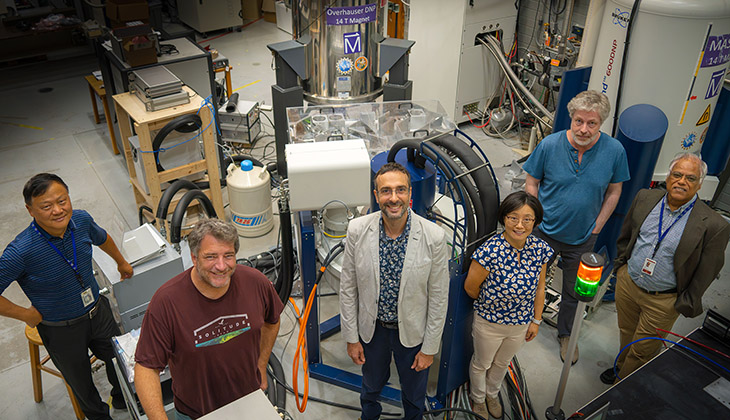
Members of the National MagLab’s NMR team (left to right): Zhehong Gan, Thierry Dubroca, Fred Mentink-Vigier, Yan-Yan Hu, Peter Gor’kov, & Ayyalusamy Ramamoorthy.

Members of the National MagLab’s NMR team (left to right): Zhehong Gan, Thierry Dubroca, Fred Mentink-Vigier, Yan-Yan Hu, Peter Gor’kov, & Ayyalusamy Ramamoorthy.

Photo credit: Stephen Bilenky/National MagLab

World-Leading Techniques

Mentink-Vigier's research focuses on Dynamic Nuclear Polarization, a technique in which he is a world-renowned expert. This new instrument represents the cutting edge of DNP, a signal amplifier that improves sensitivity by up to four orders of magnitude. The system will also utilize Magic Angle Spinning, combined either with DNP or cryoprobes, to improve resolution. That technique can lower measurement times by a factor of up to 16. This will be the only ultra-high-field magnet in the world equipped with both Magic Angle Spinning and Dynamic Nuclear Polarization.

“When people want information out of the NMR experiments, this is the combination: Magic Angle Spinning gives you resolution and Dynamic Nuclear Polarization gives you signaling intensity,” said Mentink-Vigier. “We have the ability to do experiments that previously we were not able to do. What you could not absolutely see before, you can now see.”

Yan-Yan Hu, MagLab researcher and Professor of Chemistry and Biochemistry at FSU, says the magnet system will be transformative. Hu's research focuses on understanding how proteins interact to carry out essential biological functions and on developing safer, more efficient rechargeable lithium and sodium batteries.

“This new facility will allow researchers to tackle materials and biological systems that have previously been extremely difficult or impossible to study by NMR,” said Hu.

Wednesday, October 7, 2026

National TV Trends for CFB


Tuesday, October 6, 2026

2026 TV Ratings


The FSU Bama game still drew 7 Million plus AFTER a long lightening delay (2 actually)


https://247sports.com/college/florida-state/board/36/contents/viewership-numbers-for-fsusmu-289751283/?page=1

https://www.on3.com/boards/threads/have-the-tv-numbers-for-monday-night-been-announced-yet.8979882/#post-189485201

*Remember that FSU was the only one of this bunch that was on ESPN cable/streaming only… and the game was on a return to work night and 1 hour 1/2 late. The game went to 1:00am-ish. All the others were on OTA networks.

Your final Week 1 TV ratings, per Nielsen: ND-Wis. (NBC): 8.1M LSU-Clemson (ABC): 5.8M Wash-Wash St (NBC): 5.1M Oregon-Boise St (CBS): 4.8M Lou-Ole Miss (ABC): 4.7M Baylor-Auburn (ABC): 4.2M Mich-WMU (NBC): 4.1M FSU-SMU (ESPN): 4.1M


FSU season-opening win sets CW viewership record

Florida State’s season-opening win over New Mexico State did more than put the Seminoles at 1-0, it also delivered a record audience for The CW.

The Week 0 matchup averaged 1.96 million viewers in primetime, making it the most-watched sports broadcast in The CW’s history, according to Nielsen Panel + Big Data figures released by Nexstar Media Group on Wednesday.

Viewership peaked at 2.4 million between 9:15 and 9:30 p.m. ET as Florida State pulled away for a 34-17 victory at Doak Campbell Stadium. The broadcast also drew 718,000 viewers in the Adults 25-54 demographic, another network record for a sports event.

The game’s performance extended beyond The CW’s own benchmarks. According to Nexstar, Florida State-New Mexico State was the second-strongest primetime broadcast of the night among Adults 25-54, outperforming every primetime program on ABC, CBS and NBC in that demographic.


https://247sports.com/college/florida-state/board/36/contents/game-1-drew-nearly-2m-on-the-cw-289433585/?page=1


Nielsen measured viewership for the B12 & ACC during the 2025 season

FSU adds Washington DC presence in 2025.


FSU DC Study Away Program opens doors for student interns in the nation’s capital

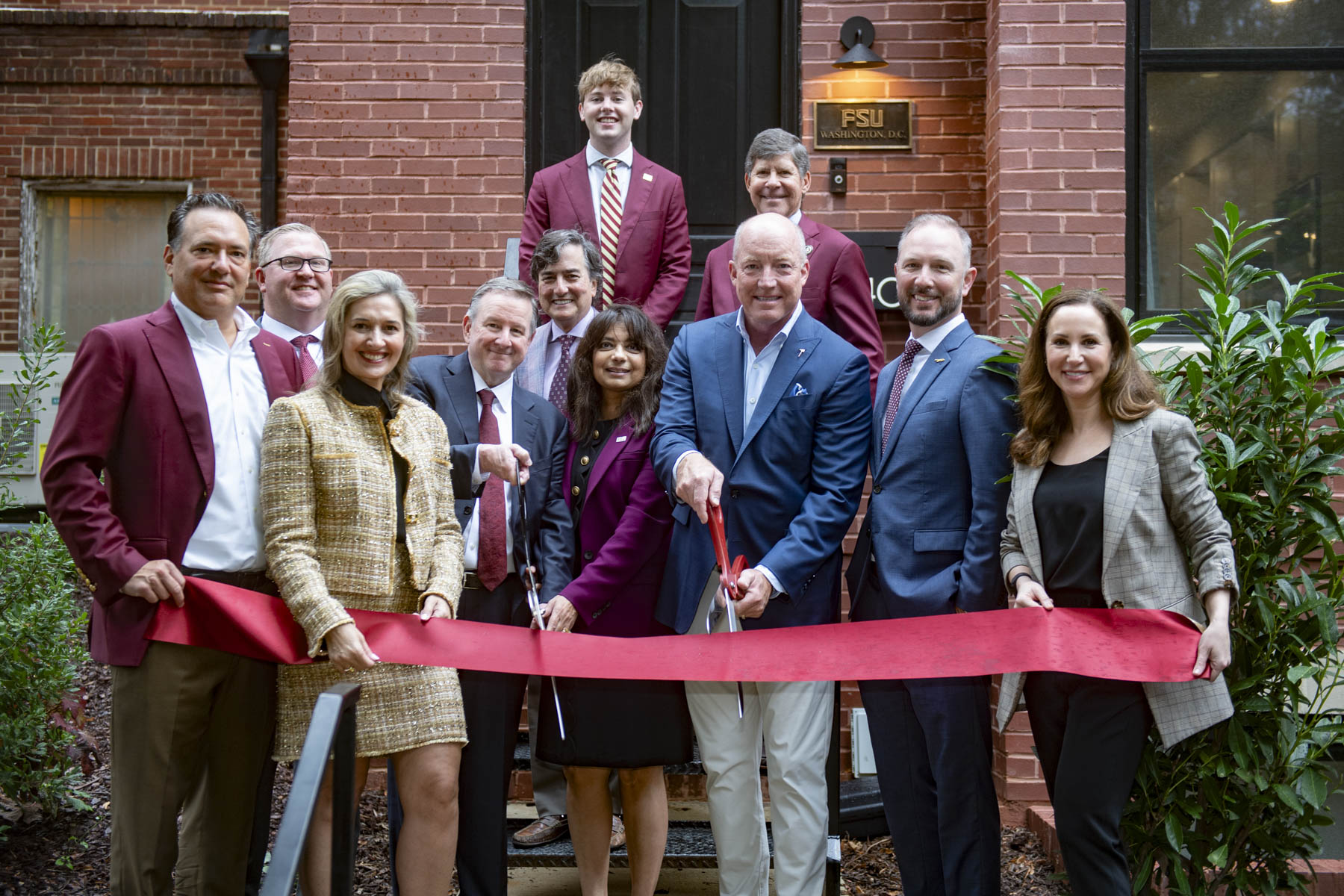
People pose and smile in front of a ribbon, holding scissors to the ribbon
Florida State University unveiled its new student housing accommodations in Capitol Hill for students participating in the new FSU DC Study Away Program. The program offers students a place to live within the FSU ecosystem while doing an internship in Washington D.C. (Matthew McConnell/Florida State University)

Florida State University is offering a new housing and internship option for students looking to gain hands-on experience in the nation’s capital.

The FSU DC Study Away Program, located in Washington, D.C., will provide students with the opportunity to obtain direct experience through internships at agencies, advocacy and association groups, corporations and government sites. A ribbon cutting was held on Thursday, Sept. 25, to commemorate the occasion.

Starting January 2026, students will live in a supportive community with their peers, where they can focus on their internships while benefiting from shared support and connection.

“Florida State is on the rise — this is our time,” said FSU President Richard McCullough. “With more than 200 students and 7,500 alumni already in the D.C. area, this new housing initiative gives our students a front-row seat to opportunity. This is about giving our students access and a direct path to success.”

 The program is a collaboration among FSU’s Division of Student Affairs, the Career Center and University Housing. Students can participate during the fall, spring or summer semesters, living in university-managed housing while continuing their academic coursework and building professional networks in one of the world’s most influential cities.

“This is more than a residence; it’s a launchpad,” said Amy Hecht, vice president for student affairs. “We’re planting our first spear in D.C., and our Seminoles will carry the spirit and values of Florida State into every boardroom and program they enter.”

“In terms of student success, this is an incredible opportunity for our students to go where the work is,” Hecht added. “They don’t have to find it on their own or deal with housing. This is something we’re packaging for our students, very similar to our international programs.”

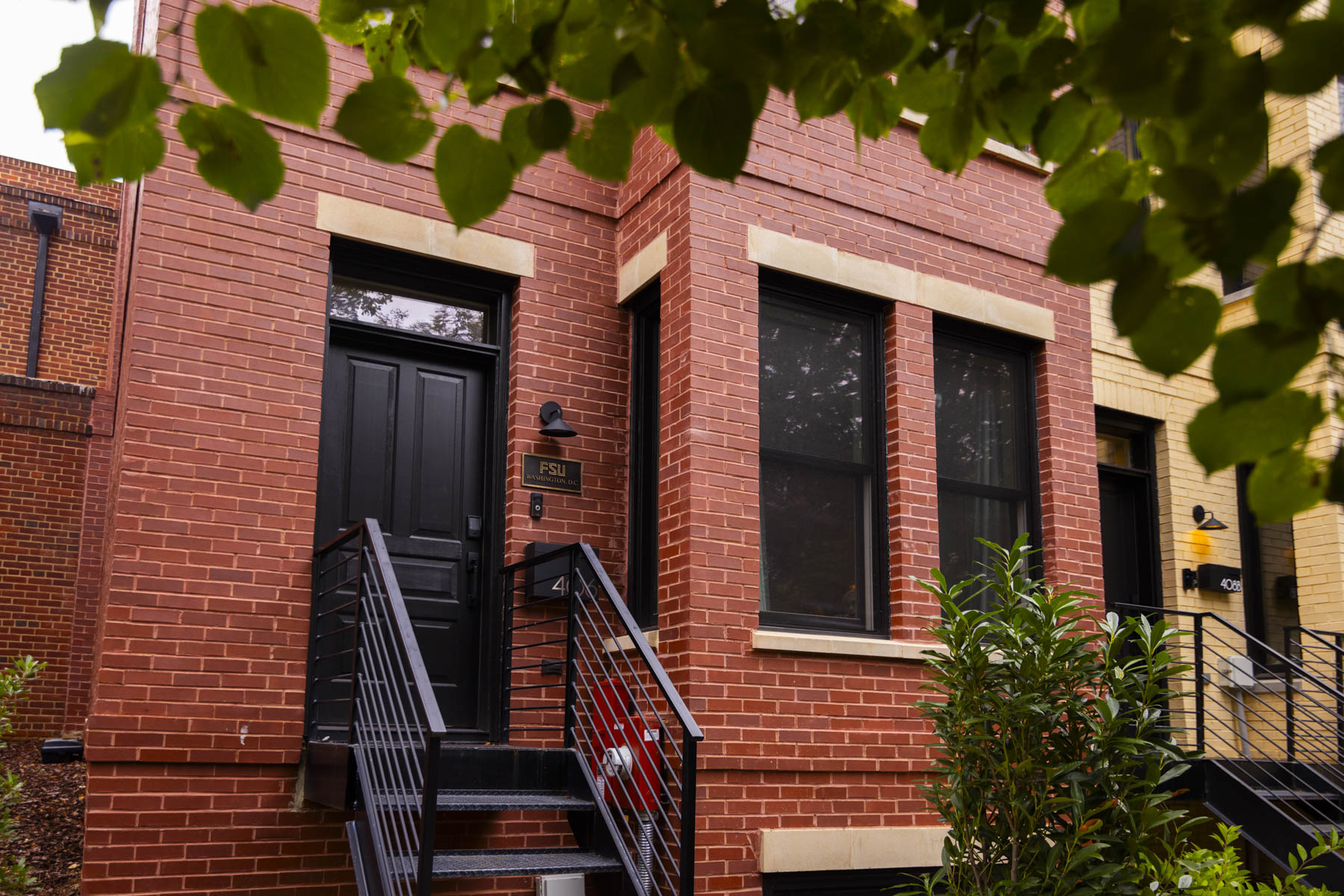
FSU’s two residences are located on historic Ebenezer Row in the Capitol Hill neighborhood, offering updated living in a quiet, residential setting just blocks from the U.S. Capitol, metro stations, Eastern Market, grocery stores and parks.


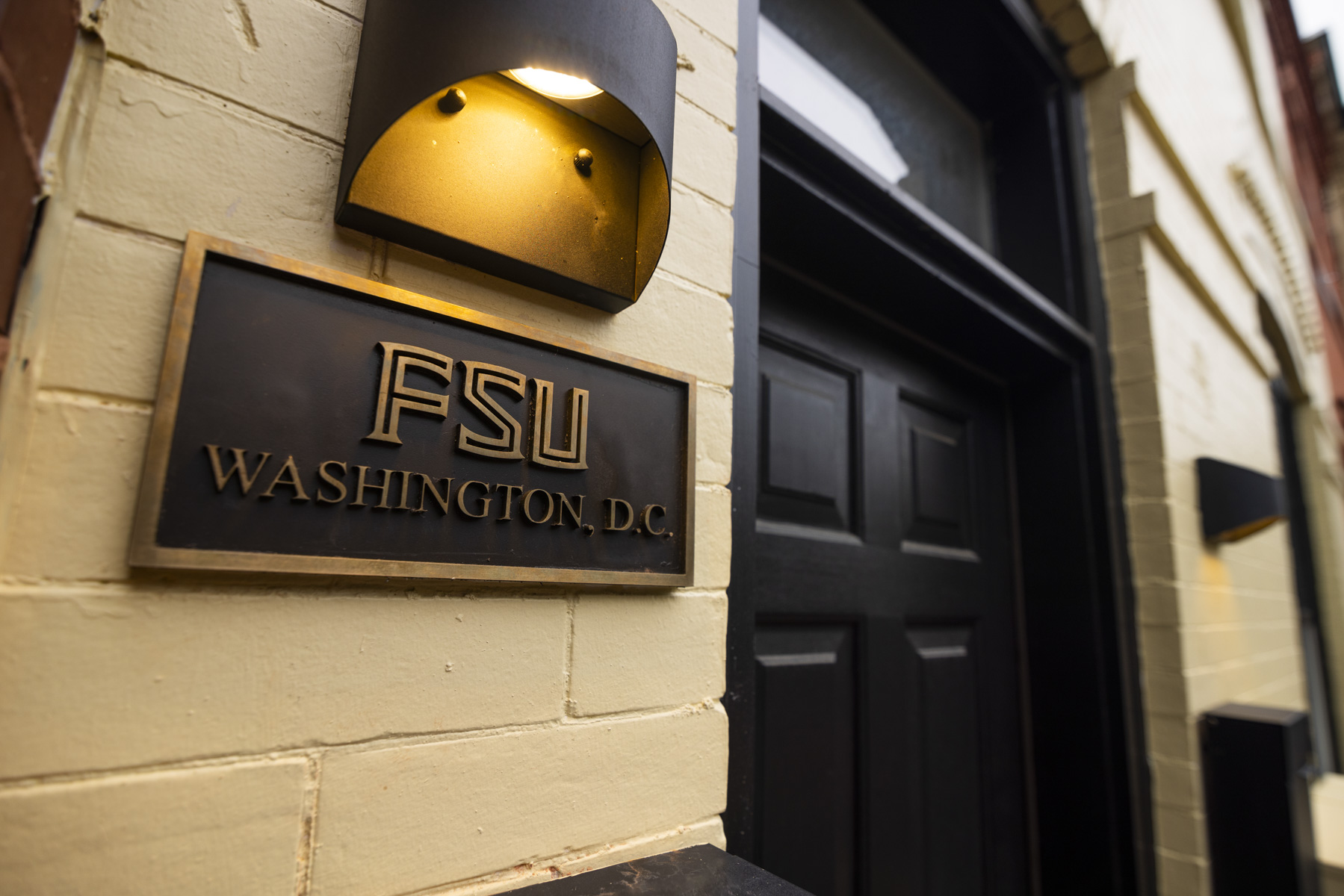
Up close photo of FSU Washington D.C plaque on tan brick building
Red brick building with black door and railing
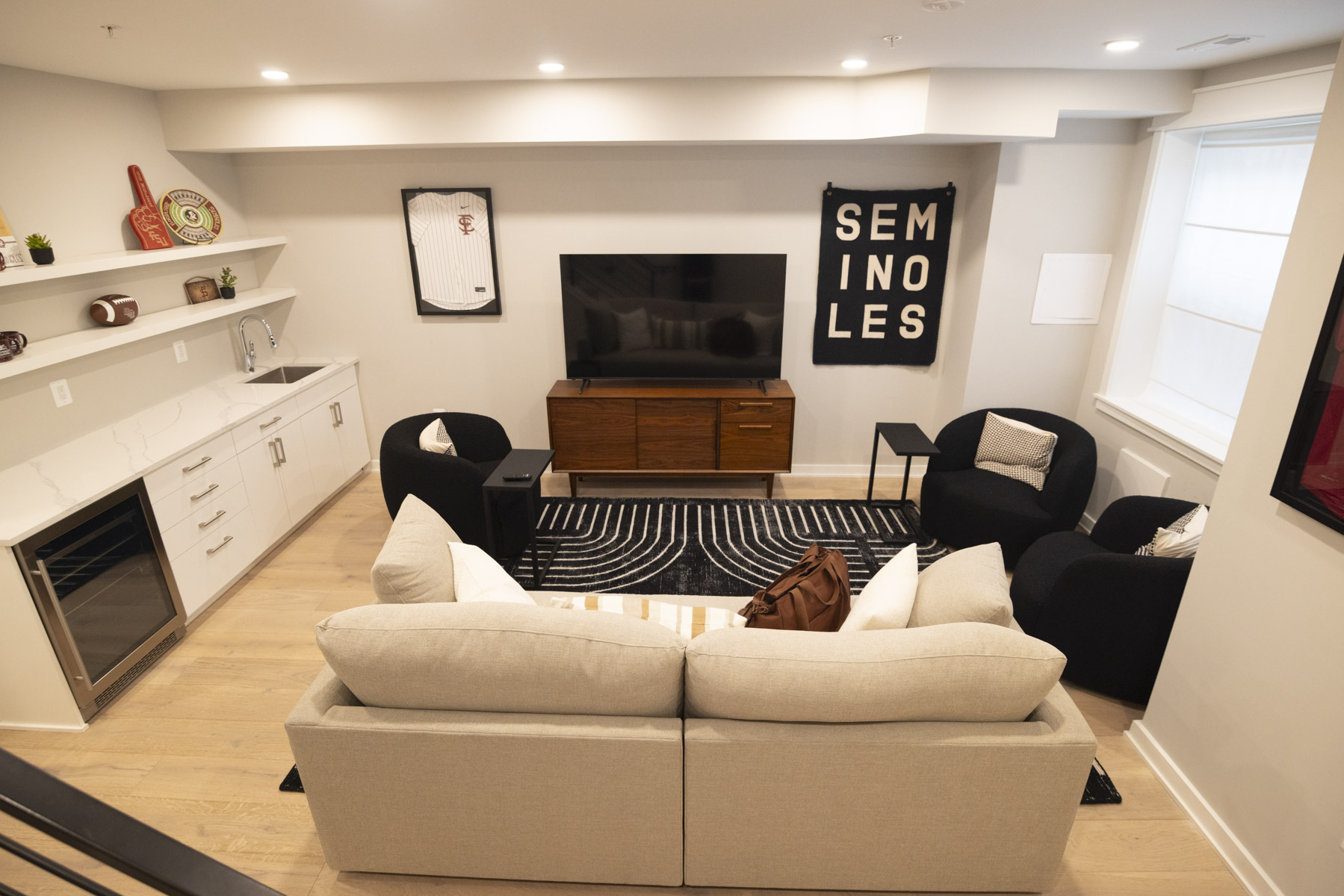
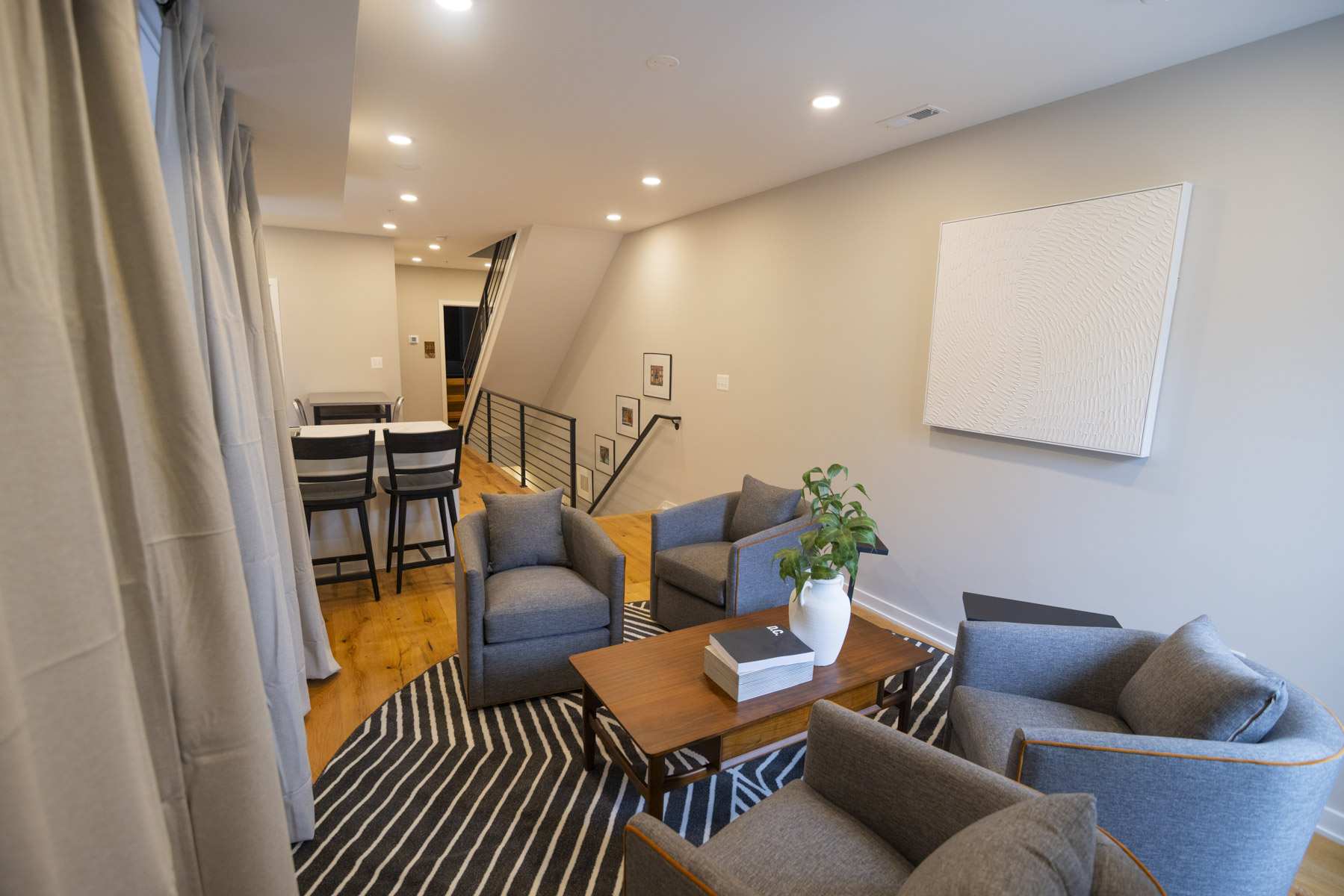
Living space of a student housing apartment with FSU paraphernalia (1/2)
Photo of living space with couches and home decor
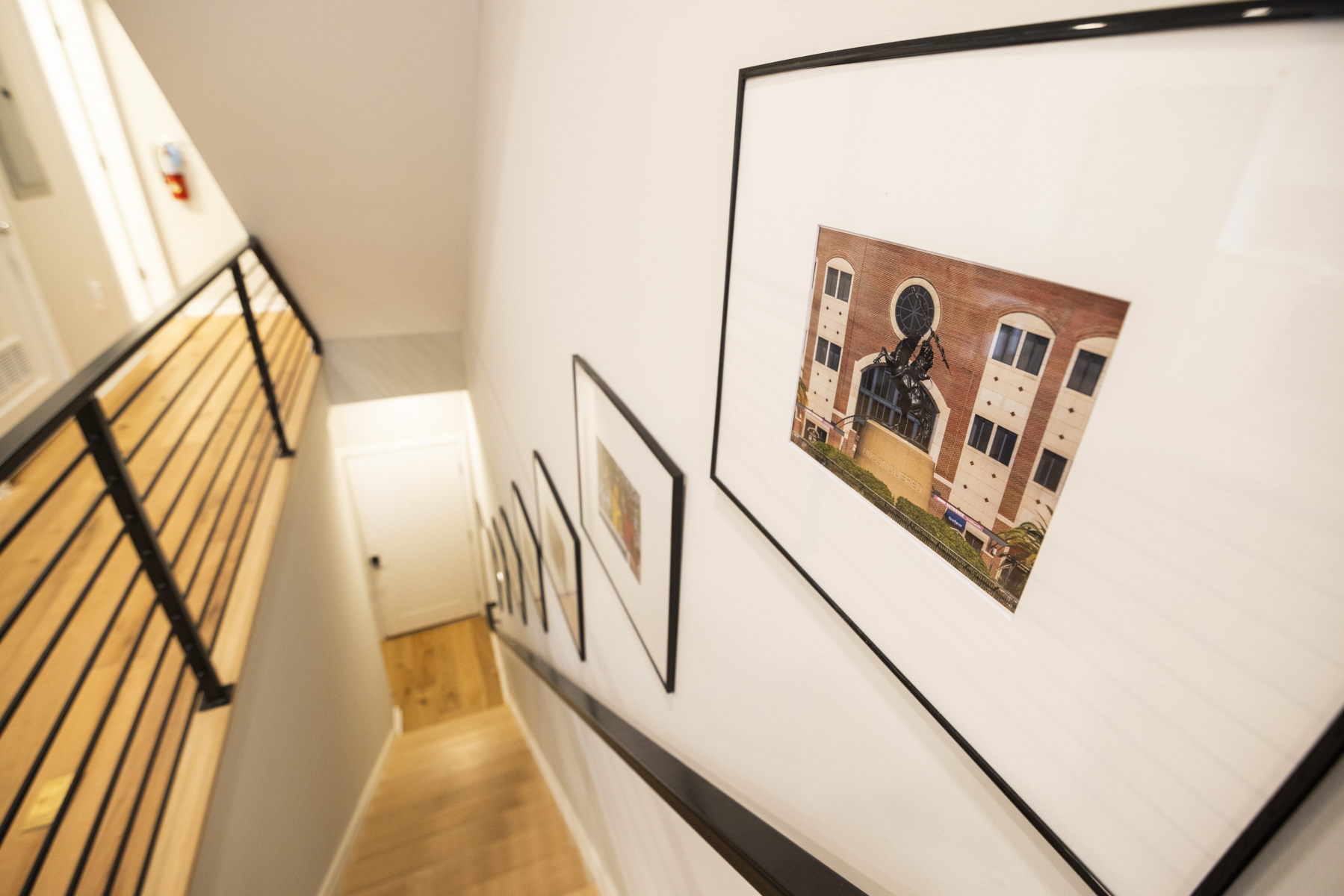
Staircase leading downward, with photo of the FSU stadium on the wall
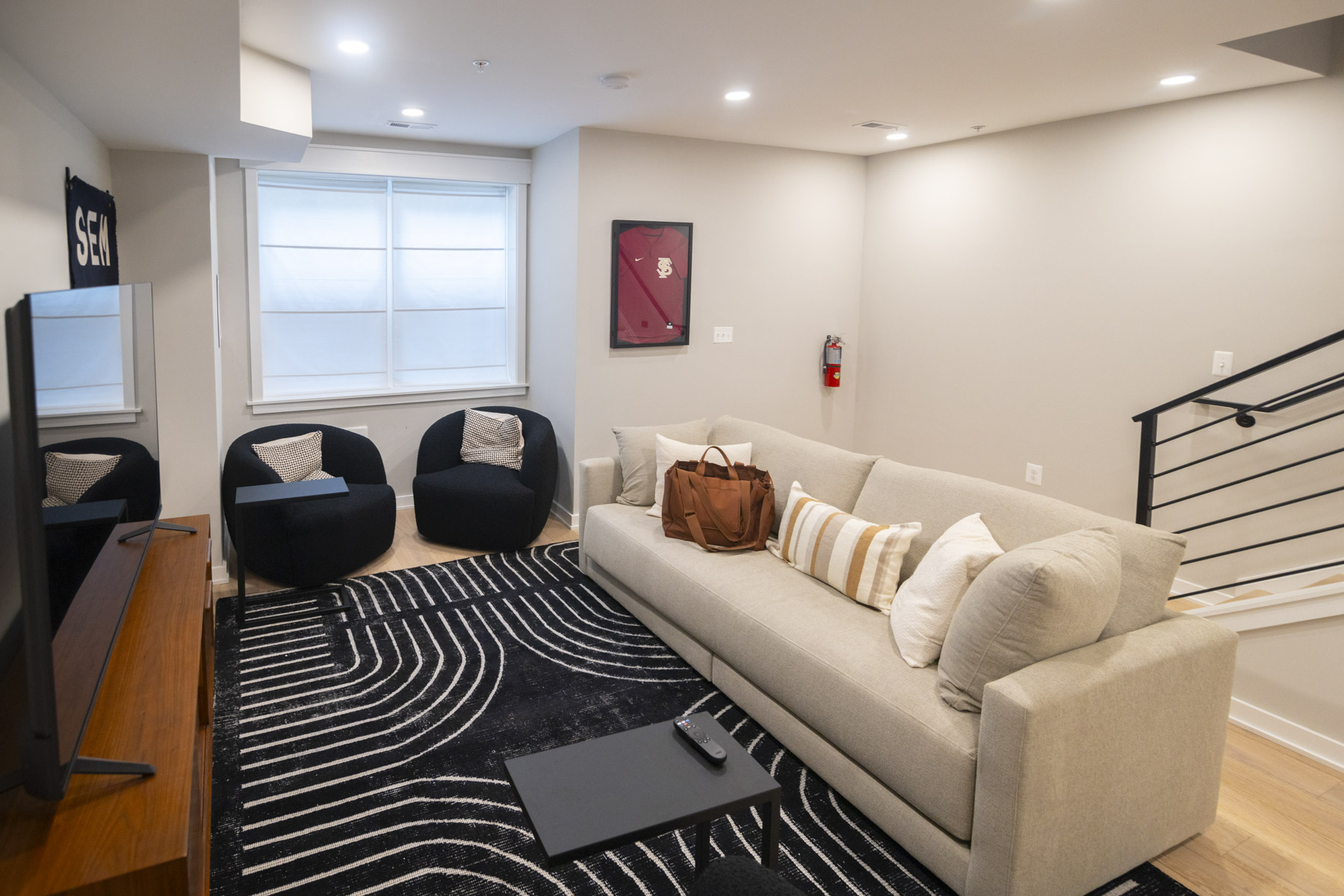
Living space of a student housing apartment with FSU paraphernalia (2/2)
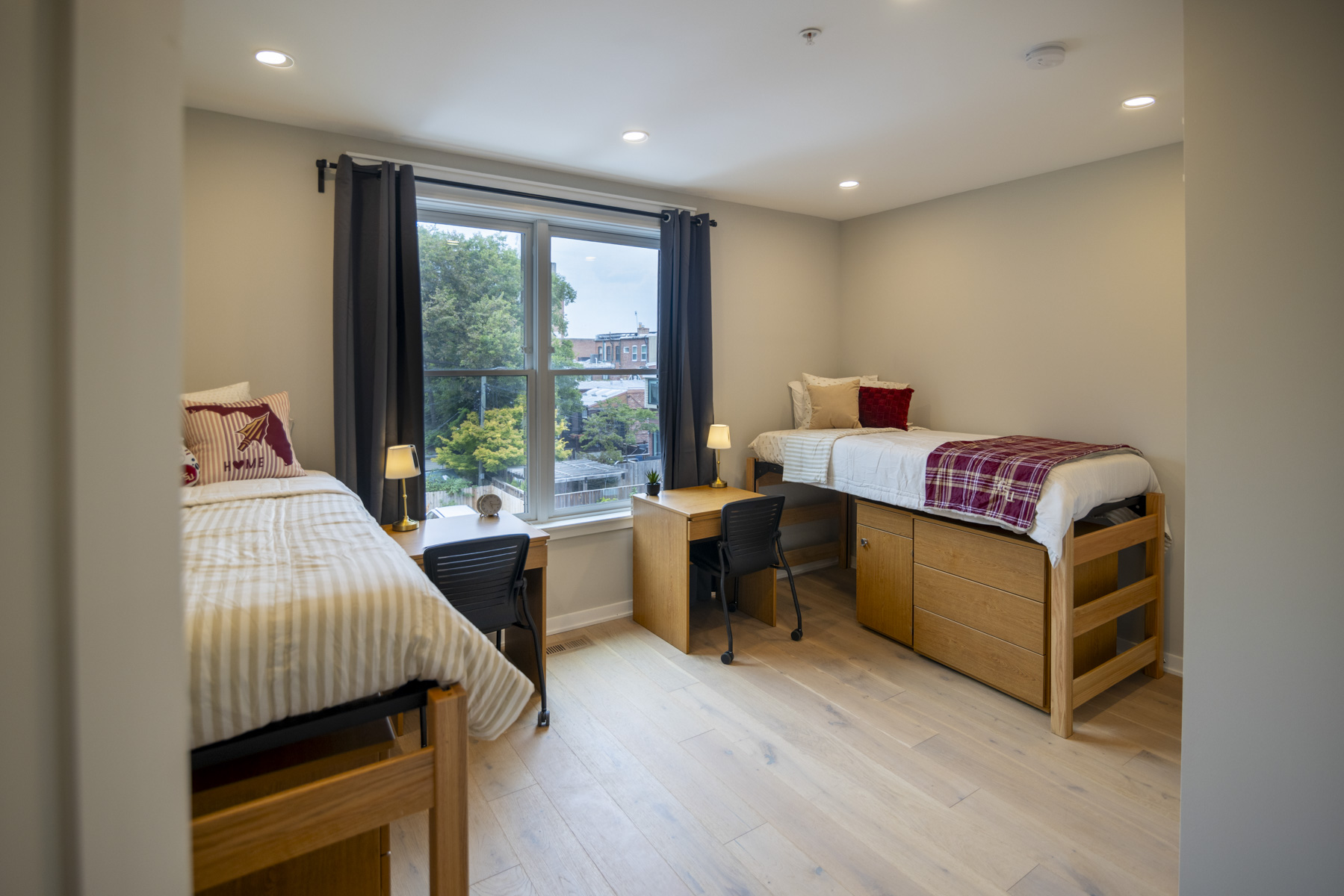
Bedroom from a student housing apartment, with two beds
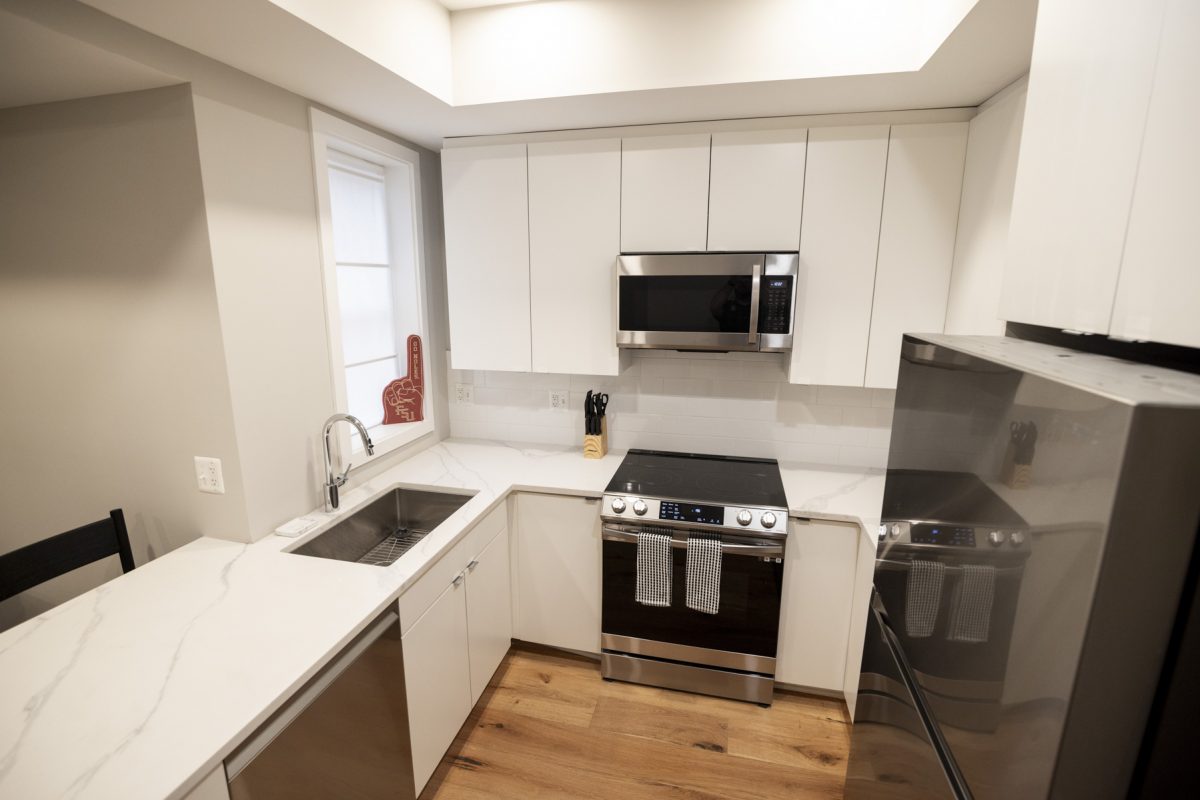
Kitchen with white cabinet 

“Located just blocks from the Capitol, 16 students will soon be able to call this place home, right here on historic Ebenezer Row,” McCullough said. “We’re going to have people coming here for our Study Away Program, where our upper-level undergraduates will live, complete their internships and gain direct experience with agencies. These internships often turn into jobs, whether in the government, with lobbying firms or with corporations; and all of that ultimately helps us. We’re really, really excited for our students to have this opportunity.”

“This property represents our deep commitment to student success and expanding Florida State’s reach,” Hecht said. “With this space, our students will build an incredible community, engage with Washington, D.C., through internships in politics, think tanks, museums and corporations, and return to Tallahassee with new insights and experiences that will shape their careers.”

Currently, 113 Florida State alumni work on Capitol Hill — more than any other school in the state and placing FSU among the top universities nationwide.

“I think it’s all about access to D.C.,” said Josh Duncan, director of federal relations at FSU. “This housing project opens the doors to so many students who wouldn’t have had that opportunity before — it’s life changing. Our goal is to increase this number and further strengthen FSU’s reputation and presence here.”


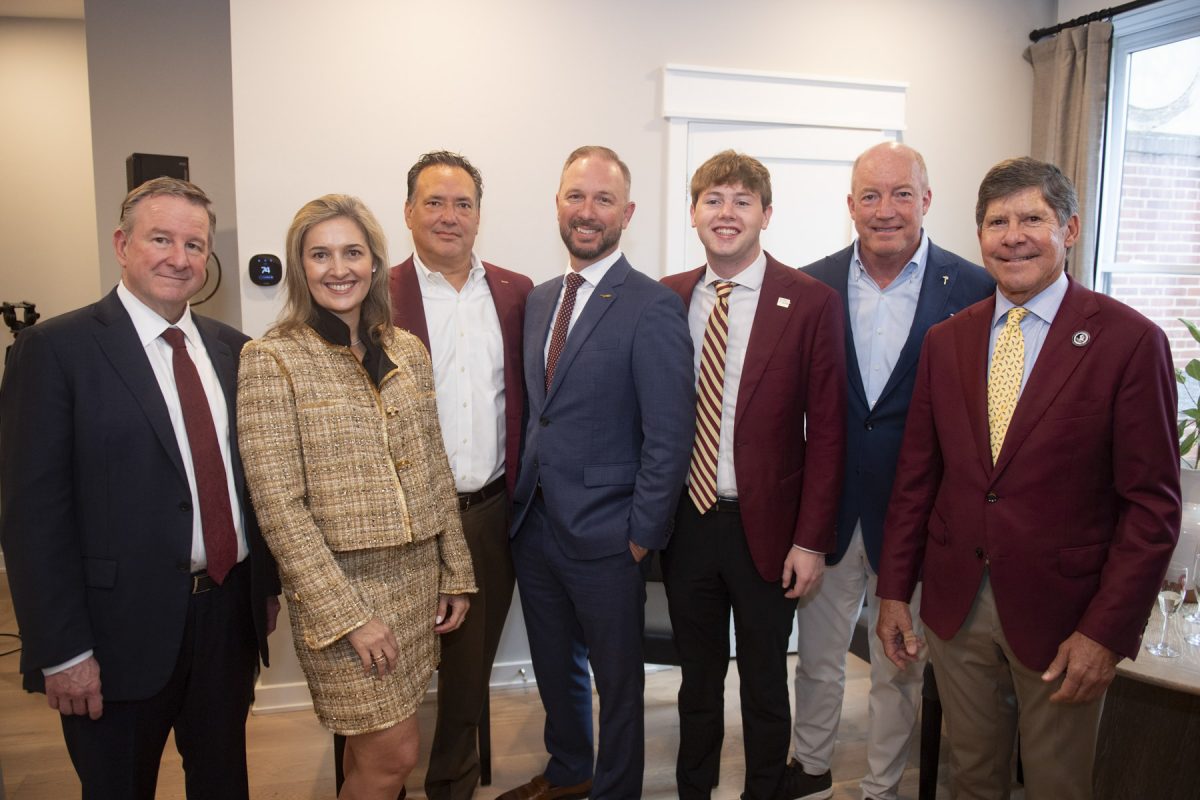
(From left) FSU President Richard McCullough, FSU Board of Trustee members Vivian de las Cuevas-Diaz, Justin Roth, Tim Weisheyer, Carson Dale, Chair Peter Collins and Peter Jones gather to celebrate the new DC housing and internship option for students. (Matthew McConnell/Florida State University)
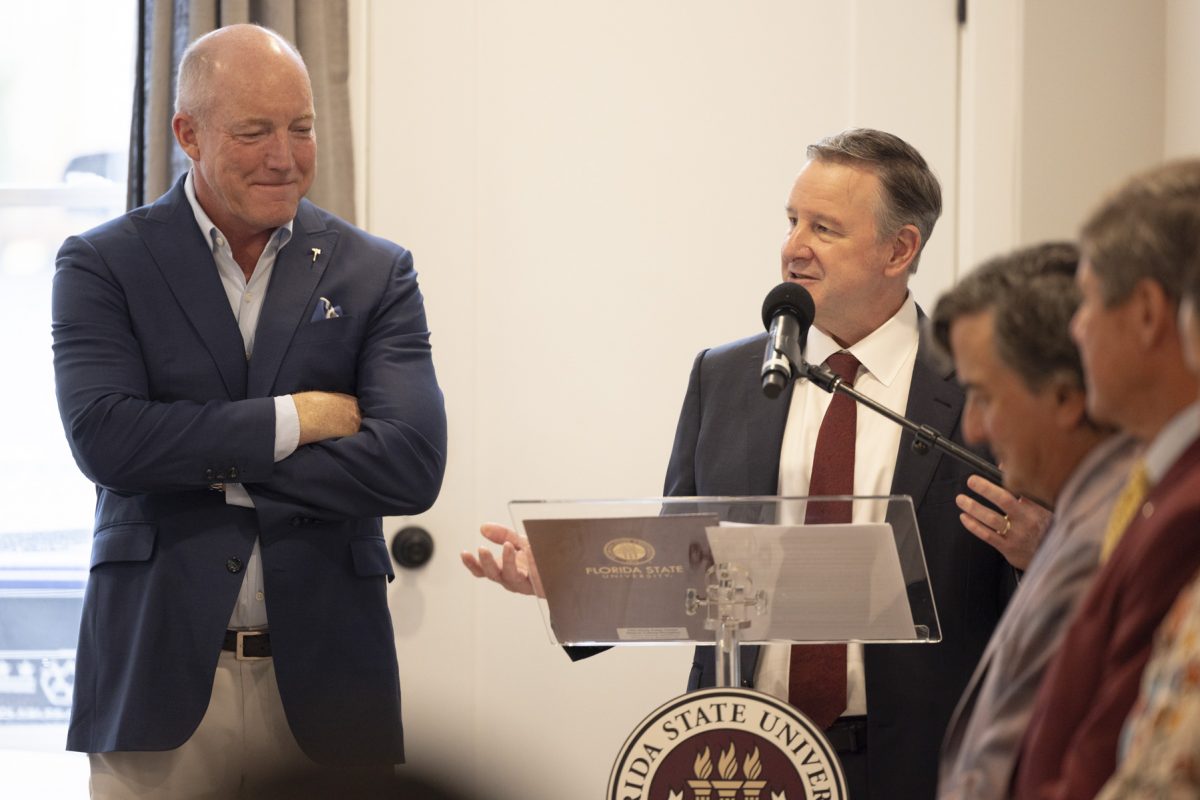
(From left) Chair Peter Collins and FSU President Richard McCullough address the audience unveiling the university's new student housing accommodations in Capitol Hill for students participating in the FSU DC Study Away Program. (Matthew McConnell/Florida State University)
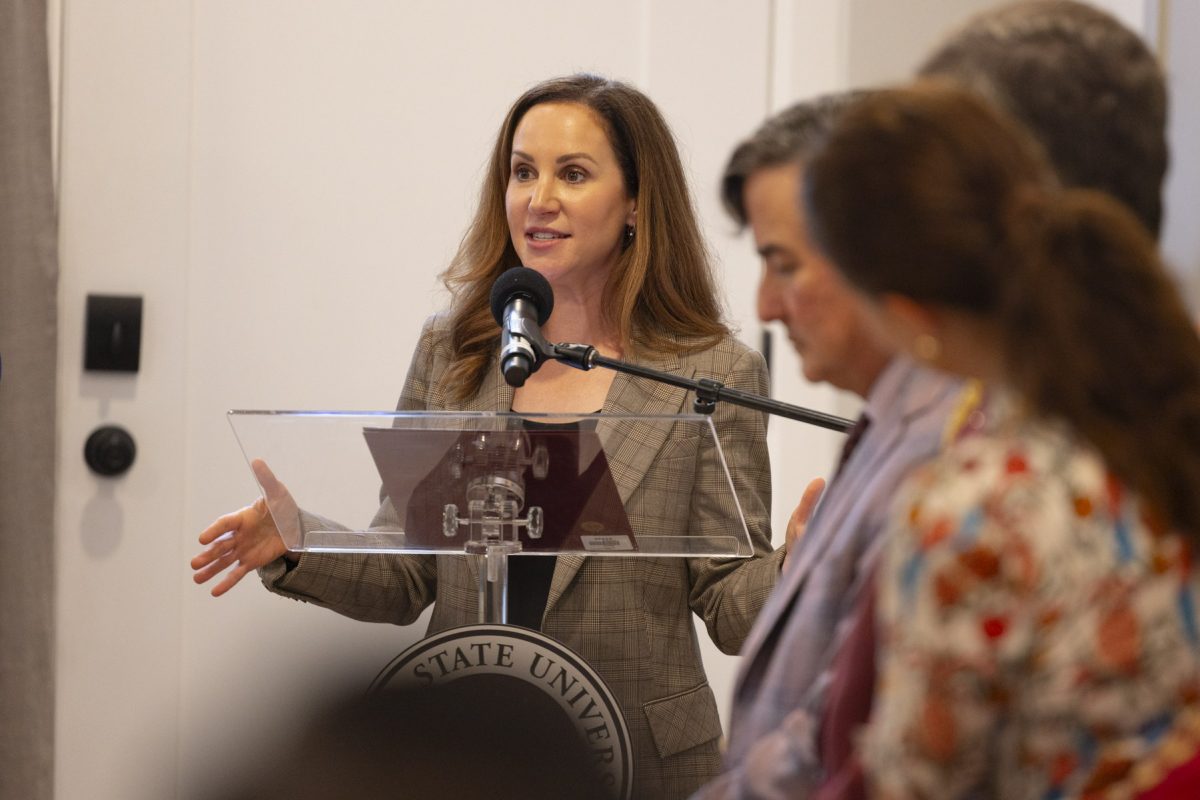
Vice President for Student Affairs Amy Hecht speaks on how the program offers students a place to live within the FSU ecosystem while doing an internship in Washington, D.C. (Matthew McConnell/Florida State University)
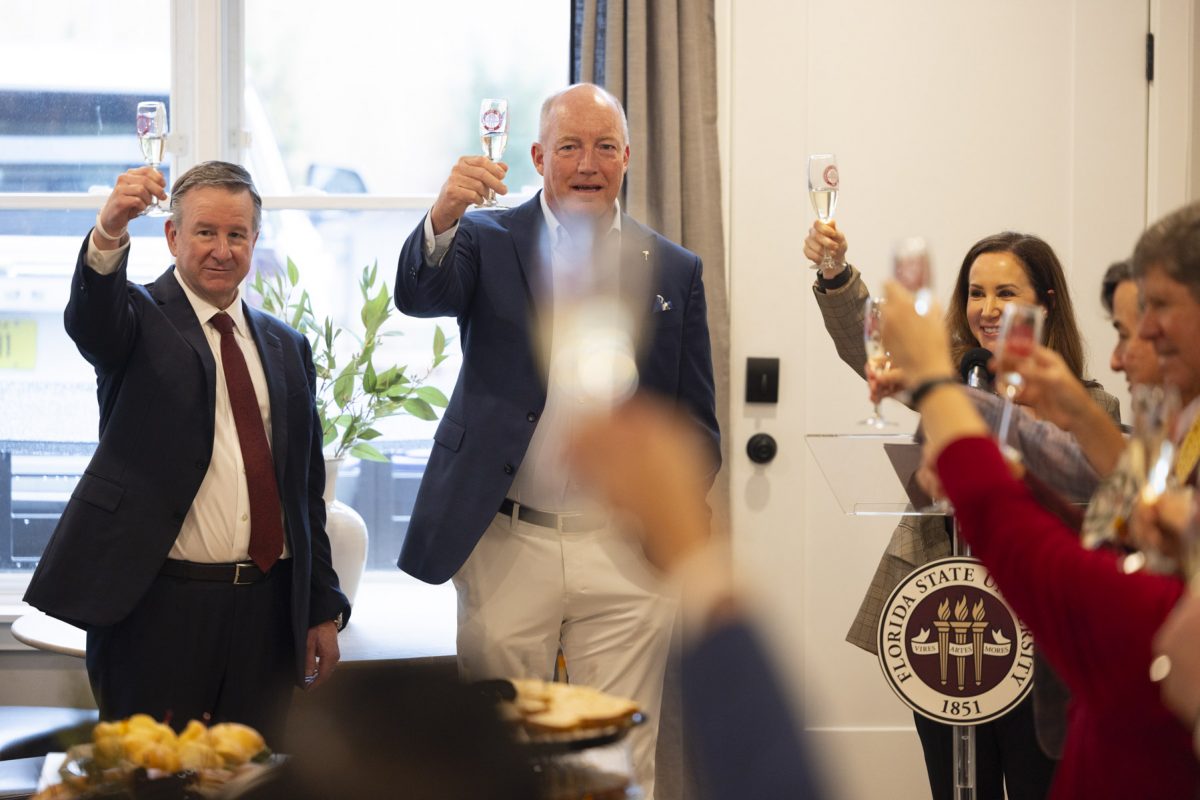
(From left) FSU President Richard McCullough, Chair Peter Collins and Vice President for Student Affairs Amy Hecht raise a toast with attendees to celebrate FSU's Study Away Program and commitment to student success. (Matthew McConnell/Florida State University)


The new housing options include a townhouse and a unit with two condominiums, providing a fully furnished experience with shared amenities. Students will have access to a house manager who offers on-site support, monitors the units and communicates student needs to the FSU Housing Office.

“When they walk in, they’re going to get a living environment that looks a lot like a home, it’s not a residence hall environment,” said Shannon Staten, executive director of University Housing and the Childcare Early Learning Center at Florida State. “They will have a staff member living on site who will be able to give them resources and support — to be a connection to us so if there’s a concern, the students can get to us.”

Students accepted into the program will benefit from a turnkey housing experience that includes utilities, Wi-Fi, laundry and kitchen access — all covered under the program fee. They’ll also be part of a supportive community of fellow FSU students, with opportunities to build lasting connections and gain career-shaping experience.

“This connects the university to the students who are going somewhere else to do that,” Staten said. “It gives them the support that says, ‘no worries, we’ve got you.’”

“FSU is incredible,” said FSU Board of Trustees Chairman Peter Collins. “Knowing that there are 7,500 alumni in D.C. — dedicated students and people in influential roles — we need to continue spreading the word about FSU.”

For students interested in applying and for more information, visit career.fsu.edu/dc-study-away-program. Applications for the spring semester are due Monday, Oct. 13.


A lavish home valued at around $4M will connect UF students and faculty to some of the nation's biggest power brokers.

The Ballards have also donated extensively to Florida State University, Kathryn Ballard’s alma mater. Earlier this year, the couple donated $1 million to FSU for its Food for Thought Pantry, which works to combat food insecurity on campus.

Brian Ballard’s firm, Ballard Partners, also previously launched an FSU scholarship fund in 2020 to honor Gregory Turbeville, who passed away that year at just 49 years old. The scholarship supports students who demonstrate exceptional academic achievement and have financial need.

And the Ballards in 2016 gifted FSU a building valued at $1.1 million to serve as the home of the Jim Moran School of Entrepreneurship and the Jim Moran Institute for Global Entrepreneurship.

UF establishes the Ballard House, a new Gator home steps from the U.S. Capitol

The University of Florida will establish a permanent home in Washington, D.C., steps from the U.S. Capitol, giving Gator students, faculty and university leaders a place of their own in the city where national policy is made.

The property, to be known as the Ballard House, is a gift from Brian and Kathryn Ballard valued at $4.25 million. It will serve as UF’s front door in the nation’s capital: a place where students can learn and grow through academic programs and professional development, where faculty can share their research with Congress and federal agencies, and where the university can convene leaders from government, public service and the private sector.

His wife, Kathryn, is an alumna of Florida State University. She currently serves as a member of the FSU Board of Trustees. The Ballards were selected by three Florida governors to co-chair their gubernatorial inaugurations.


Sunday, October 4, 2026

Florida State Secures $2.1M for Campus Quantum Communication Testbed


Florida State Secures $2.1M for Campus Quantum Communication Testbed

 Florida State University (FSU) will establish a campus-scale quantum communication testing platform with $2.1 million in federal Community Project Funding through the National Institute of Standards and Technology, secured with support from U.S. Rep. Daniel Webster of Florida’s 11th Congressional District.

A view of FSU’s Interdisciplinary Research and Commercialization Building. A federally funded quantum testbed will link a central quantum communication hub in the building with receiver nodes at the FAMU-FSU College of Engineering and the MagLab. Credit: Matthew McConnell/FSU.

The testbed will link a central quantum communication hub in FSU’s Interdisciplinary Research and Commercialization Building (IRCB) with receiver nodes at the FAMU-FSU College of Engineering and the National High Magnetic Field Laboratory (MagLab). Researchers will study how quantum communication hardware and optical links perform under challenging conditions, including strong air turbulence, high magnetic fields and cryogenic thermal cycling.

Quantum communication uses quantum properties of light, including entanglement, to transmit and protect information in ways that are fundamentally different from conventional networks. A major challenge is moving quantum communication from carefully controlled laboratory demonstrations to reliable systems that can operate in real-world conditions.

“Florida State University leads the nation in quantum science and engineering,” said Rep. Webster. “I fought for this investment in Congress as it will help establish the first quantum communications testbed facility in the southeastern United States. These resources will help expand their important work and strengthen American innovation. Advancements in quantum technology are critical to our national security and will help ensure the United States remains a leader in these emerging technologies as we counter adversaries like China.”

The testbed will connect the hub to the nodes through campus fiber resources. It will generate and distribute entangled photons and monitor measures such as link reliability, allowing researchers to improve system performance. The system will also include reconfigurable optical links so researchers can deliberately expose components and communication channels to controlled environmental stresses.

“The next frontier is not simply demonstrating quantum communication in an ideal laboratory, but understanding how to make these systems reliable in the environments where they will ultimately operate,” said Suvranu De, dean of the FAMU-FSU College of Engineering. “This investment gives us a platform to connect fundamental quantum science with engineering validation, workforce development and future partnerships with government, industry and other universities. It is an important step toward secure and resilient quantum networks that can operate in the real world.”

FSU Expands Quantum Research

The project continues FSU’s commitment to advancing research in quantum science and engineering. Since launching the FSU Quantum Initiative in 2023, the university has hired 10 new faculty members to reach a total of 45 faculty members researching quantum topics, developed Florida’s first graduate credential in quantum information science and engineering, hosted the inaugural Florida Quantum Conference and joined with other universities around the state to establish the Florida Alliance for Quantum Technology.

In July, the U.S. Department of Energy chose FSU to lead four major projects as part of the Genesis Mission, including a project to develop AI that acts as a real-time diagnostic system for quantum computers and another to improve scientists’ understanding of atomic nuclei and other quantum systems.

“This is an important research infrastructure investment that can support future quantum-networking activities and position FSU for larger-scale opportunities,” said Wei Guo, professor of mechanical and aerospace engineering, head of the MagLab’s cryogenics lab and co-director of the FSU Quantum Initiative. “Just as importantly, it will give students and researchers hands-on experience across the full quantum-networking stack, from photons and detectors to controls, data, networks and demanding operating environments.”

Friday, October 2, 2026

Who has the best college campus? Ranking the top 25 FBS schools


Who has the best college campus? Ranking the top 25 FBS schools

Niche.com has released its Best College Campuses for 2027 rankings. The rankings are based on statistics and student reviews using data from the U.S. Department of Education. "Top-ranked colleges offer outstanding campus resources across classrooms, labs, performance venues, housing, food, and recreational facilities."


No. 12:Florida State (Tallahassee, Tenn.)

Alicia Devine/Tallahassee Democrat

Wednesday, September 30, 2026

CFP set revenue-sharing program


Top 20 Best College Towns


Florida State University and Tallahassee Memorial HealthCare finalize landmark agreements advancing FSU Health


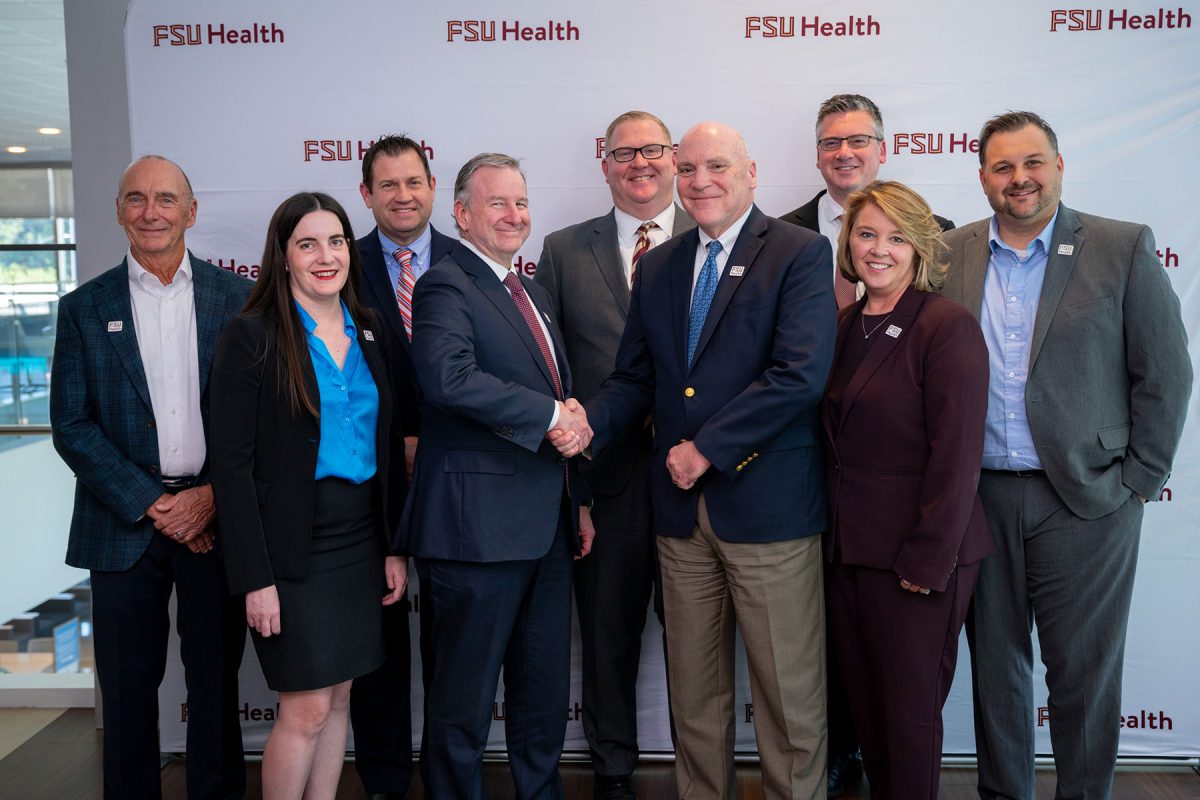
Florida State University and Tallahassee Memorial HealthCare leaders stand in front of a backdrop with the FSU Health logo.
From left: Claude Walker, Board Chair, Tallahassee Memorial HealthCare; Priscilla Needham, Chief Financial Officer, Tallahassee Memorial HealthCare; Andrew Starr, President of the Western Market, Tallahassee Memorial HealthCare; FSU President Richard McCullough; Kyle Clark, FSU Senior Vice President for Finance and Administration; Mark O’Bryant, CEO, Tallahassee Memorial HealthCare; Jeremy Slaga, FSU Vice President and Chief Clinical Operations Officer; Stacey S. Patterson, FSU Vice President for Research; Ryan Smith, President, Tallahassee Memorial Hospital.

Key Points

  • Florida State University and Tallahassee Memorial HealthCare have finalized landmark agreements establishing the long-term framework for FSU Health, an integrated academic health system serving North Florida and beyond.
  • FSU Health will connect academic research, medical education and clinical care, with Tallahassee Memorial Hospital serving as its clinical anchor and a future FSU Health hospital planned for Panama City Beach.
  • Patients will continue receiving care from their established physicians, advanced practice providers, nurses and care teams, while gaining access to expanded research, specialized services and the resources of a Top 25 public research university.

Florida State University and Tallahassee Memorial HealthCare (TMH) have finalized core agreements establishing the long-term framework for FSU Health, an integrated academic health system focused on improving health and expanding access to advanced care and research across North Florida and beyond.  

These agreements include lease and operating agreements and other definitive legal documents, including an academic and clinical framework supporting the partnership at Tallahassee Memorial Hospital and the future FSU Health hospital in Panama City Beach. 

“Today marks a defining step forward in our shared vision to build an academic health system that will serve our community and our state for generations to come,” FSU President Richard McCullough said. “Through FSU Health, with Tallahassee Memorial Hospital as its clinical anchor, Florida State University is bringing together the people, expertise and resources needed to improve lives, expand access to advanced care and create new opportunities for medical education and research across North Florida and beyond.”  

Tallahassee Memorial HealthCare Inc. will serve as a cornerstone of FSU Health, bringing trusted expertise in community-based care, an extensive network of physicians and advanced practice providers, and leading specialty and advanced-care services. 

“For nearly 80 years, TMH has grown alongside this community, always looking for new ways to bring better care closer to home,” said Mark O’Bryant, chief executive officer of Tallahassee Memorial HealthCare. “Our work with FSU, including the academic medical center strategy we developed together in 2021, has created an opportunity to build on that legacy in ways we could not achieve alone. Our patients, physicians, advanced practice providers and colleagues can expect the same commitment to exceptional, compassionate care, strengthened by new opportunities to advance medicine, educate future healthcare professionals and bring more specialized care and innovation closer to home.” 

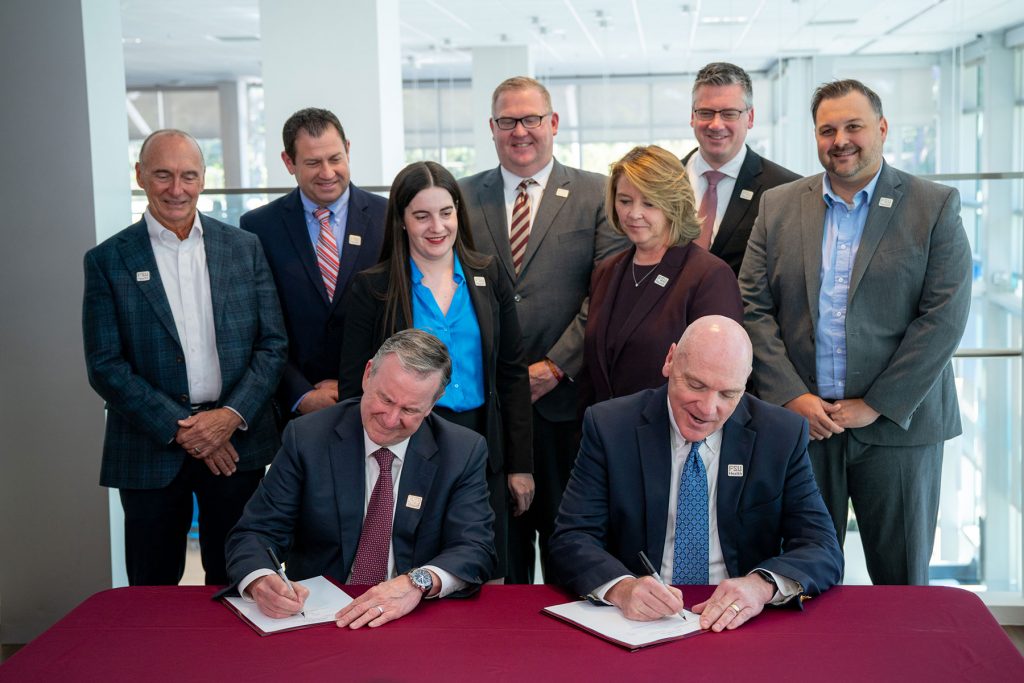
Florida State University and Tallahassee Memorial HealthCare leaders sign documents at a table with colleagues standing behind them.
(From left) Sitting: FSU President Richard McCullough and Mark O’Bryant, CEO, Tallahassee Memorial HealthCare. Standing: Claude Walker, Board Chair, Tallahassee Memorial HealthCare; Andrew Starr, President of the Western Market, Tallahassee Memorial HealthCare; Priscilla Needham, Chief Financial Officer, Tallahassee Memorial HealthCare; Kyle Clark, FSU Senior Vice President for Finance and Administration; Stacey S. Patterson, FSU Vice President for Research; Jeremy Slaga, FSU Vice President and Chief Clinical Operations Officer; Ryan Smith, President, Tallahassee Memorial Hospital.

Tallahassee Memorial HealthCare Inc. will continue managing day-to-day operations under the FSU Health brand at Tallahassee Memorial Hospital, the future Panama City Beach hospital, TMH’s other clinical care locations and its employed physician network, TMH Physician Partners. Patients will continue receiving care from their established physicians, advanced practice providers, nurses and team members, while benefiting from the added strengths and capabilities of a Top 25 public research university. 

The agreements build on an academic health center strategic alignment plan that started in 2021 and the transfer of city-owned hospital assets to FSU earlier this year and establish the long-term governance, operational and academic framework supporting the continued growth of FSU Health across North Florida and the Panhandle. They also preserve TMH’s existing charity care policy at both hospitals and establish a new governance structure that gives FSU the ability to nominate candidates for boards in Tallahassee and Panama City Beach.  

As the region’s only academic health system, FSU Health will connect patients with leading physicians, advanced treatments, clinical research and specialized services while training the next generation of healthcare professionals. Future plans for FSU Health in Tallahassee include developing new graduate medical education programs in high-demand specialties such as trauma surgery, minimally invasive and bariatric surgery and pulmonary and critical care medicine. 

Patients and the community can learn more about the partnership at TMH.ORG/FSUHealth  

Wednesday, September 23, 2026

A necessary sacrifice: Saying goodbye to FSU campus residence halls


/A necessary sacrifice: Saying goodbye to FSU campus residence halls

Rejoice, parking spot chasers! A new parking garage is coming to the FSU campus in Summer 2027 through the Northwest Campus project.

The Northwest Housing & Dining project refers to FSU's plans to modernize the Northwest side of campus by replacing Rogers, McCollum, and Salley halls and, in their place, building a 10-story, 1,200-bed residence hall, a 765-seat dining hall, and a 930-space parking garage.

The new housing and dining facilities are estimated to open in Summer 2028, and the new parking garage is set to open in Summer 2027. That means next Fall semester, hopefully, there won't be as much trouble finding parking on campus.

Rejoice, parking spot chasers! A new parking garage is coming to the FSU campus in Summer 2027 through the Northwest Campus project.

The Northwest Housing & Dining project refers to FSU's plans to modernize the Northwest side of campus by replacing Rogers, McCollum, and Salley halls and, in their place, building a 10-story, 1,200-bed residence hall, a 765-seat dining hall, and a 930-space parking garage.

The new housing and dining facilities are estimated to open in Summer 2028, and the new parking garage is set to open in Summer 2027. That means next Fall semester, hopefully, there won't be as much trouble finding parking on campus.

During the FSU Board of Trustees meeting on Aug. 28, FSU announced that it has “the funding secured” for the estimated $365 million project. This makes the Northwest Expansion the most expensive ongoing project FSU has undertaken since the Doak Campbell Stadium renovations in 2025, which totaled $265 million. It also overshadows the 2026 construction of the Herbert Wertheim Center for Business Excellence, which cost $65 million and was received as a donation.

The last time FSU opened a newly constructed housing facility and dining hall was in 2017 with the opening of 1851 and Azalea & Magnolia Halls. The last parking complex constructed and opened was Pensacola Street Garage in 2012, and every FSU student with a car knows just how evident that lack of new parking projects is.

Over the years, these dorms have been monumental institutions of FSU’s campus and have housed tens of thousands of students since their creation.

The destruction and closure of these buildings will mean saying goodbye to a large part of FSU’s history. Roger’s Hall was first opened in 1965, originally to house married students, and was later opened to undergraduates.

McCollum Hall was originally known as "Hall X" when it was first built in 1975 and has received renovations from 2005 to 2011.

The infamous Salley Hall was constructed in 1964 and originally housed the football team. It was also the first dorm to become co-ed, and its latest renovation was completed in 2000. Today, Salley is known for not necessarily being the top choice for dorms, but those who stay there freshman year tend to leave with interesting stories and the title “Salley Survivor."

It is certainly sad to see these notable pieces of FSU go, and some would say renovating these dorms would be the best step to continue the legacy of these complexes instead of building a new housing facility.

This new construction is set to offer roughly 250 more beds than the 950 beds offered by McCullom, Rogers, and Salley combined. This increase in housing will allow more students to live on campus in brand-new facilities. Not to mention, the inclusion of a new dining hall and parking garage is undoubtedly great for students.