Construction is underway for a business incubator within Innovation Park that's considered the missing piece to the region's entrepreneurial ecosystem.
A regional first, the $24-million North Florida Innovation Labs is geared toward startups and growing technology companies that need specialized lab facilities to commercialize and grow their innovations.
The 40,000 square-foot facility is slated to be complete by 2024. With 31 labs, the facility will be home to a mix of labs, including biology, chemistry and flexible workspace, and a machine shop to build prototypes.
Until now, there hasn't been a space under one roof where innovations out of the research realm could go to the next level toward commercialization, said Bill Lickson, the lab's executive director.
"This facility will allow entrepreneurs and technology related fields like biology chemistry, pharmacy, engineering, robotics and others to scale technology companies right here," Lickson said.
This lab, for example, allows companies that are creating robots or submarines a place to build those things.
Startups are often forced to travel long distances, sometimes out of state, to use lab space to advance their products and services. The closest comparable facility to the North Florida Innovation Labs has been the Sid Martin Biotechnology Incubator, two hours away in Gainesville.
The incubator is made possible by several funding sources, including more than $12 million from the U.S. Economic Development Administration, $2.5 million from the Tallahassee-Leon County Office of Economic Vitality and $2.5 million from the Leon County Research and Development Authority, that governs Innovation Park.
Officials say the labs and programs stemming from the facility will produce over 600 full-time jobs in Tallahassee and the region along the I-10 corridor.
During the groundbreaking ceremony, Florida State University President Richard D. McCullough said the laboratory facility is a "wise investment that will reap dividends for generations to come."
"It’s about more than bricks and mortar," he said. "It’s about creating a space that will allow us to harness the entrepreneurial spirit in this community and combine it with scientific discovery to create new products, bring them to the marketplace and drive the economy."
A Florida State University program that helps and inspires Gadsden County students to finish high school and college is about to get bigger and stronger.
FSU’s Upward Bound will receive about $3.5 million from the U.S. Department of Education to continue to build its decades-long Gadsden County operations and to expand to Jackson County, said DeOnte Brown, assistant dean of undergraduate studies and director of the university’s Center for Academic Retention and Enhancement, or CARE, which oversees the program.
CARE will receive about $2.1 million for Upward Bound in Gadsden County and about $1.4 for Jackson County. Both grants cover five-year cycles.
Florida State University’s trademark and licensing team is being recognized as an innovative industry leader by the International Collegiate Licensing Association (ICLA).
The licensing and trademark office oversees FSU’s trademarks, symbols, imagery and associated insignias. It’s a two-person team comprised of Katie Pugh, director of trademark licensing, and Garrett O’Connor, assistant director.
The ICLA announced this week that FSU won the group’s 2022 Synergy Award, bestowed for innovative excellence and contributions to the licensing industry. The organization also made note of the team’s efforts during the pandemic.
“Congratulations to Florida State for being named ICLA’s 2022 Synergy Award winner,” said ICLA President Karen Dertinger, director of trademark licensing at The Ohio State University. “A prime example of innovative excellence, FSU’s licensing office launched several new programs during the continued difficult economic landscape, boosting engagement across all segments of their university and community fan base.”
Revenue generation, brand protection, campus collaborations and innovations are among the criteria evaluated for the award.
TMH CEO Mark O’Bryant called the initiative a game-changer for Tallahassee and the delivery of health care across the Panhandle. He predicts it will result in a “dimension of research this community has never experienced.
“Think UF Shands, Emory, Moffitt, Vanderbilt. Those types of programs. We’re moving down that pathway,” said O’Bryant.
He credits FSU with securing the money from the Legislature for a plan the two institutions have yet to fully develop.
FSU's and TMH's goals intersect at the hospital's interest in expansion as an academic health center – a free-standing teaching hospital affiliated with a university – and new FSU President Richard McCullough’s desire to increase funding for biomedical and clinical research.
The university and TMH have worked together closely since FSU's medical school was founded 20 years ago.
TMH is FSU’s primary training and residency location for medical students. The two also collaborate on research, and share a few jointly funded positions.
Their plan now is to forge that partnership into a research alliance that attracts physician scientists to Tallahassee to advance clinical research and the delivery of health care.
“From the lab to the bed,” is McCullough’s description of how work at the health center will translate clinical research into practical application.
This month he had a $125 million down payment from the state in hand to make it a reality.
“The data shows us that FSU plays a key role in training the next generation of health care professionals with a high percentage of their graduates staying here in Florida to practice," said Simpson.
Proponents said the health center also will benefit existing programs in high-need areas such as nursing, geriatrics, psychiatry and emergency medicine.
The plan Simpson and the Legislature bought into was developed in the Spring of 2021 when the governing boards of both FSU and TMH approved a strategic plan to work closely on the latter's expansion as an academic health center.
The two institutions agreed to jointly fund up to 30 positions for practicing physicians who want to do research. The physician scientists will hold FSU faculty positions and TMH practicing privileges.
The expectation is the physician scientists will generate at least an additional $40 million annually for medical research.
FSU and TMH are engaged in ongoing talks on what will be the new health center's areas of expertise.
O’Bryant said TMH’s strengths are in heart, vascular, neurological and orthopedic care and research.
McCullough mentions neurology and imaging, cardiology, and psychiatry as possible fields in which the partnership could excel and where it could place a FSU-TMH brand, similar UF Shands' association with cancer treatments and organ transplants.
But for now, McCullough said, FSU and TMH find themselves in a unique situation.
“We have the funding for the building, before we actually have an agreement,” he said.
“We haven't figured out what's the sweet spot between FSU and TMH, in terms of what are going to be the areas that make the most sense,” said McCullough.
In the meantime, TMH has put aside up to 10 acres on its 155-acre campus on city-owned property for the new FSU health building.
When construction is completed within three years and it is fully staffed, the center is expected to generate $200 million in economic activity annually, through its research and delivery of care.
“And when you think how those are new dollars coming into the community that's re-spent — typically a multiplier effect is three times — so the economic impact of this in the community, it’s going to be 600-plus,” said O’Bryant.
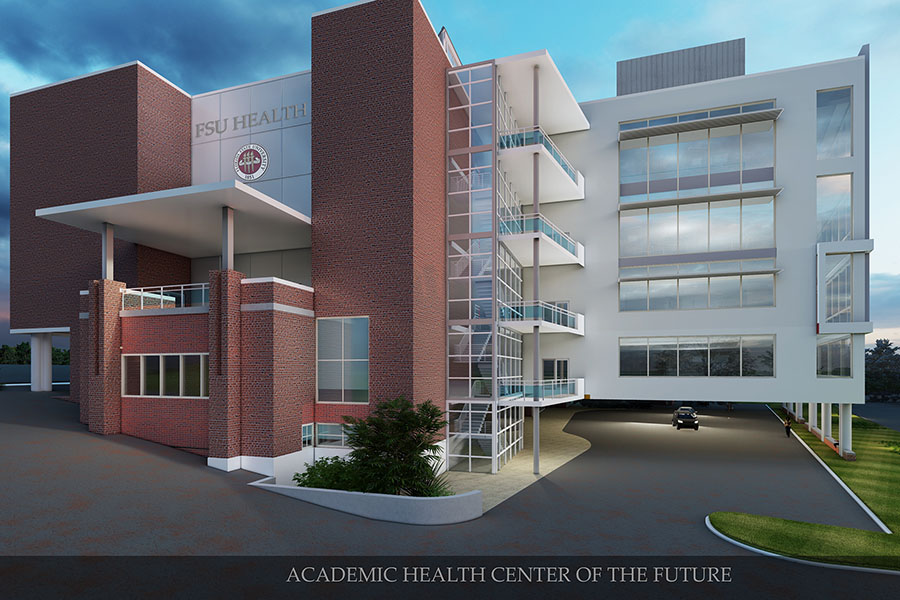
This rendering is an artist's vision of a possible design for the future FSU Health building.
Florida State University and Tallahassee Memorial HealthCare announced today a new partnership to build the FSU Health Tallahassee Center, a new facility that will offer advanced medical training and translational research opportunities and explore the academic health center of the future.
The building, funded by a $125 million appropriation from the Florida Legislature, will be located on the TMH campus and include educational, medical and research laboratory space while drawing on the knowledge and expertise of TMH clinicians and faculty from the FSU College of Medicine and College of Nursing.
“Combining advanced research and clinical care, FSU Health Tallahassee Center will facilitate the transformation of Tallahassee into a regional health care destination attracting patients from throughout the area and neighboring states,” said FSU President Richard McCullough. “The FSU Health Tallahassee Center provides FSU the potential to transform health care delivery, education, and biomedical research throughout Florida, surrounding states, and the nation.”
The center will provide about 130,000 gross square feet of medical and research-related space distributed over five floors. It will accommodate an estimated 30 principal investigators, producing an estimated $40 million of additional annual grant funding, focused on clinical trials, data-driven precision health, digital health and clinical informatics, and clinical and translational research.
“While a long relationship has existed between FSU and TMH, this partnership aligns two prestigious organizations to drive greater value locally, regionally, and for the state of Florida,” said Mark O’Bryant, president and CEO of Tallahassee Memorial HealthCare. “The collaboration will catalyze the development of an innovation district with focus on transformative clinical care, research, biomedical innovation, and education.”
TMH is a leading not-for-profit health system and nationally recognized as one of the best hospitals in Florida by U.S. News & World Report and is located minutes from the FSU campus. Over the years, TMH has experienced tremendous growth, developed highly specialized clinical services, and expanded access points in the community with a continued growth trajectory.
The university has partnered regularly with TMH over the past two decades. The College of Nursing has housed the TMH Center for Research and Evidence Based Practice since 2013. And this past year, the university and TMH jointly hired a chief clinical research officer to lead all clinical research efforts between the two institutions.
Although the new facility will have a research focus, it also will enhance the university’s training opportunities for the next generation of health care workers. FSU plays an essential role in training clinicians. Nearly 60% of FSU’s physician alumni practice in Florida or a Florida bordering county. In addition, more than 60% of FSU’s nursing alumni reside in Florida.
“The new FSU Health Tallahassee Center will provide an ideal environment to support the innovative curricula of our colleges of Medicine and Nursing,” McCullough said. “These educational offerings will attract and retain high-caliber students, residents and faculty by inspiring them with an environment of continuous learning and discovery.”
The preliminary conservative economic impact of the new Academic Health Center alone is expected to add more than $217 million annually and support more than 1,500 jobs directly and indirectly. During the three-year construction phase, roughly 1,200 jobs will be created. Post construction and activation, the center will sustain more than 350 permanent and high-paying jobs.
Florida State University is set to receive $125 million from the Legislature for a proposed project to build an academic health center in Tallahassee.
The funding will help FSU plan and build the Florida State University Health Science Tallahassee Center. The 137,700-square-foot building, whose funding was backed by Senate President Wilton Simpson, will be the cornerstone of development of an academic health center in partnership with Tallahassee Memorial Healthcare (TMH). The facility will be focused on clinical care, research, biomedical innovation and education, said FSU spokesperson Dennis Schnittker.
The budget represents the consensus between the House and the Senate for the state’s financial priorities. Individual spending items are still subject to the Governor’s veto pen, however. Last year, Gov. Ron DeSantis was thought to have wielded a relatively light touch when he slashed $1.5 billion out of the $101 billion budget.
The center will co-locate FSU’s medical and nursing education with clinical and translational research. The university hopes the health center will attract biomedical-related companies and highly skilled faculty, doctors and medical professionals who want the benefits that come with having an advanced education and health care institution like the center.
The five-story building will house the FSU College of Medicine’s Annex Internal Medicine Residency program, the TMH Family Medical Residency program, the Tallahassee Regional Medical School Campus, clinics, simulation labs, and research space for students. FSU Health will also house at least 35 principal investigators, or an individual responsible for the preparation, conduct, and administration of a research grant. The investigators will produce an estimated $17 million in additional grant funding for research.
The facility is projected to have an economic impact of about $217 million annually and support more than 1,500 jobs directly and indirectly, according to Schnittker. During the three-year construction phase, approximately 1,200 jobs will be created.
Another allocation FSU received was $20 million earmarked for operational enhancement. Schnittker said the funding will allow the university to continue to pursue a further climb in the national rankings by hiring more faculty to reduce the student-to-faculty ratio, update facilities and other goals.
In a statement to Florida Politics, FSU President Richard McCullough thanked the Legislature, as well as Speaker Chris Sprowls, Simpson and DeSantis.
“FSU has demonstrated an incredible return on investment of targeted state funding by becoming the fastest improving institution among the Top 50 public universities. Florida State University is grateful for the continued support and investment of the Florida Legislature,” McCullough said. “The support we have received from the state of Florida over recent years has propelled the upward trajectory of FSU.”
FSU also received millions in other allocations, including:
— $72,042,052 for deferred maintenance of FSU, FSU Panama, and FAMU/FSU engineering program buildings.
— $21,256,475 for the FAMU-FSU College of Engineering.
— $8,310,017 for electric infrastructure at FSU’s Magnetic Field Laboratory.
— $10,000,000 for FSU Institute of Child Welfare.
— $1,450,000 for the FSU Multidisciplinary Educational Services Center.
— $1,467,667 for need-based financial aid.
— $1,562,563 for FSU Center for Autism.
— $1,803,970 for a nursing education program grant.
— $500,000 for the FSU Student Veterans Center.
— $200,000 for American Legion’s Boys and Girls State programs.