Friday, November 8, 2019

Ignition Tradition? A Case Study of the Florida State University Athletics Department’s 2014 Logo Redesign


https://www.researchgate.net/publication/325301659_Ignition_Tradition_A_Case_Study_of_the_Florida_State_University_Athletics_Department's_2014_Logo_Redesign

Discussion and Implications

In terms of the results, FSU Athletics Department representatives indicated
that during their two-year process of working on the new brand marks, the
opinions of former and current student-athletes, current coaches, Seminole
Boosters, and the Seminole Tribe of Florida were included. While the exact
number of individuals included in this process is not known, it does appear that
FSU Logo Redesign
10
several important constituent groups (e.g., students, alumni who were neither
Seminole Booster members nor former student-athletes) were not included. In
other words, the opinions of two of the largest groups of FSU stakeholders were
not included. Moreover, groups like “current coaches” may have limited interest
in FSU’s brand marks, because their job responsibilities include managing their
teams and winning intercollegiate competitions, not what logos are used or
displayed by the Athletics Department.
In addition, FSU Athletics Department representatives indicated that “you
have to stop your focus group somewhere” (Slade, 2014c). While having too many
opinions is a genuine concern in any data collection, modern survey research
techniques can be utilized with great eect to gather the opinions of large groups of
people. As noted by Slade (2014a), FSU had promoted the changes to the original
logo as “subtle,” and the primary word FSU Athletics ocials used to describe
the changes was “rened” (Seminoles.com, 2014). Aer the new logo rst was
photographed at Walmart and shared on social media, many people felt it had
undergone much more than subtle changes or renements (TomahawkNation.
com, 2014). ere is little doubt that because the logo was initially revealed on
social media, rather than through more traditional university-controlled press
releases and events, FSU was not able to control the narrative and eectively
discuss the redesign process. However, as noted by Slade and others, FSU also may
not have accurately represented the purpose and extent of the redesign (2014a,
2014b, 2014c).
Regarding the reported behaviors over the last 12 months compared to the
intended future behaviors in the upcoming 12 months, the results indicated that
the eect of not changing the logo would result in increases for both the amount
of FSU-branded merchandise respondents intended to purchase, and the amount
of FSU-branded merchandise they intended to wear (3.9 to 4.1 and 4.2 to 4.3
respectively), while a change from the original logo to the new logo would result in
a large decrease between the last 12 months and the upcoming 12 months in terms
of the amount of FSU-branded merchandise respondents intended to purchase,
and the amount of FSU-branded merchandise they intended to wear (3.9 to 1.9
and 4.2 to 1.9, respectively). In previous research, this type of result has rarely
been documented, in that such a large decrease in both the intention to purchase
and wear team-branded merchandise would decrease because of the change
in the team’s brand marks. For example, Ahn and colleagues (2012) displayed
results showing that the purchase intentions of highly and lowly identied fans of
merchandise with the each teams’ logo would increase due to a logo change. e
results of this research indicate that opposite eect is present for FSU fans. ese
dierent results are perhaps indicative of FSU fans feeling strongly connected to
the history and traditions of FSU as represented by the original (and hybrid) logos.
However, it should be noted that at the time of data collection FSU had recently
won a national championship in football, which may have positively inuenced
future sporting event attendance intentions.
Hedlund, Gordon, Yoshida, St. Germain, and McPhatter
11
Finally, Ahn et al. (2012) reported results that indicated that highly identied
fans reacted negatively to logo redesigns, while lowly and moderately identied
fans had a positive reaction to the same type of logo change. In the results shown
in Figure 1, slightly dierent results are found. e die-hard (highly identied)
FSU fans had a similar negative reaction to the new logo compared to both the
old and hybrid logos, however, the not die-hard fans of FSU also had a more
negative reaction to the new logo compared to both the old and hybrid logos. is
should act as a cautionary tale for athletic administrators, marketers, and graphic
designers when contemplating a substantial change to the overall brand identity
of a college sport team.
In conclusion, Kaikati and Kaikati (2003) created a list of strategies that may
mirror some of the challenges the FSU Athletic Department’s redesign of its brand
marks faced. First, as was noted earlier in this research, because the announcement
and displaying of the redesigned logo happened on social media, rather than
through a more controlled event, the phase-in/phase-out strategy that ties the
original brand marks to the new ones could not be successfully completed. FSU
fans had more than one week to vocalize their feelings through social media prior
to the ocial announcement. Second, while FSU fans had been told that a subtle
or rened approach had been taken with the redesign of the brand marks, when
the actual reveal happened on social media, many fans perceived the changes
as much more extensive than expected. Kaikati and Kaikati (2003) termed this
the as the “translucent warning strategy.” In other words, customers are alerted
beforehand of the change, however in the FSU case, the changes were much more
extensive compared to fans’ expectations.
Another strategy that could be used to mitigate potential issues during
rebranding would be to engage in crowdsourcing the (re)design of a logo. In the
June 2006 issue of Wired magazine, Je Howe coined the term “crowdsourcing”
(also termed as “user-generated content”), which he described as tapping into
and using the talent of a crowd to complete a project or solve a problem (Howe,
2006). In a historical and legal review, Gibbons (2012) noted that crowdsourcing
the creation of brand marks is not a new practice. For example, in early 2014,
before their debut in Major League Soccer (MLS), the New York City Football
Club (NYCFC) asked fans to submit logo designs for the team and vote on them
(Edwards, 2014). In a press release published aer voting had completed, NYCFC
unveiled its ocial team badge and noted that more than 100,000 votes had been
cast over the course of four days and fans appeared to be supportive of the new
logo (New York City Football Club, 2014). Crowdsourcing the creation or redesign
of an organization or sport team’s brand marks and logos provides opportunities
for consumers and fans to feel like they have a direct relationship with the team,
because they can directly impact the identity of the organization through the
production and choice of the team’s brand marks and/or logos. In addition, the
organization could also receive benecial increases in brand equity through the
marketing of the logo (re)design process.
FSU Logo Redesign
12
Finally, organizations also have the opportunity to engage in retrobranding.
During this process, organizations can maintain (i.e., not completely abandon)
their previous brand marks (Kaikati & Kaikati, 2003). In sports, there are
numerous examples of this, oen called “throwbacks,” which occur when teams
wear or produce merchandise modelled on a previous look or images related to
the brand. In the case of FSU’s original logo, it could still be licensed and produced
for consumption by fans in limited quantities. In an article posted on FoxSports.
com (2014), in reference to apparel with the original logo, FSU Athletic Director
Stan Wilcox is quoted as saying that teams “all have what is called ‘vintage’ apparel.
You’ll still be able to get [merchandise with the original logo] through [stores and
online]. So I think people that love the new logo will go out and buy the new logo.”
While perhaps not ideal in terms of branding (i.e., having two separate logos),
continuing to license and allow the production of merchandise with the original
logo might appease a large cross-section of fans and consumers that have a strong

preference toward the original logo.

Wednesday, November 6, 2019

Jim Moran School of Entrepreneurship becomes FSU’s newest college


https://news.fsu.edu/news/university-news/2019/11/01/jim-moran-school-of-entrepreneurship-becomes-fsus-newest-college/

Florida State University’s newest school — the Jim Moran School of Entrepreneurship — will now become its newest college, the university announced Friday during its Board of Trustees meeting.
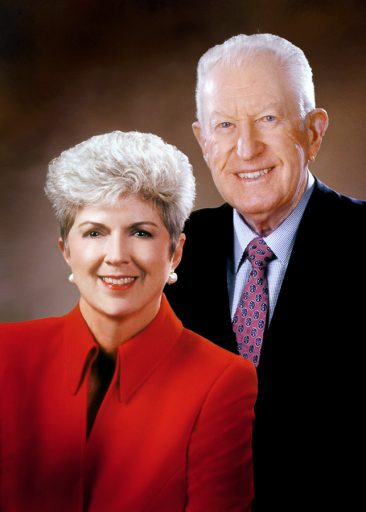
Jan Moran and the late Jim Moran
With the board’s unanimous approval of the name change, the Jim Moran College of Entrepreneurship becomes the nation’s first stand-alone college of entrepreneurship. In addition to elevating the college’s prestige and profile, the transition acknowledges that the college grants graduate degrees.
“Entrepreneurship is one of Florida State’s strategic goals and having the nation’s first stand-alone college of entrepreneurship signals our strong commitment to that goal,” said Sally McRorie, provost and executive vice president for Academic Affairs. “We are so thankful to Jan Moran and The Jim Moran Foundation for their generosity in helping us fulfill this vision.”
The green light from the BOT for the name change cements a series of successful votes by numerous university boards and councils, including the FSU Faculty Senate.
Founded with a $100 million gift from Jan Moran and The Jim Moran Foundation in December 2015, it’s been a period of rapid growth for the school-turned-college.
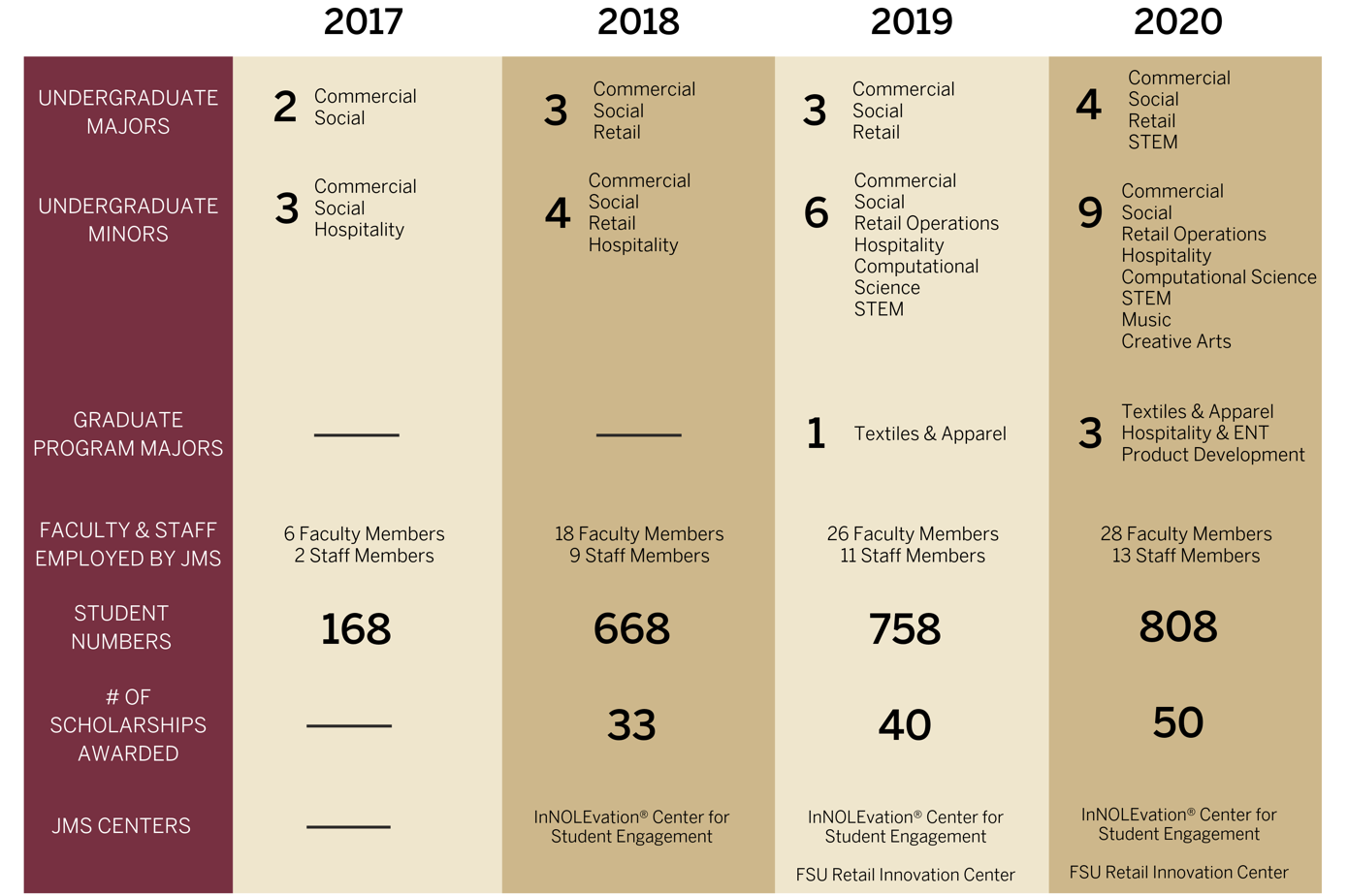
The school opened its doors in fall 2017 with a class of 80 students and watched its first graduates collect their degrees in spring 2019. There are now about 760 students, 25 faculty and 11 staff members.
The college, which offers three undergraduate majors (commercial, social and retail entrepreneurship), welcomed its first class of graduate students this fall in the new Master of Science degree program in Retail Entrepreneurship with a major in Textiles and Apparel Entrepreneurship. The addition of a graduate program allowed the school to begin the process of becoming a college.
Susan Fiorito, dean of the Jim Moran College of Entrepreneurship
Jim Moran Professor Susan Fiorito, the new college’s dean, was the school’s founding director and has led its transition to college status. Fiorito said the achievement couldn’t have happened without the hard work of many.
“So many people including faculty and staff have been involved to make this happen,” she said. “It started with Jim Moran’s entrepreneurial legacy and Jan Moran and The Jim Moran Foundation’s generous gift, Jan’s continued guidance and university leaders who believe in and facilitate our success.”
Fiorito added that Melvin Stith, emeritus dean of the College of Business, was instrumental in this accomplishment. During his tenure at FSU, Stith built a friendship with Jim and Jan Moran. That rapport led to numerous financial gifts, including $1 million in 1995 to establish the Jim Moran Institute for Global Entrepreneurship.
The Jim Moran College of Entrepreneurship is FSU’s 17th college, and the university’s first new college since the creation of Panama City’s College of Applied Studies in 2010.
For more information about the Jim Moran College of Entrepreneurship, visit https://jimmoranschool.fsu.edu/.
Year-by-year growth of FSU’s 17th college.

Sunday, November 3, 2019

Why Willie Taggart should be fired


Nov 3. 2019


10/28/19

https://floridastate.forums.rivals.com/threads/fsu-homecoming-not-quite-as-happy-for-local-merchants.270949/

It’s looking like this will be FSU’s smallest Homecoming crowd in at least three decades. And that’s not good news for local businesses.

FSU Homecoming not quite as happy for local merchants

According to a report by the Tallahassee Democrat on Friday afternoon, FSU had only sold about 50,000 tickets for Saturday's game against Syracuse (3:30 p.m., ESPN2). If those projections are anywhere close to accurate, it will be the smallest Homecoming crowd for the Seminoles in at least three decades.
The last time Florida State saw a crowd of less than 60,000 for a Homecoming game was when Cincinnati came to town in 1990. That 70-21 blowout was witnessed by just 59,678 fans ... of course, Doak Campbell Stadium's capacity back then was 60,519.
The stadium now seats nearly 80,000, but crowds have been nowhere close to that level in any home game this season. The N.C. State game drew 60,351 fans, and that was the best turnout of the year. One week earlier, FSU played Louisville before just 46,530 -- that was the smallest crowd at Doak since 1983.

10/19/19


10/18/19 (Wake Game)
https://floridastate.forums.rivals.com/threads/team-staying-in-durham.269076/

Brother just called me asking why We were staying in Durham: my response was we probably booked the trip on Priceline this week or they still thought wake was in wake forest, nc.

The team flew into greensboro airport.

If they flew into Greensboro, makes no sense to drive 45 mins in the opposite direction to Durham and add 45 mins to the drive to Winston Salem tomorrow. But then again, not much is making with our football program these days.


10/17/19


Post Clemson loss, Taggart is 3-21 against ranked teams.

2010 Western Kentucky - Loss at #9 Nebraska
2011 Western Kentucky - Loss at #1 LSU
2012 Western Kentucky - Loss at #1 Alabama
2013 USF - Loss vs #15 Miami
2013 USF - Loss vs #16 Louisville
2013 USF - Loss at #19 UCF
2014 USF - Loss at #19 Wisconsin
2014 USF - Loss vs #19 East Carolina
2015 USF - Loss at #11 Florida State
2015 USF - WIN vs #21 Temple
2015 USF - Loss vs #25 Western Kentucky (Bowl)
2016 USF - Loss vs #13 Florida State
2016 USF - Win vs #22 Navy
2017 Oregon - Loss at #11 Washington State
2017 Oregon - Loss at #23 Stanford
2017 Oregon - Loss at #12 Washington
2017 Oregon - Loss vs #25 Boise State (Bowl)
2018 FSU - Loss vs #20 Virginia Tech
2018 FSU - Loss at #17 Miami
2018 FSU - Loss vs #2 Clemson
2018 FSU - Loss at #3 Notre Dame
2018 FSU - WIN vs #22 Boston College
2018 FSU - Loss vs #13 Florida
2019 FSU - Loss at #25 Virginia
2019 FSU - Loss at #2 Clemson

So of the 3 wins, none on the road, none vs teams in the top 20, only one against P5 school.


https://floridastate.forums.rivals.com/threads/55-60-career-8-10-at-fsu.268587/

2-10
7-5
7-5
2-10
4-8
8-5
10-2
7-5
5-7
Wow, first time I’ve actually looked at his records each year. I was the first one to be excited about his hire. Amazing how I couldn’t see the forrest for trees.

He’s been a head coach since 2010 and has a 0-1 bowl record. He hasn’t exactly done a whole lot of high level coaching.

https://floridastate.forums.rivals.com/threads/can-willie-go-14-2-in-his-next-16-games.268542/

Can Willie go 14-2 in his next 16 games? (post Clemson game)


If so, he'll have the same exact record as Jim McElwain... when McElwain was fired.


https://n.rivals.com/news/three-point-stance-coaches-that-won-t-work-out-recruiting

Willie Taggart, Florida State – The Seminoles are about to lose to Clemson by about 30 or 40 points and Taggart has a losing record in two seasons in Tallahassee. Does anyone think this is going to turn around? Search deep inside yourself for the answer.

In the article he says it's the hot seat and "it should be clear to everyone involved that their coach isn't the answer their program needs."

  1. Jeremy Pruitt-Tennessee
  2. Manny Diaz-Miami
  3. Chip Kelly-UCLA
  4. Willie Taggart-Florida State
  5. Justin Fuente-VT
  6. Jim Harbaugh-Michigan
  7. Lovie Smith-Illinois
  8. Kevin Sumlin-Arizona
  9. Clay Helton-USC
  10. Will Muschamp-South Carolina
  11. Chad Morris-Arkansas


https://accfootballrx.blogspot.com/2019/09/penalties-per-game-as-of-92019.html

It's no secret - penalties have been a problem for ACC football teams so far this season. If you saw the end of the Florida State/Virginia game, you probably couldn't believe how many first downs were given up due to penalties.

I feel confident in saying that most ACC football teams will commit more penalties Saturday - except for Duke, Georgia Tech and Virginia Tech (all of whom have byes). That said, this is what it looks like before the games of week 4...

Teamppg
Wake Forest2.67
Georgia Tech4.00
Virginia5.00
Boston College5.33
Virginia Tech5.33
Clemson5.67
Pittsburgh5.67
NC State6.00
North Carolina6.00
Louisville6.33
Duke6.67
Syracuse8.33
Florida St.8.67
Miami8.67

COMMENTS:
Wake Forest appears to be winning with discipline - less than 3 penalties per game.
Syracuse, Florida State and Miami - all well over 8 penalties per game - not good.

Would FSU and Miami be undefeated if they committed fewer penalties? I'm not ready to say that's the only thing standing between those teams and perfection... but I'm pretty sure things would've been different, at least.


https://247sports.com/college/florida-state/board/36/Contents/florida-state-plays-in-front-of-smallest-home-crowd-since-1983-135908289/

Florida State is off to a disappointing 1-2 start to their 2019 season.  The Seminole fanbase has high expectations for this program each year and the results on the field have lead to less fans in the stands.
On Saturday, the announced attendance for FSU's 3:30 p.m. kickoff against Louisville was 46,530.
The Seminoles played in front of the smallest crowd at Doak S. Campbell Stadium since 42,117 on Oct. 20, 1983 against Louisville.
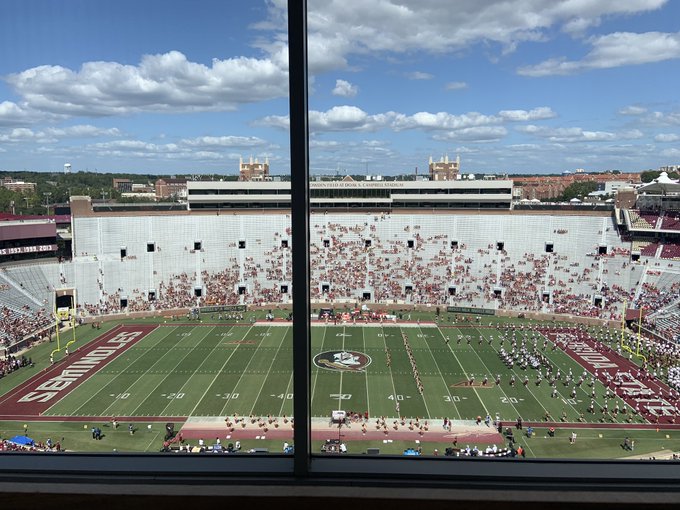
Here is what the stadium looked like just before kickoff:
The Seminoles (1-2, 0-1 ACC) are looking for their first Atlantic Coast Conference victory of the season. A win would be No. 300 for the Noles in Doak Campbell and the 308th all-time at home. FSU is 3-2 against Louisville since the Cardinals joined the ACC for the 2014 season. All-time, FSU is 15-4 vs. Louisville in a series that dates back to 1952.

Florida State is 90-19 against Atlantic Coast Conference teams in Doak Campbell Stadium since joining the league in 1992, including a 39-0 record from 1992 to 2001. FSU has had a perfect home record against league opponents 16 of 25 seasons since joining the league.


"FSU commits some of the dumbest penalties that I have ever seen." -- Dave Pasch, ABC Play-by-Play Commentator during the 2018 UF vs FSU game after Stanford Samuels, III committed a dead ball Unsportsmanlike Conduct Penalty after FSU had stopped UF on a 3rd and 7 play


https://247sports.com/college/florida-state/board/36/Contents/a-running-list-of-issues-wt-owns-as-fsu-head-coach-135456159/

I’ve been looking for such a list but have not seen one in awhile. Trying to keep these mostly, game management, culture, and generally mistakes that can be attributed to WT himself. For instance, not going to blame bad position group play like 2018 OL on WT himself, but will criticize him for not taking advantage of the transfer market like we should have. So, in no particular order, here is a list of issues I believe WT owns as HC at FSU. Fee free to debate/add to the list.
  • Not signing a single qb in 1st 2 recruiting cycles (allowing Bell to be sole POC for Howell)
  • His handling of Francois, allowing Francois to continue to play over Blackman knowing he was not a leader and not good for the program
  • His hiring of Walt Bell, Harlon Barnett, Alonzo Hampton, and Greg Frey
  • Not fielding a full coaching staff because of his coaching search issues and handling of David Kelly
  • Watergate
  • Calling a timeout with 30 seconds on playclock against ULM to punt
  • Not taking more advantage of transfer portal (specifically OL) after witnessing disaster in his face last year
  • General disorganization on the field throughout 2018
  • poor game management
  • Allowing upper classman like D Jackson to continue selfish play on the field without consequence
  • Poor initial assessment of team heading into 2018 leading to much higher expectations from the coaches and fan base
Some of these may crossover and im sure ive missed some so please help me out.
The Standard
Image may contain: 1 person, standing