From the same team who brought Tallahassee Madison Social and Centrale Italian Eatery, the ever-expanding College Town just gained a new hot spot: Township. Right across the street from Madison Social, Tallahassee’s first and only “beer hall” calls a lofty 8,000 sq. ft. location home. With exposed brick, high ceilings, a beer garden and community style wooden dining tables, Township creates the perfect atmosphere to enjoy a great beer with good friends.
What makes Township different from other craft beer bars? Let’s start by the welcoming sound of clinking glass you’re bound to hear upon entering. Township exclusively serves their brews in glass steins- ranging from the classic German 1-liter size, (roughly the same size as my head, to give you an idea,) down to more manageable ½ liter and 1/3 liter sizes as well. So, no matter what your drinking ambition is for the night, you still get to enjoy your beverage of choice in a hearty and festive glass that’s perfect for group toasts. Prost!
Speaking of beverages, Township boasts three bars and a total of ninety-six taps. Yes, you read that correctly. With three bars, (named after their locations: Woodward, Madison, and Garden,) and thirty-two taps per bar, the creators of Township made sure no patron would face trouble in their quest to acquire a full glass. While 31 of the taps at each bar contain craft beer carefully selected from both local and national breweries, the 32nd tap holds a special value. Deemed “The People’s Tap,” this beer will be selected by, you guessed it, the people. Through a voting process that has yet to be announced, this final tap will rotate out with whichever brew won the popular majority. Spoon tip: Not a beer fan? No problem. Along with the ninety-six taps, Township has a full bar that serves up mixed drinks and cocktails to your heart’s content.
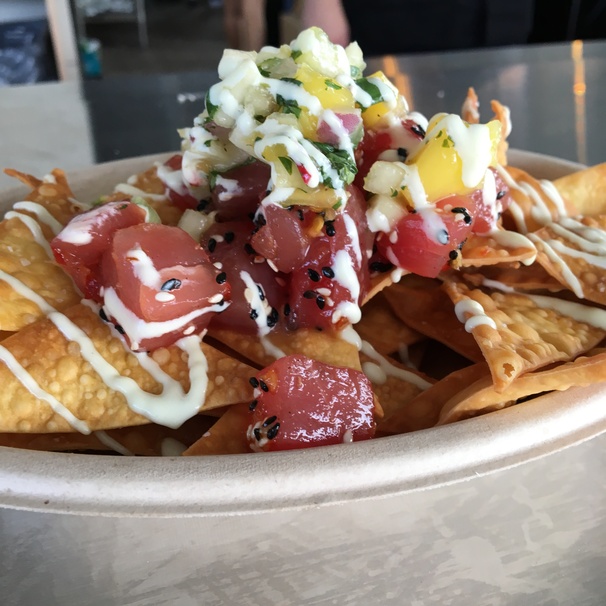
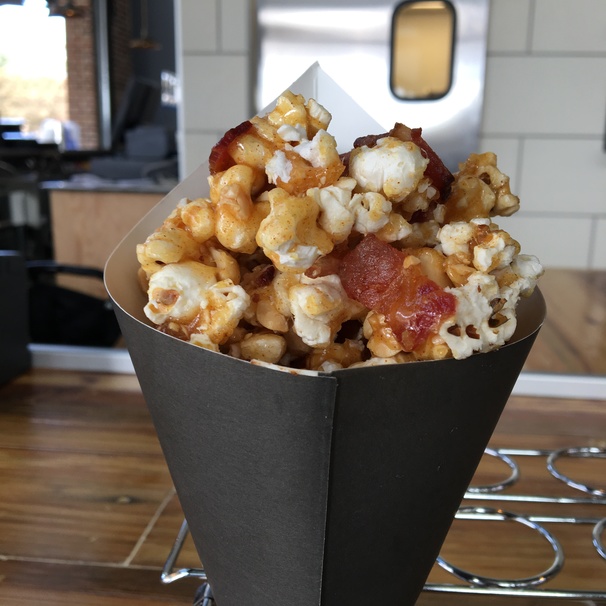
Amanda Olivero Naturally, with great drinks comes great food. Once again, Township has not failed to deliver. With a focus on urban street fare, the quick-fire counter service dishes out a variety of portable and flavorful cuisine. Enjoy a twist on a traditional Hawaiian dish with tuna poke "nachos", or use your stein of beer to wash down a classic “Knockwurst”. Differently, if you can’t decide between sweet or savory, get the best of both worlds with a helping of salted caramel popcorn with peanuts and bacon.
Amanda Olivero
If that menu isn't enough, there’s talk of a brunch menu currently in development. If the rumors are true, you can find me relaxing in the beer garden on a Sunday morning soon, enjoying the kitchen’s newest breakfast creations (and hopefully sipping a mimosa out of a beer stein- please let that be a thing.)
While the food and drink offerings are exceptional, Township’s sense of community is truly a cause for celebration. Along with the welcoming atmosphere, the beer hall has already joined the Tallahassee Brew District to bring exciting events to Tallahassee residents. On December 8th, don’t miss the Booze Cookie Crawl- where $20 will get you one drink at each location, (Township, Madison Social, and Centrale,) two boozy cookies, and a commemorative holiday mug.
Amanda Olivero
On December 10th, step up your bar crawl game with Santahassee. This Santa-themed bar crawl spans the entire brew district, (Township, Madison Social, The Brass Tap, Grasslands Brewing Company, and Proof Brewing Company), and $25 gets you a craft beer at each location plus a donation to Guardian Ad Litem.
Additionally, if you’re staying in town for New Years, Madison street is the place to be. Township, Centrale, and Madison Social are joining up to host an Epcot-style Drink Around the World to ring in 2017. Bounce around each location to experience beer, wine and cocktails themed after six different countries.
Finally, this Friday, December 1st, be sure to check out Township's first Stein Hoisting Challenge- winner gets to keep a commemorative porcelain stein.
Unique food, great brews, and memorable times. With so much to offer under one roof, grab a group of friends and head over to Township ASAP.
The ACC has a history of working against it's football brands and for it's basketball brands. But still expects the football brands to bring in the money.
Thankfully, it looks like the ACC is starting to figure it out (20 plus years too late though).
"This is one of the many great things our team has been up to this year. Later today we'll have more images on the Architects Lewis + Whitlock page. Institute for Global Entrepreneurship by Florida State University and the Jim Moran Institute."
"In the fourth quarter of the Oct. 29 football game between No. 3 Clemson and 12th-ranked Florida State, the Seminoles were thinking upset. FSU led 28-26 when star tailback Dalvin Cook ripped off a 50-yard run into Clemson territory.
Then came a penalty flag for an illegal block, negating the play. FSU Coach Jimbo Fisher stormed the sideline, screaming at the officials, dropping an apparent F-bomb. Then came another flag, for unsportsmanlike conduct. FSU punted. Clemson escaped with a 37-34 win.
Fisher resumed his tantrum at a postgame press conference, blasting the game’s officials as “gutless” and “wrong.” Eyes bulging, Fisher said, “You hold coaches accountable [and] players accountable—hold the damn officials accountable.” The Atlantic Coast Conference, which includes both FSU and Clemson, later fined Fisher $20,000.
Blaming the zebras is hardly novel. But Fisher’s tirade revived a question that has taken on greater significance in the era of lucrative college football playoffs: Do officials paid by the top NCAA conferences slant their calls—even if only unconsciously—to help their employers’ top teams? New research suggests the answer is yes.
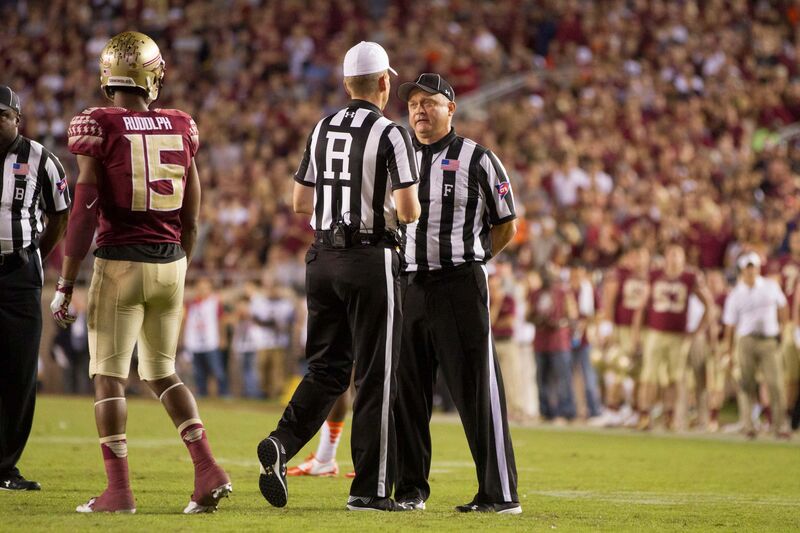
The officiating crew discusses a call during the Clemson-Florida State game.
Photographer: Logan Stanford/Icon Sportswire via Getty Images
Unlike in NCAA basketball, which draws referees from pools overseen by groups of conferences, most football referees are hired, trained, rewarded, and disciplined by individual conferences. That means officials are entrusted with making decisions that could hurt their employers—as with the call in the Clemson-FSU game. Clemson was the ACC team with the better shot at making the College Football Playoff and the financial bonanza it dangles.
“This is an incestuous situation,” says Rhett Brymer, a business management professor at Miami University in Oxford, Ohio. He spent more than a year parsing almost 39,000 fouls called in games involving NCAA Football Bowl Subdivision teams in the 2012-2015 seasons. His research finds “ample evidence of biases among conference officials,” including “conference officials showing partiality towards teams with the highest potential to generate revenue for their conference.”
It’s potentially a big deal now that the playoff has become such a rich source of cash for the Power 5 conferences that supply the teams: the Big Ten, Pac-12, Big 12, Southeastern Conference, and ACC. Those conferences split about $275 million in bowl-season television money, and get paid an additional $6 million for each of their teams that qualify for the four-team playoff, plus $2.16 million for expenses. That’s on top of money for game tickets and merchandise, as well as the recruiting bump that can help schools return to the playoff year after year (see Alabama).
The Miami of Ohio research offers no evidence that specific officials intentionally skewed game outcomes. Nor does it assert that conferences would try to manipulate the part-time, independent contractors who officiate for $2,000 to $2,500 a game.
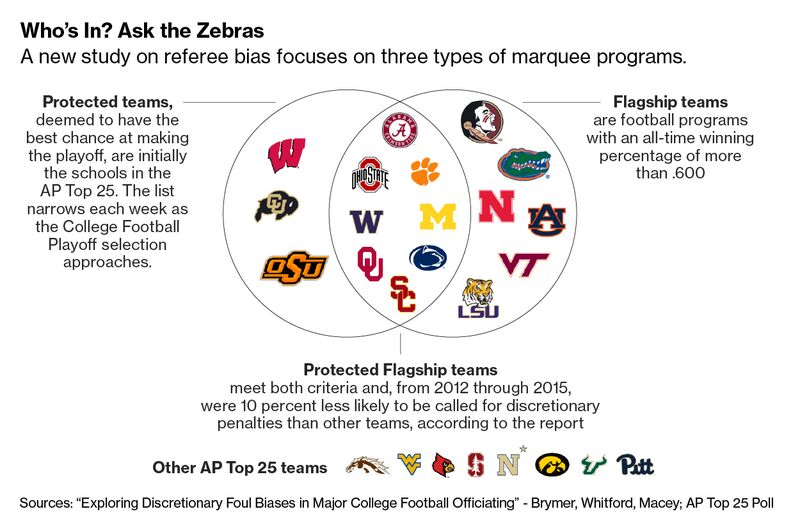
Brymer’s data suggest something more insidious. Across the 3,000-odd regular-season and bowl games he studied, a bit less than half of the fouls called were what he terms “discretionary”—holding, pass interference, unsportsmanlike conduct, and personal fouls like roughing the passer. Refs were on average 10 percent less likely to throw discretionary flags on teams that enjoy both strong playoff prospects and winning traditions. Brymer calls these teams “protected flagships.”
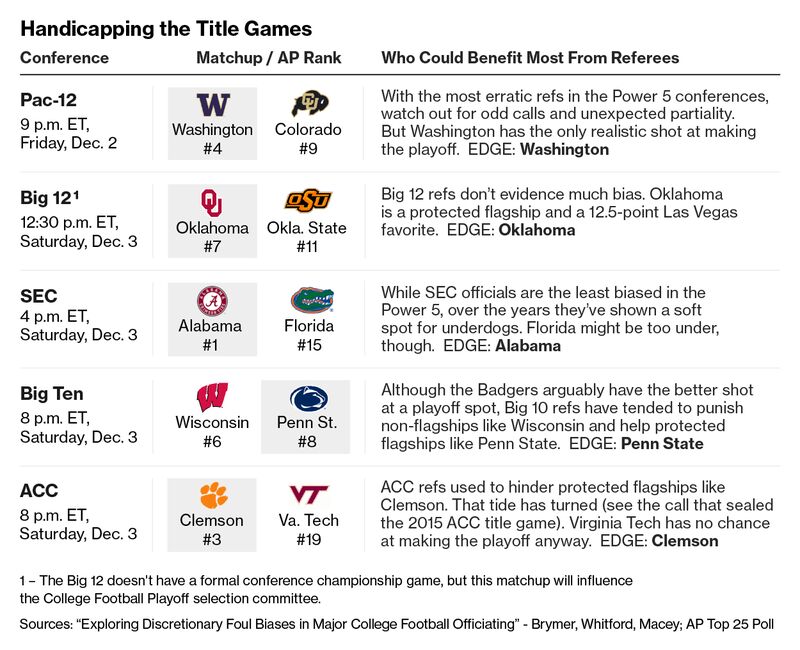
Protected flagships in the Big Ten did especially well with officials, the research shows. Ohio State, the conference’s most competitive flagship team in the years Brymer studied, was 14 percent less likely to be dinged for a discretionary foul than, say, Purdue, a non-flagship team with little chance of contending for a national title. The Buckeyes fared even better with refs in 2014, when it made the first-ever formal playoff and won the national championship on Jan. 12, 2015.
Rogers Redding, national coordinator for NCAA football officiating, says referees are human but unfailingly scrupulous. “I can unequivocally say that I have never seen any sign of bias on the part of officials at any level,” says Redding, who officiated NCAA football for 18 years.
While admitting “my bias is to be defensive about this,” Redding faults Brymer’s research for failing to account for whether the fouls analyzed were correctly called. “Some teams are just better” at avoiding penalties, he says. The study also doesn’t establish a baseline from which to judge variations in calls, Redding says. “What’s the expectation of the number of fouls that would be called in the absence of bias? We don’t know.”
NCAA refs undergo training year-round, from spring practice scrimmages to fortnightly videos prepared by Redding. “This is an avocation,” he says, with refs dreaming of being selected to work a bowl game or, the pinnacle, a national championship. Botching penalty calls can cost refs those opportunities—and their jobs. Spokespeople for the Power 5 conferences either declined to comment or didn’t respond to interview requests.
Barry Mano, founder and president of the 22,000-member National Association of Sports Officials, wishes Brymer had included fouls like offsides and such decisions as ball spots. “Very few things in officiating aren’t discretionary,” he says. However, Mano concedes that officials could be susceptible to unconscious pressures and thinks it reasonable to consider moving refs out from under conference control. “The perception of our impartiality is important,” he says.
If one assumes zero bias on the part of on-field officials, Brymer says, his data should show greater consistency among calls. Instead, “where officials from some conferences are systematically calling it one way, other conference officials call it another way. Individual people and crews will have their own idiosyncratic ways of calling games. But this is more than that.” The refs are subject to the scrutiny of large organizations, he says, “which we in business all know is subject to money and power.”
As an assistant professor at Miami of Ohio’s Farmer School of Business, Brymer, 43, usually writes about such esoterica as the use of human capital in corporations. He grew up in Florida, and became a Florida State fan when he lived on the same block as legendary Seminoles coach Bobby Bowden. Brymer was in the stands for the 2003 “Swindle in the Swamp,” when ACC refs were pilloried for questionable calls that helped his team beat archrival Florida.
While earning his Ph.D. at Texas A&M, he came to sympathize with Aggie fans who believed that all close calls favored the University of Texas. “I reached a breaking point,” Brymer says. Weary of fans whining about refs without empirical evidence, he decided to see if he could find any. “At least I’m bringing myself peace,” he says.
Earlier research he presented at an MIT sports analytics conference drew criticism from the NCAA’s Redding. In an e-mail exchange, Redding told Brymer the study oversimplified things by merely using total penalty yards to gauge bias, without accounting for the different types of fouls called or other factors.
Seeking a more precise measuring stick, Brymer bought four years of data—38,871 penalties, including offsetting and declined calls—from SportSource Analytics, a firm that provides data to the committee that chooses the four playoff teams. Working with Miami business students Mickey Whitford and Michael Macey, he analyzed it against half a dozen variables, including home field, the Las Vegas betting line, and “game outcome uncertainty,” which discounts fouls called in blowouts while accounting for tight games in which refs might be reluctant to toss late flags.
Brymer accounted for officiating crews from different conferences and distinguished games between conference foes from those between teams from different conferences. (The away team’s conference usually provides the on-field officials.) He defined flagship teams as those with an all-time winning percentage above 60 percent and protected teams as those ranked highly in Associated Press polls.
The results show significant variations in penalty calls among conferences and seasons. Pac-12 officials showed the most erratic tendencies, swerving from favoring protected flagship teams in 2012-14 to punishing them in 2015. Playoff contenders lacking the flagship label—such as Wisconsin this year—often draw more subjective penalties than flagship teams, like Michigan, that also happen to generate healthy revenue.
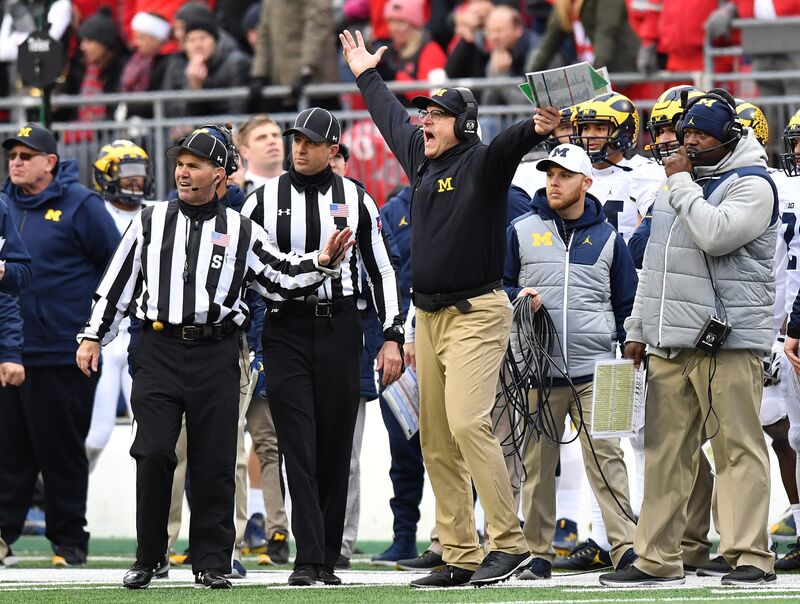
Jim Harbaugh (center), coach of the Michigan Wolverines, argues a call on the sideline during the second half against the Ohio State Buckeyes in Columbus, Ohio, on Nov. 26.
Photographer: Jamie Sabau/Getty Images
Some of the study’s conclusions defy more-cynical views. For instance, teams favored by Vegas tended to get significantly more discretionary calls against them than underdogs. Ref-baiters might be distressed to learn that the SEC—winners of eight of the last 10 national titles—appears to have the least biased officials.
ACC refs actually worked against their top teams in 2012, with discretionary calls against them making up 56 percent of penalties, vs. 41 percent for less-competitive squads. The 56 percent dropped sharply over the next three years, during which two flagships—Clemson and Florida State—went undefeated through the ACC championship game. FSU won the national title after the 2013 regular season.
With a per-game average of about 13 penalties, the alleged bias might apply to only one or two fouls. But a single call or no-call can be disastrous, as Michigan State fans can painfully attest. Last year, the Spartans lost to Nebraska on a controversial touchdown pass to a receiver who stepped out of bounds—illegally, to MSU partisans—before the catch.
Brymer argues that the conferences should yield oversight of officials to an independent national body or regional pools, as with basketball. Redding says, “That’s a reasonable question to ask” but the conferences have worked hard to standardize officiating practices and “are happy with what they’ve got.” Retired Big Ten ref and current ESPN analyst Bill LeMonnier says it wouldn’t hurt to assign more third-conference officiating crews—a Pac-12 group for Alabama vs. Penn State, for instance—especially in big games. “If that eliminates the perception, it’s worth doing,” LeMonnier says.
Last Saturday’s Michigan-Ohio State classic underscored again the outsize role refs can play in big games. After Michigan’s 30-27 loss, Coach Jim Harbaugh said he was “bitterly disappointed” in officials, citing among other things a borderline pass interference call that extended a late Ohio State drive. Both teams came into the game as protected flagships, but Harbaugh might think the Buckeyes were a little more protected than the Wolverines.